Poetry
At This Harlem Chef’s Table, the Rosh Hashana Menu Is Full of Ethiopian Spices
/https://tf-cmsv2-smithsonianmag-media.s3.amazonaws.com/filer_public/26/42/26421b5e-13cf-4629-aa87-a03b21d3b487/title_page_chapter_8_holiday_celebrations_rituals_and_menus_copy.jpg)
With a café in New York City and a new cookbook, Beejhy Barhany is bringing the stories and flavors of Ethiopian Jews to the States
“The base of Ethiopian cuisine as a whole is very much Jewish, more than anything else,” says Beejhy Barhany. Clay Williams
Andrea Cooper – Freelance writer
Delicious as they may be, matzo ball soup, challah, brisket and other Ashkenazi Jewish favorites will not be at the table when Beejhy Barhany celebrates Rosh Hashana this month.
The chef and owner of Tsion Cafe in Harlem, one of the few Ethiopian Jewish restaurants in the United States, suggests a Jewish New Year menu of beg wot, a lamb stew brightened with the Ethiopian spice blend berbere and ground, roasted korarima, akin to cardamom. For sides, she recommends dubba wot, a lush pumpkin stew with date honey, and a salad dotted with black-eyed peas, tomatoes, barley and arugula. Dabo, a spiced whole wheat bread, can soak up all the flavors. She’d top the feast off with ma’arn tzava cake, which mingles sweetness from honey with a slight tang from Ethiopian coffee extract.
/https://tf-cmsv2-smithsonianmag-media.s3.amazonaws.com/filer_public/3a/ed/3aed17ec-9b52-4c2b-a701-9d8581666b84/beejhy_barhany_c_clay_williams_copy.jpg)
Barhany, who was born in Ethiopia and grew up in Israel, is the author, with Elisa Ung, of a new cookbook,Gursha: Timeless Recipes for Modern Kitchens, From Ethiopia, Israel, Harlem and Beyond—the first major title to share Ethiopian Jewish food with home cooks. Gursha, in Amharic, one of the primary languages in Ethiopia, refers to the Ethiopian tradition of feeding others a mouthful by hand to show affection and respect.
“The base of Ethiopian cuisine as a whole is very much Jewish, more than anything else,” says Barhany, given that people practiced Hebraic traditions in Ethiopia prior to the arrival of Christianity in the fourth century.
How did Judaism get to Ethiopia?
Some of Tsion Cafe’s Black customers are surprised to learn that Barhany’s cuisine is Jewish. Other Jewish customers are surprised to meet a Jew from Africa. To these folks, Barhany says, “We Ethiopian Jews never knew of the existence of white Jews. We always thought we were the only ones, and white Jews thought they were the only ones.”
It’s unclear exactly how and when Jews arrived in Ethiopia. One theory is from the Midrash Rabbah, a set of Jewish commentaries and stories about the Torah written over at least eight centuries. It describes how Moses fled to Ethiopia, then known as Cush, following his killing of an Egyptian who was beating a Hebrew. Moses reigned there for 40 years and married an Ethiopian woman. He later returned to Egypt to lead the exodus of the Jews.
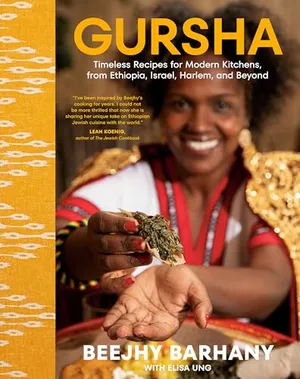
Gursha: Timeless Recipes for Modern Kitchens, from Ethiopia, Israel, Harlem, and Beyond: A Cookbook
A joyous celebration of Ethiopian Jewish cuisine: more than one hundred accessible and healthy recipes, stories, and traditions from the intersection of the African and Jewish diasporas.Buy Now
A second account, in the Kebra Nagast, a 14th-century book venerated as the national epic of Ethiopia, recalls a tale about Makeda, the queen of Sheba. She visited King Solomon at his court and later had a son with him, Menelik, who became the first emperor of Ethiopia. The story holds that Menelik took the original Ark of the Covenant, the gold-plated wooden chest containing the tablets from which God delivered the Ten Commandments to Moses at Mount Sinai, from Israel to Ethiopia. According to Ethiopian tradition, it is currently housed in the Church of St. Mary of Zion in Aksum, protected by a monk with no one else permitted to view it.
The third theory suggests the tribe of Dan resettled in Ethiopia following the fall of the First Temple, a center of worship in ancient Israel, in the sixth century B.C.E. One former Sephardic chief rabbi of Israel, Ovadia Yosef, cited this argument when he granted permission for Ethiopian Jews to make aliyah, or immigrate to Israel and become citizens, in the 1970s under the provisions of the 1950 Law of Return. The law allows Jewish people with one or more Jewish grandparents and their spouses to move to Israel and gain Israeli citizenship.
Did you know? The meaning of Tsion
- In Amharic, the word “Tsion” refers to Zion, a term for Jerusalem. In Ethiopia, it is broadly associated with heaven, paradise or a sacred space.
Ephraim Isaac, director of the Institute of Semitic Studies in Princeton, New Jersey, says the historical entry of Jews into Ethiopia also has a non-biblical explanation: economics. A thriving trade of spices and, later, silk existed among Israel, Rome, Greece, India and China. Traders crossed through Ethiopia and used the ancient port of Adulis (now part of Eritrea), beginning in the late second century B.C.E. Trade along the Red Sea, including in Yemen, led to the development of Yemenite Jewish communities. The Hebrew Bible references ancient Israelites eating coriander and cumin, prized spices in Ethiopian Jewish cooking.
“The presence of Jews in Ethiopia goes back to biblical times,” says Isaac, an Ethiopian Yemenite Jew and the first faculty member hired for Harvard University’s Department of African and African American Studies in 1969. “With all due great respect, the presence of Jews in Poland is more surprising to me than the presence of Jews in Ethiopia.”
Estimates of the number of Ethiopian Jews still living in Ethiopia are hard to come by, in part because some opted to convert to Christianity, and some were forced to convert, in the 19th and 20th centuries, due to pressure from Christian missionaries. From 1974 to 1991, Ethiopia’s civil war, which pitted the country’s Marxist government against multiple insurgent groups, brought civil unrest and violence, later coupled with famine, to the Jewish community.
Ethiopia’s communist government banned Jews from leaving the country in the 1980s. Some escaped and left covertly for Israel via Sudan through several Israeli military operations, totaling about 23,000 emigrants. The latest, 1991’s Operation Solomon, later set a world record for the number of passengers—estimated at 1,088—on a commercial flight, including two babies born en route. The airline had removed the plane’s seats to accommodate more people.
Today,168,000 residents of Israel are of Ethiopian descent, the vast majority of whom are Jews. According to Barhany, a few thousand Ethiopian Jews make their home in the United States.
“It’s often told as a story of rescue, but it’s really important to emphasize the agency of the Ethiopian Jewish community,” says Shayna Weiss, senior associate director of the Schusterman Center for Israel Studies at Brandeis University. “There had been activists fighting for the ability to be recognized as a formal Jewish community to be able to immigrate.” They were, she stresses, “active participants in their own destiny.”
The journeys of Ethiopian Jews, Barhany included, helped spread their foods and flavors beyond Africa.
Four-year-old Barhany and her family fled their home in the Tigray region of northern Ethiopia in 1980 with several hundred others in a caravan. They traveled by land, in an exodus organized by her cousin to Sudan, where they would then depart for Israel. The group had packed flaxseed, teff, coffee, chickpeas and honey for their subsistence, but locating water was a constant challenge. They would pause their trek for the Sabbath and bake kita, a flatbread. They ended up living in a Sudanese village with other Ethiopian refugees for several years before relocating to Israel.
Mingling cuisines
Two generations of Ethiopian Jews living in Israel have now left their mark on the culinary scene, helping contribute to the rise of vegan food in the country. Vegetables figure prominently in Ethiopian cuisine, and the Ethiopian Orthodox Church permits only vegan meals on fasting days, such as the 40 days of advent. Ethiopian Jews are also known for making vegetable dishes. “To go to Israel today is to have babka next to berbere next to bourekas,” says Michael Twitty, a culinary historian and the author of Koshersoul: The Faith and Food Journey of an African American Jew. “It’s no different than the concept of American food, where all of a sudden a red sauce in Italy becomes Sunday gravy in America.
/https://tf-cmsv2-smithsonianmag-media.s3.amazonaws.com/filer_public/42/09/42095bd0-f756-4461-9986-013db4a4e675/hanukkah_copy.jpg)
Ethiopian food and Ethiopian Jewish food is basically inextricable, Barhany explains. The foundations of the former derive from the latter.
A clear example of that is berbere, a classic Ethiopian spice. What’s in it? That varies as much as cooks themselves. Barhany begins hers with a hefty amount of paprika and cayenne pepper, then laces in korarima, ground ginger, cloves, cinnamon, nutmeg, fenugreek and more. Stews are a central element of the cuisine, frequently built on kulet, a thick, fragrant sauce with tomato paste, onions, korarima, garlic, ginger and lots of berbere.
Misir wot, a comforting red lentil stew familiar to diners at Ethiopian restaurants, has an ancient Hebraic reference in the biblical story of brothers Esau and Jacob. “Esau came from the field, had an exhausting day, and he’s smelling this delicious stew that his brother Jacob was cooking,” Barhany says. Esau gave up his birthright, the story goes, in exchange for this rich meal.
Another favorite dish among Ethiopians, doro wot, or chicken stew, might be served on the Sabbath or at weddings. “Cutting up a whole chicken for doro wot is among the first skills that Ethiopian Jewish mothers teach their daughters,” Barhany writes in Gursha. Ethiopian Jews traditionally celebrate the Sabbath with readings from the Orit, a version of the Hebrew Bible that includes the five books of Moses plus the books of Joshua, Judges and Ruth, written in an ancient semitic language called Ge’ez.
Observant Ethiopian Jews don’t eat the country’s hallmark raw or very lightly cooked beef dishes, such as kitfo, a mix of raw ground beef, spices and niter kibbeh, or spiced butter, because of the Torah’s prohibition against mixing meat and milk.
Ethiopian Jewish food taking hold in the United States
Twitty is among the creative cooks devising American Jewish meals with Ethiopian flavors. He’s used berbere in brisket, fried chicken, greens, rice and black-eyed peas.
“Jewish food and Black food crisscross each other throughout history,” he writes in Koshersoul. “Both are cuisines where homeland and exile interplay.”
/https://tf-cmsv2-smithsonianmag-media.s3.amazonaws.com/filer_public/e1/1a/e11a4a02-4330-49b7-8fed-52ae5747b38e/kita_-_kicha_-_flatbread_for_a_journey_copy.jpg)
/https://tf-cmsv2-smithsonianmag-media.s3.amazonaws.com/filer_public/ed/05/ed051226-dbbc-4675-9448-c4de4a87cac5/gomen_-_hamli_-_braised_collard_greens_copy.jpg)
Twitty sees parallels between Ethiopian Jewish foodways and the cuisines of other African cultures that focus on a starch accompanied by soups and stews. Ingredients such as “okra, field peas, melons, teff, enset,” he says, “these are things which have resonance in the whole canon of African eating, because they’re part of that Upper Nile Valley agricultural system.”
As for any connections among Ethiopian Jewish cookery and the cuisines of Ashkenazi, Sephardi or Mizrahi Jews, Twitty notes that bread is central to them all, including tandoori bread in Central Asia and India, jachnunand malawach in Yemen, bejma in Tunisia, and injera in Ethiopia. He suspects Ethiopian and Yemenite dishes are the closest to what Jews ate in biblical times.
Barhany honors these connections at her vegan and kosher café in Harlem. One highlight of her menu is the portabella tibs, a sauté with mushrooms, tomatoes, fresh herbs and the Ethiopian hot sauce called awaze. The chef prepares her version of the spicy condiment with jalapenos, garlic, ginger and cilantro. The “Mama Africa” entrée combines jollof rice, black-eyed peas cooked in coconut milk, plantains and beets with a tahini, cilantro and lime sauce. In Gursha, she shares her recipes for schnitzel, shakshuka, Yemenite chicken soup, and collard greens and cabbage bourekas, to name just a few.
Barhany’s restaurant space was previously the site of Jimmy’s Chicken Shack, where jazz saxophonist Charlie Parker, comedian Redd Foxx and even Malcolm X once worked. She describes Tsion Cafe as a place of Pan-African love and Black Israeli pride.
“As a multicultural person, I have the ability to facilitate dialogue and understanding,” Barhany says, between two minorities—Jews and African Americans—who have been persecuted for hundreds of years. “Why not come together, amplify the story and unify? That’s been my core value.”

Comic Strips

That’s Funny
Poetry

Poetry

That’s Funny
When ‘The Wiz’ Debuted on Broadway 50 Years Ago, It Sparked a Brand New Day for Audiences
/https://tf-cmsv2-smithsonianmag-media.s3.amazonaws.com/filer_public/5e/60/5e600fa9-e992-467b-b987-bbaf5fe64bc1/thewizopener-noleftaligntext.jpg)
How the remarkable musical transformed a beloved folk tale into a celebratory vision for the future of Black America
Kayla Randall – Digital Editor, Museums
The costume for the Wiz, the title character of The Wiz musical, which made its Broadway debut in 1975, is in the collection of the National Museum of African American History and Culture. JD Barnes
When Dwandalyn Reece was a kid, in the 1970s, her mother took her to see the original Broadway production of The Wiz, the groundbreaking all-Black stage adaptation of The Wonderful Wizard of Oz. Watching Stephanie Mills play the role of Dorothy, and “telling this story from this point of view—it made an impact,” recalls Reece, who is now the associate director for the humanities at the Smithsonian’s National Museum of African American History and Culture.
The musical not only reimagined the story with Black characters, but it also carved out its own identity, with new songs written by, among other artists, the composer Charlie Smalls and the R&B legend Luther Vandross, from “Ease on Down the Road” (a soulful take on “Follow the Yellow Brick Road”) to “Everybody Rejoice/A Brand New Day.” The latter song, like many Vandross classics, is jubilant, and its exaltations of liberation and hope take on special meaning when sung by Black characters, speaking to the long struggle for freedom.
The show, directed by the Trinidad-born American actor and dancer Geoffrey Holder, who also designed the costumes, earned seven Tony Awards, including Best Musical, Best Direction and Best Costume Design. Sidney Lumet’s 1978 film version, starring Diana Ross, Richard Pryor and Michael Jackson, further cemented the story as a part of American pop culture.
Essential to The Wiz was, of course, the Wiz, played on Broadway by André De Shields. “This character was modern, he could move to soul music and he had something to say,” Reece says. He wore a tight white jumpsuit, boots and a spectacular emerald-lined cape. With that cape and collar, De Shields says in an interview with Smithsonian, “he’s a superhero.” De Shields, now 79, brought his electric style and charisma to the character. His famous introductory number is “So You Wanted to Meet the Wizard,” and De Shields’ Wiz was somebody everyone would want to meet.
Fun fact: When did The Wiz open on Broadway?
The Wiz opened on Broadway at the Majestic Theater on January 5, 1975. Since then, it’s had a 1978 film adaptation, a 1984 Broadway revival, a 2015 NBC television special and a 2024 return to Broadway, with the new production now touring nationally.
/https://tf-cmsv2-smithsonianmag-media.s3.amazonaws.com/filer_public/e1/5f/e15f670a-9231-4a7a-87a6-7eb4bed686ea/sm_x_the_wiz0054.jpg)
/https://tf-cmsv2-smithsonianmag-media.s3.amazonaws.com/filer_public/05/a1/05a1194e-23d3-43a7-80d6-98d9d29bf96d/sm_x_the_wiz0064.jpg)
Even 50 years later, fresh off reprising a Tony-winning role in Hadestown in London’s West End, De Shields remembers the creative joy of bringing the Wiz to life. “That’s the deliciousness of being an actor,” he says. “You become a chef. You get into that kitchen and you see what you’ve got in your cupboard. You take a little of this and a little of that, a pinch of this and a pinch of that, a morsel of this and a morsel of that, and you throw it all together and you make something new, different, exciting, surprising and medicinal.”
Underneath the Wiz’s bravado, De Shields says, he’s just as lost as young Dorothy, who only wants to get back home. He wears the mask of an all-powerful wizard to hide the fact that he’s an ordinary person. He discovers that by helping Dorothy and her friends realize that they had the brains, heart and courage they sought all along, he is also empowering himself. Turns out, he really was the Wiz all along, too.
A big part of the show’s identity is its distinctive look. Holder, describing his inspiration for the stage production in an interview years later, said, “I wanted to make it an American fairy tale,” and as Reece points out, the Wiz costume’s aesthetic fits squarely in the realm of Afrofuturism, an artistic movement that blends Black history with science fiction, fantasy and other speculative elements. It also often specifically represents the African diaspora: At the heart of Afrofuturism, says Steven Lewis, curator of music and performing arts at the museum, is “wanting to celebrate and affirm not only African American culture but different Black cultures around the world.”
Reece has previously described Holder’s costume design as embodying his interest in African heritage, his own Caribbean upbringing and his eventual diasporic perspective, which made The Wiz a “down-to-earth folk interpretation” of the original material. For example, Holder’s Tin Man, which is also in the museum’s collection, brings various influences together: His oilcan was fashioned from a Dominican percussion instrument known as a güira, his hat was a skillet, and his beer-can-and-scrap-metal suit looked as though it was collected straight from the streets of American cities. Holder’s designs feel rooted in the past while envisioning new horizons. As De Shields puts it, “You cannot know where you’re going if you do not know where you’re coming from.”
And for a man who famously escapes Oz in a hot air balloon, the Wiz is fittingly dressed: His costume is “a flight jumpsuit, it’s a spacesuit,” Reece says, symbolizing an endeavor that, literally and figuratively, exemplifies reaching new heights. “That liberation of aspiring toward space—that’s a very clear message.”
Afrofuturism’s message is still relevant, as is The Wiz’s legacy. A new production of the musical is currently on a national tour.
Reflecting on Afrofuturism’s special resonance for Black audiences, De Shields zooms in on one word: imagination. His Wiz character, he says, created a persona to make it in the Land of Oz, just as people do in reality. “Our strongest tool for survival is imagination.”
/https://tf-cmsv2-smithsonianmag-media.s3.amazonaws.com/filer_public/62/ad/62adcc63-76bc-41a2-a713-b4ab364b938e/sm_x_the_wiz0080.jpg)

Comic Strips


 HPS Magazine