Hurricane Ida Damages Whitney Plantation, Only Louisiana Museum to Focus on the Enslaved

Two original slave cabins, as well as the 1790 Big House, 1790 barn and 19th-century kitchen, survived the storm. But Ida destroyed at least several structures on the historic plantation. Amber N. Mitchell / Whitney Plantation via Twitter

The historic site will remain closed indefinitely as staff assess the destruction and make repairs

Hurricane Ida’s deadly winds and downpours battered Louisiana this week, destroying buildings and knocking out power across the state. Among the sites affected by the storm was the Whitney Plantation, the state’s only museum dedicated to the lives of enslaved people.

The museum posted an update on its website announcing that it had suffered significant damage and would be closed indefinitely while staff assess the destruction and make repairs. Employees will continue to receive pay throughout the closure.

“We are still assessing damages, but it is certain that we have lost some structures,” wrote Amber N. Mitchell, the museum’s director of education, on Twitter. “Thankfully, two original slave cabins as well as the 1790 Big House, 1790 barn, and 19th-century kitchen survived.”

Arriving on the 16th anniversary of the devastating Hurricane Katrina, Ida wreaked havoc in southern Louisiana and parts of Mississippi before heading north to cause more destruction in the Mid-Atlantic and Northeast. As of late Thursday, about 900,000 Louisiana households were without electricity, and 185,000 had no running water, report Rebecca Santana, Melinda Deslatte and Janet McConnaughey for the Associated Press (AP).

At least 13 people in Louisiana, Mississippi and Alabama were reported dead due to the storm. Flooding linked to Ida also resulted in at least 46 fatalities between Maryland and Connecticut, per the AP’s Bobby Caina Calvan, David Porter and Jennifer Peltz.
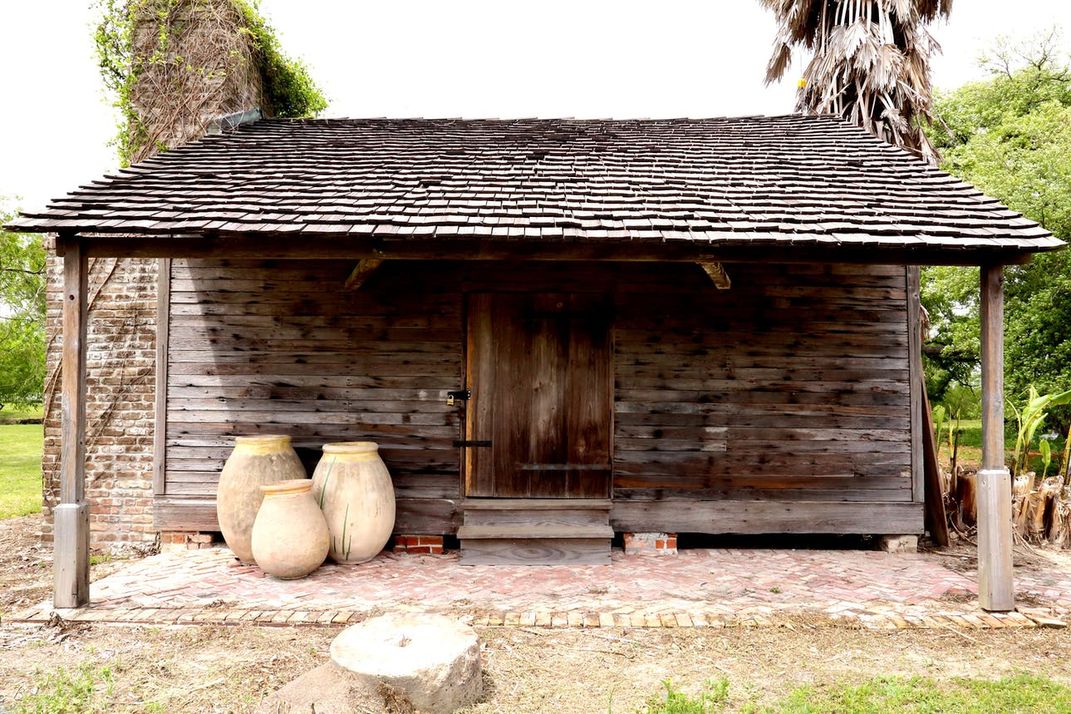
Kitchen at the Whitney Plantation
The Whitney Plantation opened as a museum in 2014. Whitney Plantation

Located east of New Orleans along the Mississippi River, the property was once a sugarcane plantation where enslaved people grew sugar and indigo. As of 1819, notes the museum on its website, 61 enslaved men and women lived there. Nineteen, including individuals of MandeBantu and Tchamba backgrounds, were born in Africa. Others were born in bondage in the Caribbean, Louisiana or other parts of the southern United States.

As Jared Keller wrote for Smithsonian magazine in 2016, a German immigrant bought the tract of land in 1752 and turned it into an indigo plantation. His descendants later made the plantation into a major player in the state’s sugar trade. (By the early 19th century, sugar had replaced indigo as Louisiana’s main cash crop.)

Today, visitors begin their tour at a historic church built on the property in 1870. Inside are clay sculptures of enslaved children “who lived and, in short order for many, died on the grounds of the plantation,” according to Smithsonian.

Artist Woodrow Nash created the statues in response to the Federal Writers’ Project, which recorded the testimonies of more than 2,300 formerly enslaved people in the late 1930s. The accounts describe brutal violence, the commonplace deaths of infants and children, and relentless backbreaking labor. Per the Whitney’s website, Nash’s sculptures “represent these former[ly enslaved people] as they were at the time of emancipation: children.”

Attorney John Cummings funded the restoration of the property, which he owned from 1999 to 2019. It opened to the public as a museum in 2014 and received more than 375,000 visitors in its first five years. In 2019, Cummings transferred ownership of the museum to a nonprofit organization governed by a board of directors. The estate stands in contrast to many other restored plantations, which frequently romanticize the lives of white landowners in the pre-Civil War South and downplay the experiences of the enslaved.

On Thursday, Clint Smith, a staff writer at the Atlantic, drew attention to the damage sustained by the plantation in a Twitter post encouraging readers to donate to help rebuild and pay staff. Smith features the museum in his bestselling book How the Word Is Passed, which recounts his visits to sites associated with slavery.

As Meilan Solly writes for Smithsonian, the book challenges common historical accounts that focus on slaveholders rather than the enslaved. Smith argues that “the history of slavery is the history of the United States, not peripheral to our founding [but] central to it.”

Livia Gershon

Livia Gershon |  

Livia Gershon is a daily correspondent for Smithsonian. She is also a freelance journalist based in New Hampshire. She has written for JSTOR Daily, the Daily Beast, the Boston GlobeHuffPost and Vice, among others.

The U.S. Ran Its First Space Weather Preparedness Drill—Here’s How It Went

Ironically, the exercise last May was interrupted by a real scenario, when Earth was hit by the strongest solar storm in two decades

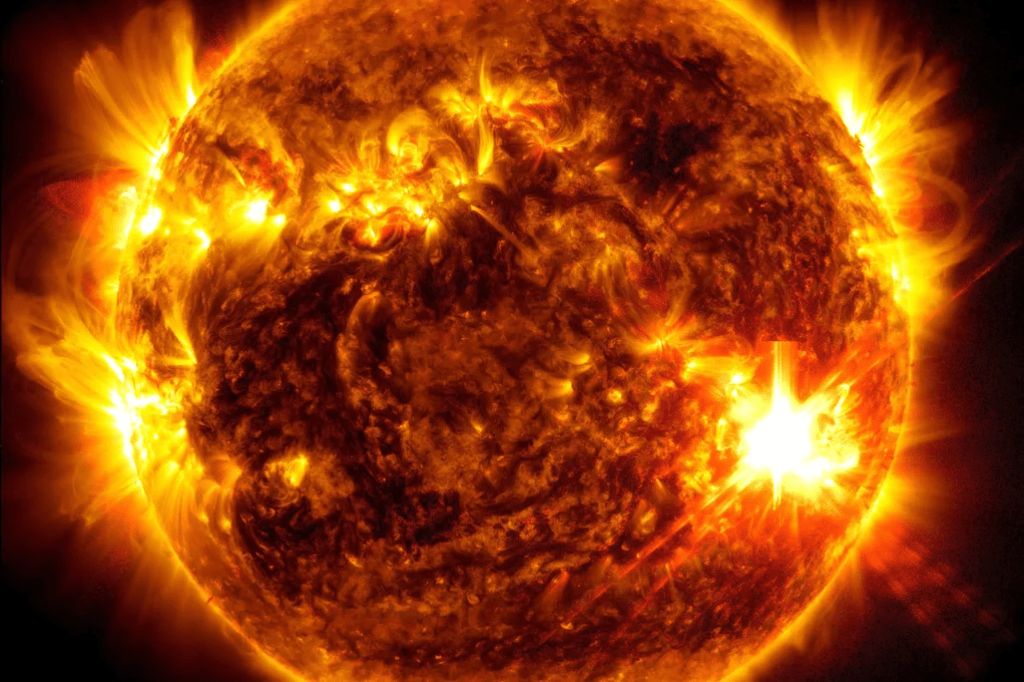
NASA’s Solar Dynamics Observatory (SDO) captured this image of extreme solar activity on May 10, 2024. NASA SDO

In May last year, the United States government hosted its first-ever “Space Weather Tabletop Exercise,” a hypothetical practice test to determine whether the country is prepared for space weather events, such as intense geomagnetic storms.The exercise brought together agencies such as NASA, the National Oceanic and Atmospheric Administration (NOAA) and the Department of Homeland Security to talk through how they would handle such a threat—and the risks it would pose to Earth.

“Minimizing the impacts of such storms requires close coordination, and this meeting was their chance to practice,” reads a NASA statement.

The outcome of the test? State and federal agencies found out they need all the practice they can get.

“Overall, the exercise demonstrated the need for better coordination to produce meaningful [space weather] notifications that describe the potential impacts to critical infrastructure,” reads the post-exercise report, “as well as emphasized the importance of the whole-of-government planning approach for significant [space weather] events.”

Geomagnetic storms are strong disturbances in Earth’s magnetic field, and they can result from solar storms: explosions of material including energy, particles and magnetic fields from the sun’s surface, which can include solar flares and coronal mass ejections. Geomagnetic storms can wreck satellites, trigger radio blackouts and power outages and endanger astronauts by exposing them to intense radiation, according to the statement.

Extreme geomagnetic storms only occur every few decades, per Live Science’s Tereza Pultarova. But our society has become so dependent on vulnerable technologies that the impact of space weather today could be significant.

On May 8 and 9, 2024, participants at the Johns Hopkins Applied Physics Laboratory in Maryland and the Federal Emergency Management Agency office in Colorado pretended it was January 2028, and they had to work through hypothetical scenarios involving harmful solar activity. At the beginning of the exercise, NOAA’s Space Weather Prediction Center notified participants that an active region on the sun had rotated to a point that, if it exploded, it could impact Earth. To make matters worse, two NASA astronauts were in a spacecraft orbiting the moon, with two of their colleagues currently on the lunar surface.

The scenario quickly introduced harmful solar activity. Hypothetical effects included satellites, astronauts and airplanes exposed to intense radiation; disrupted or blocked radio communication and GPS systems; degraded communication with orbiting satellites and widespread power outages.

One issue the report highlights is that space weather forecasters have very little time to determine the potential impact of the sun’s coronal mass ejections (CMEs). They can’t measure the CME until it passes satellites at the first Lagrange point, a gravitationally stable location that’s about 930,000 miles from Earth.

“We never know … what the CME is composed of and what to make of it until it gets just one million miles from Earth, where it’s only 15 to 45 minutes away,” Shawn Dahl, senior space weather forecaster at the Space Weather Prediction Center, told Gizmodo’s Passant Rabie in August. “That’s when we can see what the CME is composed of. How strong is it magnetically? What’s the speed of its movement? Is it going to connect with Earth?”

According to the NASA statement, the exercise demonstrated “a critical need” for “more robust forecasting capabilities of space weather drivers and effects.” The report also emphasizes the need to educate the public, continue developing response plans, make critical infrastructure less vulnerable and collaborate with both the private sector and international agencies.

Notably, the hypothetical exercise last year was interrupted by a real one, when Earth was hit by the most severe solar storm in more than 20 years, now named the Gannon storm. That staggering event, which first struck our planet on May 10, 2024, provided a real-world example for scientists to study.“These extraordinary events required key participants to simultaneously manage both simulated actions of the [exercise] and the real-world needs of the nation,” according to a statement from NOAA.

The storm tripped high-voltage lines, overheated transformers, interfered with GPS-guided farm equipment and re-routed flights over the Atlantic Ocean. The atmosphere expanded from heat, reaching a whopping 2,100 degrees Fahrenheit (compared to the standard high of 1,200 degrees), and that led to increased drag on satellites. It super-charged the magnetosphere with the largest electric current seen in 20 years, and it temporarily restructured the planet’s ionosphere.

Participants reported that running through the hypothetical scenario generated important conversations and improved communication across agencies. Still, it remains to be seen how prepared we’ll be next time an angry solar region turns our way.

Margherita Bassi – Daily Correspondent