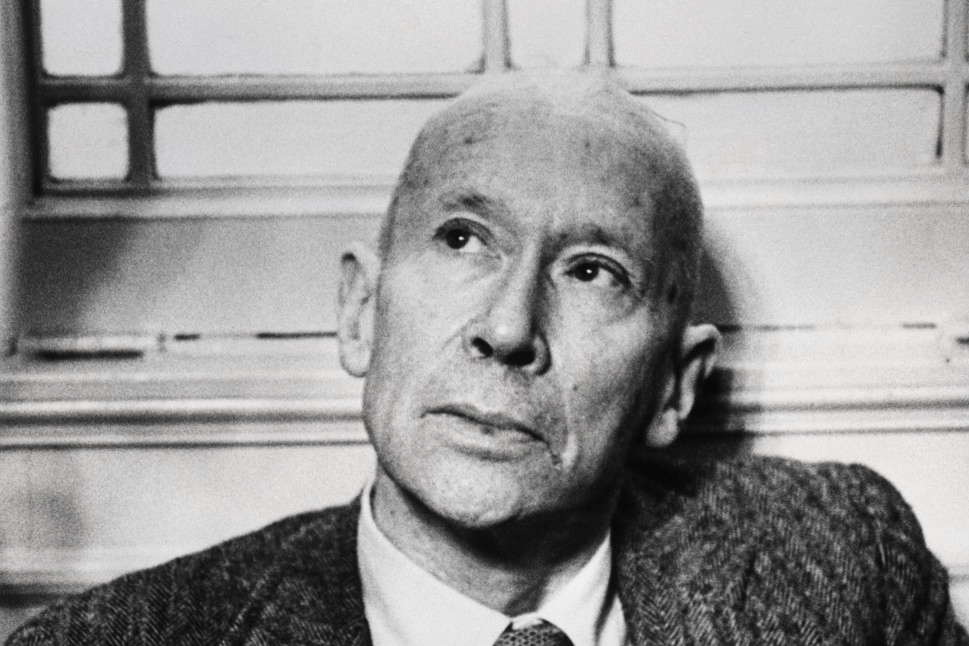
Zen Ase

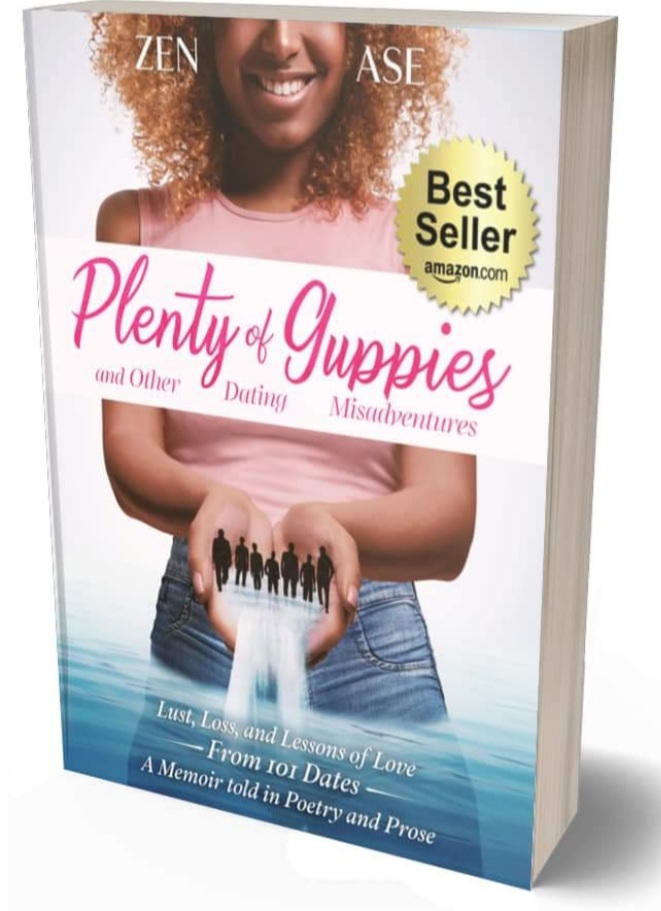
What motivated you to write your book Plenty of Guppies and Other Dating Misadventures?

It wasn’t a book I wanted to write or planned on writing. I woke up on 10/3/21, my mom’s
birthday. She had passed two years before. I really felt stuck. I couldn’t do any of the things I would normally have done with her. I sat at my computer and begin writing. I looked up and five hours had passed. When I looked back at what I had written, I realized I had begun writing the book that people had said I should write for the past 6 years.
I had a strong intuition that I needed to reflect on all that had passed. Seven is a number
of completion. And it was seven years since I divorced, seven years since I decided to remake my life. Then I felt inspired to chronicle my journey- using the journals and poems I had written as well as my reflections on that time. It was my chance to show how I freed myself from so many boxes, and unlearned so many negative programs that society had placed in me. Once the book was written I was really glad and proud, and I thought my journey would help a lot of people. Whenever it got hard to
write it, I pictured writing to the me of 7, 6, 5, 4, 3, 2 years ago, or someone in a similar situation: someone who had just gotten divorced and felt like a failure and had lost self-confidence, someone dealing with the ups and downs of online dating, someone dealing with aging/sickly parents, someone dealing with grief, someone dealing with boomeranging children, opening a business, changing their
business model and more. I wanted them to see the lessons I learned on this journey in hopes that those insights would help and encourage them. And I wanted them to laugh.

You also do a Postcast, What is the name of it?

Zennurgy

What is the focus of the podcast?

Zennurgy is about embracing what you have rather than focusing
on what you lack. We cover a topic each week that is inspirational. The focus is self actualization. What makes it rather unique is that it’s organized alphabetically- the A- Z of living a life of peace and fulfillment. I have a podcast guest form with ten topics listed at a time. The first thirty minutes is on a topic that the guest picks. The second thirty minutes is on the guest. We’ve covered topics like Attitude, Abundance, Alignment, Accountability, Balance, Boundaries and more. We discuss our personal struggles, triumphs and lessons with these topics, the tools we use including role models, books, strategies, affirmations, tips and more.

What do you like to express in your poetry?

Truth. Freedom. Love. Growth. The complexity and simplicity of life. My poetry is lyrical and practical, and common sense and metaphysical. It covers all aspects of life, both the good and the bad.

What inspires you to continue to showcase your craft?

Many things. I have a mantra- Get Zenned!
Stay Zenned! Spread Zen! Getting Zenned means getting my mind right, getting to peace and balance, releasing stress- poetry helps me do that. It helps me process the world around me and gain wisdom. I believe we were all placed on Earth to spread/share our talents and skills, so sharing my craft helps me Stay Zenned (it’s a rush and gives me a sense of purpose).

Who motivated you to share your spirit when you started writing poetry?

I’ve had many friends, mentors and inspirations in my life. Many of these people- my parents, my kids, my mentor etc are mentioned in my memoir.

What advice would you give someone who wants to write a book but doesn’t know where to start?

Everyone’s journey is different. Some people write to make money. If that is the goal, then do the research to see if there is a market. Build your writing skills. Decide who your target audience is and how you plan to publish.
If you’re writing out of sense of mission or purpose then to me the first step is to clarify the message. Then decide how to organize it. Then write being as true to that message and purpose as possible. I’d still do research on the top books in that genre. What makes yours stand out?

What’s one topic you think that you couldn’t see being brought up on your podcast? And why?

I don’t deal much with pop culture scandals. The point of my podcast is challenging yourself to grow and seeing the best in yourself and others.

How do you juggle your crafts and your day to day life?

That’s something I struggle with at times. One thing that really helped me was buying a Passion Planner. Each week it provides a table that looks like this


Personal To -Do List Work To -Do List
Top Priority Top Priority

Priority Priority

Errands Errands

Every day has a box titled
Today’s Focus:

I use stickers for whatever I finish. Prioritizing things per week helps me know what to schedule each day. It also helps me realize what’s most important. At the end of each month, there are two reflection pages where I can reflect on how I used my time, and what I want to do differently in the following month.

What went through your mind when you sold your first book?

I actually wasn’t surprised. My first book was a guided journal. It was actually created because so many people who listened to the podcast asked me how to journal, and if I could teach them, so I actually had 8 people who got the prototype
and didn’t even wait for the fully edited version. I was grateful, honored and felt amazed that something I had done since 5th grade was now something I was teaching and selling. In Zennurgize Your Life, I fixed the problems I saw in all the guided journals I’d ever bought. They were repetitive- the same prompt over and over. Mine included 5 different prompts. They only included writing prompts. Mine included
scrapbooking, using movies, songs, books, role models and mini vision boards. They were too long-usually 365 days/pages. Mine was 29 pages/20 concepts. If you did one concept per week, it would take 5 months.

Where do you want to see your life in the next 5 years?

That changes day to day. Some days I think I’ll focus on consulting, podcasting and writing. Other days, I see myself performing and leading conferences. So much has happened in the past 4 years, I can’t even imagine the next 5.

For you, what is the meaning of life?

To find and spread beauty, harmony and community.

How do you handle conflict when someone comes at you about something you’re doing?

I listen and tell them my reaction. If I agree with their assessment, I fix the problem.

Who would be your dream guest on your podcast?

Iyanla Vanzant or Oprah Winfrey

What’s a funny memory you have when it comes to promoting your book and podcast? Having comments on my show

What do you want your legacy to be?

That I encouraged people to live unapologetically, fully, and purposefully.

How do you want to impact women to leave their mark in this world?

I want women to realize that our society is patriarchal and has oppressed women. Many of the lessons we were taught are just methods of control. As one famous person said, “Well behaved women rarely make history.” So I hope women develop their own standards that are not oppressive or limiting so that they can reach their full potential.

What’s something people would be surprised to know about you?

Everyone is surprised to learn that I went on 147 dates in 7 years.

When you think of change in this world we live in, where do you see where it needs to be focused on first?

I think everything is interrelated. But change starts within first, in the mind, the mindset.

What’s the positive and negative aspects of being an independent artist?

I think indie authors have to work harder to become well known and sell lots of books. But on the other hand, we have more freedom with our subject matter.

How does the American School system works

Photo by Pixabay on Pexels.com

What Is the Structure of the US Higher Education System?

As an international student, you may be wondering how colleges and universities fit into the larger US higher education system. Students in America are required to go to school between the ages of six and 18 in what are called grades, which run from 1st through 12th. (There is also an earlier option, called kindergarten, for the year before 1st grade, but it is not mandatory in most US states.)

Primary, or elementary, education lasts until 5th grade, middle school or junior high school covers 6th through 8th grade, followed by secondary education in 9th-12th grades. Secondary education can cover both college-preparatory curriculum or vocational training.

After 12th grade, students have two options for post-secondary education: vocational training (typically a year or two, designed for immediate employment in a trade) or higher education (typically a two-year associate’s degree or four-year bachelor’s degree in an academic program). 

For international students in British-style education systems, you may have had 13 years of education before entering post-secondary studies. Other countries may only have 11 years of pre-university level studies. Typically, for students enrolled in post-secondary education in the United States, US colleges and universities require 12 years of education.

What Are the Different Types of Higher Education Institutions in the US?

College vs. University

In many countries, post-secondary institutions are called universities. However, in the US, the words college and university are often used interchangeably. Some are even called institutes (e.g., Massachusetts Institute of Technology, California Institute of Technology). Within larger universities in the United States, there are different colleges or schools that represent different academic areas of study (e.g., College of Engineering, School of Business).

State Colleges and Private Colleges

Depending on where you are from, the best colleges or universities may be public or run by the national or regional/state government. But in the United States, the federal government does not manage any college or university. Instead, the governments of the individual 50 states, the District of Columbia, Puerto Rico, and other US territories have the authority to operate, fund, and (in some respects) control public colleges and universities within their boundaries. 

Alternatively, private colleges can operate on their own, without direct control from state or national governments. For instance, hundreds of private colleges in the US were founded by religious denominations or churches, such as the University of Dayton (affiliated with the Catholic church) and University of the Pacific (a Methodist university). 

According to U.S. News & World Report, in 2017 there were 4,298 post-secondary colleges and universities in the United States: 1,626 public, 1,687 private, and 985 for-profit. Among the top twenty US universities with the most international students (according to the 2019 Open Doors Fast Facts report), 13 are public and seven are private. So, remember: quality is not determined by whether a college or university is public or private. 

Tech Colleges and Community Colleges

While most international students come to the United States for academic programs, some students enroll in technical or vocational colleges designed for job training, like flight school or air traffic control programs. 

Additionally, another option in American post-secondary education is community college. Community colleges offer low-cost education in local communities and provide workforce preparation or credits toward completing a bachelor’s degree. According to the American Association of Community Colleges (AACC), there are almost “1,200 2-year, associate degree-granting institutions and more than 12 million students” enrolled in these colleges. Approximately 100,000 international students currently attend community colleges in the United States.

What Are the Different Education Levels and Degree Types at US Colleges and Universities?

Undergraduate 

Undergraduatestudies can start immediately after secondary school. There are two main options: a two-year associate’s degree and a four-year bachelor’s degree. 

Generally, associate’s degrees are granted at two-year US community colleges, while bachelor’s degrees are awarded from four-year colleges and universities. In both cases, students choose a focus for their academic studies called a major. In addition to courses in a major, students take required core curriculum or general education classes that develop critical thinking and communication skills.

Graduate

Graduatestudies are only available to students who have completed a bachelor’s degree. In many countries, graduate studies are called post-graduate studies and can take up to five years or more. In the US, the term post-graduate studies can refer to work after a master’s degree program, including studies for a doctoral degree. 

International students who have finished bachelor’s degrees in their home countries, the United States, or third countries have two options for graduate studies in the United States: master’s and doctorate (or doctoral) degrees. 

Master’s degrees can require one to two years of study. In the final term of most master’s programs, students must complete a thesis (a large, well-documented essay) or a project before they will be awarded the master’s degree.

The length of doctorate programs will depend on two things: 

  1. whether students must first complete a master’s degree in a related field, and
  2. how long it takes to complete a dissertation

Generally, if you have finished a master’s degree and are then admitted to a doctoral program, the coursework will take two to three years. After finishing doctoral classes, you typically begin work on a dissertation or research paper/project that serves as the focus of your degree studies. With any paper or project, a faculty member will serve as a director or adviser.

In addition to these degree programs, international students may take various other continuing education or certification courses. Some are in addition to degree studies, while others may count toward meeting licensing requirements to work in certain fields. 

What Should I Know About Courses of Study and Choosing a Major?

The US education system is designed to teach life skills that will serve students well, no matter which career they choose after graduation. So, students enrolled in colleges or universities will take a variety of courses in order to get a degree. 

For many international students, taking courses outside their intended academic field of study is a foreign concept. But US colleges and universities value liberal arts classes in subjects like history, English literature, and foreign language as well as mathematics, social, and natural sciences. These courses are considered important foundations for critical thinking, logical thought, and communications skills.

Majors, Minors, and Concentrations

When starting college or university, international students should not expect to have more than half their total classes in their intended major. Majors represent what students are most interested in learning to prepare for a career in a related field of study or to go on to graduate school. 

Minors are other academic focus areas in addition to a major, and typically require half as many classes as a major.  

Concentrations are specializations within a given major that allow students to explore a more specific area of study. For example, at the University of South Carolina, the department of history offers regional concentrations (i.e., Latin America, Middle East/North Africa, etc.) as well as 13 different subject areas such as political history, history of slavery, or history of religion. 

BA vs BS vs BFA Degrees

When it comes to bachelor’s degrees in the United States, the three most common are BA (bachelor of arts), BS (bachelor of science), and BFA (bachelor of fine arts). BA degrees focus on liberal arts majors in humanities and social sciences, while BS degrees cover business, math, sciences, engineering, health sciences, and other tech fields. BFA degrees align with the creative arts, such as music or dance.

Accreditation

International students may wonder which US colleges and universities are government-approved. Remember, in America, there is no Ministry of Higher Education, and the federal government does not determine which colleges or universities may operate. 

In the US education system, there are six regional accreditation groups that enable nearly all public and private nonprofit colleges and universities to operate. (Most for-profit private colleges are accredited by national accrediting groups.) Within each institution, there may be several academic programs that also have a national program accreditor as well (e.g., ABET, which focuses on the quality of science, technology, engineering, and math — or STEM — programs). Program accreditations are signs of academic quality as well. 

To research the accreditations of the US colleges you are considering, visit the U.S. Department of Education’s online database. When in doubt, only choose accredited US colleges and universities for your academic studies.

As international students, you also will need to check that these universities and colleges are legally able to enroll students who want to study abroad in the USA. The Department of Homeland Security (DHS) requires all US colleges and universities to apply for certification (and recertification every two years) in order to issue the I-20 forms that international students use to apply for student visas. You can research certified colleges on the DHS website

What Do I Need to Know About College Applications and Applying to University in the USA?

When applying to US colleges and universities, be ready for a fairly complex, lengthy, and sometimes confusing process. But with the right approach and appropriate guidance, you can find the right place that meets your needs. (Check out our How to Study in the USA article for all the specifics.) 

College Application Forms

While most colleges have their own application forms online, prospective undergraduate international students may also be able to use the Common Application to apply to one (or more) of nearly 900 US colleges and universities. If you are applying to Shorelight partner institutions, you can use one online application to apply to multiple institutions for both undergraduate and graduate programs. Whichever form you use, be aware that each college sets its own application deadlines. Additionally, beyond an application form, each university or college will have its own required application checklist.

Standardized Tests

International student applicants will need to take at least one type of test to determine English proficiency (e.g., TOEFL, IELTS, PTE Academic, Duolingo, iTEP). SAT or ACT test scores may be required for undergraduate students, while graduate programs may need a GRE or GMAT score to submit an application. Ask in advance: a growing number of undergraduate colleges and graduate departments are now test-optional (including Shorelight partner institutions) when it comes to SAT/ACT or GRE/GMAT. 

Academic Records

For most colleges in the US education system, your academic records (translated into English) will be the most important piece of the evaluation process. For undergraduate applicants, that means submitting transcripts from every institution you have previously attended: your complete secondary school academic transcripts, external exams, and (for transfer students) any prior colleges or universities. For graduate applicants, it means submitting official copies of undergraduate (and any graduate) degree transcripts of coursework taken. 

Essay and Recommendations

More selective colleges and universities will require an essay (for undergraduate applicants) or statement of purpose (for graduate applicants) and letters of recommendation. Essay topics can be as broad as “What do you want to do with your life?” or as specific as “What event has had the biggest impact on you?” Letters of recommendation should be written by someone who has either taught you in a class and can speak to your academic abilities, or by an advisor who can provide a more well-rounded perspective on the kind of person you are.

Whichever path you choose, the college application process is not meant to be done alone. A dedicated college guidance counselor or advisor can assist you through the college admissions process.

How Do Transfer Credits Work?

If you have already done some undergraduate coursework, you may be considered a transfer student, and this can change application requirements for study in the US. 

Transfer students have a slightly different application process, especially with standardized test requirements and deadlines. Some colleges and universities may only take transfer undergraduate or graduate applicants for the fall term, while others let transfer students start in spring or even summer. 

The classes you have already taken may count toward your bachelor’s degree requirements. These are called transfer credits. Transfer programs at US colleges and universities are designed for students who have not taken more than two years of study and, at many colleges, no more than two years of course credit can be applied toward fulfilling degree requirements. 

How Is the Academic Year Set Up in the USA?

Semesters, Trimesters, Quarters

In the American education system, the academic year typically begins in August or September. Depending on the university, the academic year may be divided into quarters, trimesters, or semesters, and will run until May or June. For colleges that follow semesters, the fall term runs from late August or early September to mid-December, and the spring semester runs from January through May.

When to Apply

For new international undergraduate students considering US colleges and universities, applications are generally accepted as early as a year before the academic term you wish to join. For example, if you want to start at the University of Illinois at Chicago in late August 2021, you could have applied for admission as early as September 2020. 

While many selective universities in the USA have regular admissions application deadlines in January or February, some colleges also offer early decision or early action deadlines in November. These earlier deadlines give students the chance to get a decision as far in advance as possible, although it often requires a commitment to enroll if admitted. Other colleges have rolling admissions policies and will accept applications throughout the year for the next academic term (or year).

Typically, early decision or early action applicants find out if they are accepted within a month of the submission deadline. For January or February application deadlines, students will learn if they are admitted in March or early April. International students who apply to rolling admissions colleges, like many of the Shorelight partner universities, generally find out as early as a few days to three to four weeks. 

How to Enroll

After admission, you will be told what your next steps are to accept an offer from a college or university. Many American universities will set a deadline date for admitted students to send in their deposit (the amount varies by college) to hold their place for the next academic year.

What is the Classroom Experience Like in the US?

The Undergrad Classroom

In US colleges, class sizes can be as large as 400 students in an auditorium or as small as four students around a table. At larger state universities, you will likely find big class sizes in the first two years of study. At liberal arts colleges, smaller class sizes (10 to 20 students) are standard. Colleges and universities must list on their websites their average student-to-faculty ratio (i.e., how many students are on campus for every faculty member and the average class size), so you can easily get a sense of the class sizes at the colleges that interest you.

For instruction, professors and academic experts typically teach college classes. Teaching assistants (often graduate students working for a professor) may teach large lecture classes or smaller lab or discussion sections. In addition to teaching staff, you will have either an academic advisor or faculty advisor (once you declare an academic major) who will help you choose classes and make sure you are on track for graduation.

On the first day of each class at the beginning of an academic term, students receive a syllabus from the professor or instructor, which covers what students can expect during the course — all the scheduled quizzes, tests, papers, and final exam requirements. Additionally, the syllabus will list the required textbooks and the reading that must be done for each class meeting. In many classes, the syllabus will also break down what percentage of your course grade comes from papers, quizzes, tests, group projects, mid-term and final exams, and even classroom participation. (That’s right — in many courses your grade is impacted by your involvement in discussions!)

Campus Jobs and Co-ops

Once you are settled, you may want to explore the opportunity to work on campus. Legally, as F-1 student visa holders, if there are jobs on campus available for international students, you can work up to 20 hours per week while classes are in session and up to 40 hours per week during vacation periods. 

As you progress into your academic major, there may be internships, co-ops, or other work options off-campus in jobs related to your program. Keep an eye out for these opportunities and be sure to bring this topic up with your academic/faculty advisor and also with your international student advisor, as there are immigration regulations that you will need to be familiar with and permission you will need to receive before working off-campus. Many of these internships or co-ops may also offer credits toward your degree studies.

The Grad Student Experience

For graduate students, similar classroom and work rules apply for both master’s degree and doctorate coursework. Graduate students will have a required master’s thesis/project or doctoral dissertation at the end of a graduate program. These could take anywhere from a few months for a master’s thesis to two or more years for a dissertation.

What Is the Grading System at US Colleges and Universities?

Grades

Most US colleges use a combination of a 4.0 grade point average (GPA) scale and a letter grading system from A to F. Grades often look like: 

  • A = 4.0 Best
  • B = 3.0
  • C = 2.0
  • D = 1.0
  • F = 0.0 Worst

Many American universities will also use different categories — A, A-, B+, B, B-, C+, C, C-, D+, D, D-, and F — and the +/- will have a different value on the 4.0 scale (e.g., A- = 3.7, B+ 3.3). Some universities offer classes with Pass/Fail or Satisfactory/Unsatisfactory grades, but these will not impact a student’s GPA. 

Credits

Students usually take between three and six classes each academic term, and each class is given a certain number of academic credits. As long as you pass a course (i.e., a D grade or better) you will get full credit for that course. 

Most university classes are worth between three and five credits. The number of credits per class varies by the hours of instruction each week. For example, if you have a course that meets a total of three hours a week over the course of a 16-week semester, that course will typically be worth three credit hours. If you have three hours of instruction plus an hour lab section each week, the course will likely be a four-credit class.

So, over one semester, let’s say you have five classes worth three credits each. If you pass each course, you will receive 15 credits. If, over eight semesters (or four academic years), you took that same number of credits each term and passed each class, you would have 120 credits and the end of your program. Most bachelor’s degrees require 120 to 133 credits, depending on the field of study.

How Successful Are International Students Studying in the USA?

More international students choose to study in the USA than in any other country. According to the Institute of International Education (IIE) 2019 Open Doors Report, foreign students make up 5.5% of all college students in the US, and for the fourth year in a row, more than one million students from overseas studied at American colleges and universities. 

For international students who complete degrees in the United States, roughly 60-65% choose to stay in the US for work opportunities. For F-1 student visa holders, that means one to three years of potential paid employment in your field of study, depending on your major. This work permission is called Optional Practical Training (OPT). If you enroll in a STEM major, you can have three years of OPT for each degree level (bachelor’s, master’s, and doctoral) you complete in the United States. 

Of the million-plus international students in the United States in the 2018-19 academic year, more than 20% were in OPT. Over the last five years, the number of F-1 students on OPT has increased by more than 85%. 

A recent international student satisfaction survey from World Education Services revealed that 92% of current international students and 89% of recent alumni believe their US education was a good investment, and 85% of students and 88% of alumni feel positive about their career prospects.

US Education System Terms to Know: A US Colleges and Universities Glossary

Academic credits: the unit of measure for a student’s progress toward graduation. A typical university-level bachelor’s degree class is worth three credits. Normally, to graduate with a bachelor’s degree, students need to earn between 120 and 133 credits, which equals 40 to 44 classes.

Accreditation: six regional and dozens of program-specific groups, recognized by the U.S. Department of Education, that permit colleges to operate as educational institutions.

Associate degree: the first academic degree possible after completing secondary school. This two-year degree program has an academic focus in one area with a number of other classes in the liberal arts. Associate degrees are normally completed at two-year community colleges.

Bachelor’s degree: typically a four-year degree completed at post-secondary colleges and universities.

College: a post-secondary institution in the United States. It can be a two-year institution for either academic or vocational studies or a four-year academic institution. Within universities, the academic divisions may be called colleges (e.g., College of Arts and Sciences, College of Business, etc.).

Community college: a two-year post-secondary educational institution that primarily offers associate degree programs.

Doctoral degree: often called a PhD (doctor of philosophy) or EdD (doctor of education), this is the highest academic level of study offered in the United States. Doctoral programs are available to students who have either completed a bachelor’s degree or master’s degree in a related subject. The length of the program depends on whether students already have a master’s before entry and the time it takes after completion of coursework to write a required dissertation (between one and four years).

GPA: the academic grade point average students receive from their various classes taken in college or university. Generally, students are graded in each course on a 4.0 scale (4 being high, 0 low). In the US education system, a 4.0 GPA equals an A, 3.0 is a B, 2.0 is a C, 1.0 is a D, and 0.0 is an F.

Graduate studies: academic programs that start after completing a four-year undergraduate degree and generally lead to master’s or doctorate degrees.

Liberal arts: areas of study covering humanities subjects like history, English literature, foreign language, mathematics, social studies, and natural sciences.

Liberal arts college: post-secondary institutions that focus primarily on academic programs in the humanities and social sciences.

Major: the primary focus of an undergraduate student’s degree studies. Majors are similar to the term “course of study” for international students. In US colleges and universities, the major represents anywhere from 33-50% of the total number of classes a student takes to graduate.

Master’s degree: normally a one- to two-year graduate study degree with an intensive focus in a particular academic subject. A master’s thesis or project is often required.

Quarter: An academic calendar variation that divides the year into four 10-week-long periods, with only three required (fall, winter, spring).

School: a US institution that educates students; often refers to places with K-12 learners. Within colleges and universities, “schools” can be considered a sub-division of a university’s academic areas (e.g., School of Engineering, School of Business). It can also be used as a slang term (e.g., “How many schools are you applying to?”).

Semester: a common measurement for an academic term. Typically, colleges and universities have two semesters (fall and spring) in a required academic year. Each semester is approximately 16 weeks long. Many universities also offer a summer semester for students who do not start in fall or for those who may want or need to take additional courses to accelerate or stay on track with their academic programs.

State university: a public four-year institution, funded in part by the state in which it is located. Public state universities tend to have large student body sizes.

Transfer credits: credits for students who have already completed some academic work at a different university that is then applied toward a degree program at a new university where the student is enrolled.

Trimester: an academic calendar that follows three terms–fall, winter, and spring. Each trimester is 12 to 13 weeks long.

Undergraduate studies: the first level of academic studies students take after completing secondary school. Undergraduate studies lead to either associate’s or bachelor’s degrees.

University: a four-year post-secondary educational institution. These institutions can offer all levels of post-secondary degrees (associate, bachelor’s, master’s, and doctorate).

Gun violence In America

Photo by NEOSiAM 2021 on Pexels.com

What the data says about gun deaths in the U.S.

BY JOHN GRAMLICH

More Americans died of gun-related injuries in 2020 than in any other year on record, according to recently published statistics from the Centers for Disease Control and Prevention (CDC). That included a record number of gun murders, as well as a near-record number of gun suicides. Despite the increase in such fatalities, the rate of gun deaths – a statistic that accounts for the nation’s growing population – remains below the levels of earlier years.

Here’s a closer look at gun deaths in the United States, based on a Pew Research Center analysis of data from the CDC, the FBI and other sources. You can also read key public opinion findings about U.S. gun violence and gun policy in our recent roundup.

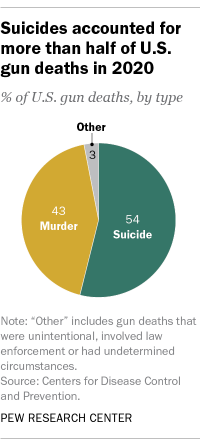
A pie chart showing that suicides accounted for more than half of U.S. gun deaths in 2020

In 2020, the most recent year for which complete data is available, 45,222 people died from gun-related injuries in the U.S., according to the CDC. That figure includes gun murders and gun suicides, along with three other, less common types of gun-related deaths tracked by the CDC: those that were unintentional, those that involved law enforcement and those whose circumstances could not be determined. The total excludes deaths in which gunshot injuries played a contributing, but not principal, role. (CDC fatality statistics are based on information contained in official death certificates, which identify a single cause of death.)

What share of U.S. gun deaths are murders and what share are suicides?

Though they tend to get less public attention than gun-related murders, suicides have long accounted for the majority of U.S. gun deaths. In 2020, 54% of all gun-related deaths in the U.S. were suicides (24,292), while 43% were murders (19,384), according to the CDC. The remaining gun deaths that year were unintentional (535), involved law enforcement (611) or had undetermined circumstances (400).

What share of all murders and suicides in the U.S. involve a gun?

Nearly eight-in-ten (79%) U.S. murders in 2020 – 19,384 out of 24,576 – involved a firearm. That marked the highest percentage since at least 1968, the earliest year for which the CDC has online records. A little over half (53%) of all suicides in 2020 – 24,292 out of 45,979 – involved a gun, a percentage that has generally remained stable in recent years.

How has the number of U.S. gun deaths changed over time?

The 45,222 total gun deaths in 2020 were by far the most on record, representing a 14% increase from the year before, a 25% increase from five years earlier and a 43% increase from a decade prior.

Gun murders, in particular, have climbed sharply in recent years. The 19,384 gun murders that took place in 2020 were the most since at least 1968, exceeding the previous peak of 18,253 recorded by the CDC in 1993. The 2020 total represented a 34% increase from the year before, a 49% increase over five years and a 75% increase over 10 years.

The number of gun suicides has also risen in recent years – climbing 10% over five years and 25% over 10 years – and is near its highest point on record. The 24,292 gun suicides that took place in 2020 were the most in any year except 2018, when there were 24,432.

How has the rate of U.S. gun deaths changed over time?

While 2020 saw the highest total number of gun deaths in the U.S., this statistic does not take into account the nation’s growing population. On a per capita basis, there were 13.6 gun deaths per 100,000 people in 2020 – the highest rate since the mid-1990s, but still well below the peak of 16.3 gun deaths per 100,000 people in 1974.

The gun murder and gun suicide rates in the U.S. both remain below their peak levels. There were 6.2 gun murders per 100,000 people in 2020, below the rate of 7.2 recorded in 1974. And there were 7.0 gun suicides per 100,000 people in 2020, below the rate of 7.7 measured in 1977. (One caveat when considering the 1970s figures: In the CDC’s database, gun murders and gun suicides between 1968 and 1978 are classified as those caused by firearms and explosives. In subsequent years, they are classified as deaths involving firearms only.)

Which states have the highest and lowest gun death rates in the U.S.?

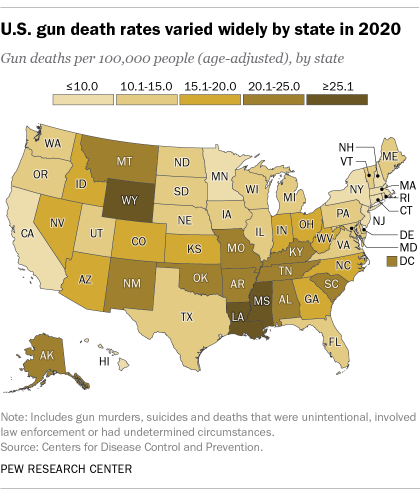
A map showing that U.S. gun death rates varied widely by state in 2020

The rate of gun fatalities varies widely from state to state. In 2020, the states with the highest rates of gun-related deaths – counting murders, suicides and all other categories tracked by the CDC – included Mississippi (28.6 per 100,000 people), Louisiana (26.3), Wyoming (25.9), Missouri (23.9) and Alabama (23.6). The states with the lowest rates included New York (5.3), Rhode Island (5.1), New Jersey (5.0), Massachusetts (3.7) and Hawaii (3.4).

How does the gun death rate in the U.S. compare with other countries?

The gun death rate in the U.S. is much higher than in most other nations, particularly developed nations. But it is still far below the rates in several Latin American countries, according to a 2018 study of 195 countries and territories by researchers at the Institute for Health Metrics and Evaluation at the University of Washington.

The U.S. gun death rate was 10.6 per 100,000 people in 2016, the most recent year in the study, which used a somewhat different methodology from the CDC. That was far higher than in countries such as Canada (2.1 per 100,000) and Australia (1.0), as well as European nations such as France (2.7), Germany (0.9) and Spain (0.6). But the rate in the U.S. was much lower than in El Salvador (39.2 per 100,000 people), Venezuela (38.7), Guatemala (32.3), Colombia (25.9) and Honduras (22.5), the study found. Overall, the U.S. ranked 20th in its gun fatality rate that year.

How many people are killed in mass shootings in the U.S. every year?

This is a difficult question to answer because there is no single, agreed-upon definition of the term “mass shooting.” Definitions can vary depending on factors including the number of victims and the circumstances of the shooting.

The FBI collects data on “active shooter incidents,” which it defines as “one or more individuals actively engaged in killing or attempting to kill people in a populated area.” Using the FBI’s definition, 38 people – excluding the shooters – died in such incidents in 2020.

The Gun Violence Archive, an online database of gun violence incidents in the U.S., defines mass shootings as incidents in which four or more people are shot, even if no one was killed (again excluding the shooters). Using this definition, 513 people died in these incidents in 2020.

Regardless of the definition being used, fatalities in mass shooting incidents in the U.S. account for a small fraction of all gun murders that occur nationwide each year.

How has the number of mass shootings in the U.S. changed over time?

A chart showing that active shooter incidents have become more common in the U.S. in recent years

The same definitional issue that makes it challenging to arrive at an exact number of mass shooting fatalities comes into play when trying to determine the frequency of U.S. mass shootings over time. The unpredictability of these incidents also complicates matters: As Rand Corp. noted in a research brief, “Chance variability in the annual number of mass shooting incidents makes it challenging to discern a clear trend, and trend estimates will be sensitive to outliers and to the time frame chosen for analysis.”

The FBI found an increase in active shooter incidents between 2000 and 2020. There were three such incidents in 2000; by 2020, that figure had increased to 40.

Which types of firearms are most commonly used in gun murders in the U.S.?

In 2020, handguns were involved in 59% of the 13,620 U.S. gun murders and non-negligent manslaughters for which data is available, according to the FBI. Rifles – the category that includes guns sometimes referred to as “assault weapons” – were involved in 3% of firearm murders. Shotguns were involved in 1%. The remainder of gun homicides and non-negligent manslaughters (36%) involved other kinds of firearms or those classified as “type not stated.”

It’s important to note that the FBI’s statistics do not capture the details on all gun murders in the U.S. each year. The FBI’s data is based on information voluntarily submitted by police departments around the country, and not all agencies participate or provide complete information each year.

The Formula Shortage: The smallest victims of the growing inflation crisis.

Photo by Pixabay on Pexels.com

Why is there a shortage you ask?

The baby formula shortage began in November 2021, when about 11% of popular brands were out of stock, according to data analytics firm Datasembly. As of May 8, 43% of baby formula was sold out at retailers across the U.S. because of recalls and supply chain strains.

America’s baby-formula shortage has gone from curious inconvenience to full-blown national crisis.

In many states, including Texas and Tennessee, more than half of formula is sold out in stores. Nationwide, 40 percent of formula is out of stock—a twentyfold increase since the first half of 2021. As parents have started to stockpile formula, retailers such as Walgreens, CVS, and Target have all moved to limit purchases.

The everything shortage isn’t new. But rationing essentials for desperate parents? That’s a twisted turn in the story of American scarcity.

Three factors are driving the U.S. baby-formula shortage: bacteria, a virus, and a trade policy.

First, the bacteria. After the recent deaths of at least two infants from a rare infection, the Food and Drug Administration investigated Abbott, a major producer of infant formula, and discovered traces of the pathogen Cronobacter sakazakii in a Michigan plant. As a result, the FDA recalled several brands of formula, and parents were advised to not buy or use some formula tied to the plant.

Recalls are common. Thousands of drugs and products are recalled every year, and they don’t create a meltdown at pharmacies or require CVS to instate Soviet-style rationing of essentials. So something else is going on here.

That brings us to the second cause: the virus. The pandemic has snarled all sorts of supply chains, but I can’t think of a market it’s yanked around more than infant formula. “During the spring of 2020, formula sales rocketed upwards as people stockpiled formula just like they stockpiled toilet paper,” Lyman Stone, the director of research at the consulting firm Demographic Intelligence, told me. Then, as “families worked through their stockpiles, sales fell a lot. This oscillation made planning for production extremely difficult. It was complicated to get an idea of the actual market size.” Meanwhile, Stone’s research has found that an uptick in births in early 2022 has corresponded with a “very dramatic decline in rates of breastfeeding” among new mothers, which pushed up demand for formula once again.

In brief: Demand for formula surged as parents hoarded in 2020; then demand fell, leading suppliers to cut back production through 2021; and now, with more new mothers demanding more formula in 2022, orders are surging faster than supply is recovering.

Finally, the third factor: America’s regulatory and trade policy. And while that might not sound as interesting to most people as bacteria and viruses, it might be the most important part of the story.

FDA regulation of formula is so stringent that most of the stuff that comes out of Europe is illegal to buy here due to technicalities like labeling requirements. Nevertheless, one study found that many European formulas meet the FDA nutritional guidelines—and, in some ways, might even be better than American formula, because the European Union bans certain sugars, such as corn syrup, and requires formulas to have a higher share of lactose.

Some parents who don’t care about the FDA’s imprimatur try to circumvent regulations by ordering formula from Europe through third-party vendors. But U.S. customs agents have been known to seize shipments at the border.

U.S. policy also restricts the importation of formula that does meet FDA requirements. At high volumes, the tax on formula imports can exceed 17 percent. And under President Donald Trump, the U.S. entered into a new North American trade agreement that actively discourages formula imports from our largest trading partner, Canada.

America’s formula policy warps the industry in one more way. The Department of Agriculture has a special group called WIC—short for Special Supplemental Nutrition Program for Women, Infants, and Children—that provides a variety of services to pregnant and breastfeeding women and their young children. It is also the largest purchaser of infant formula in the United States, awarding contracts to a small number of approved formula companies.  As a result, the U.S. baby formula industry is minuscule, by design. A 2011 analysis by USDA reported that three companies accounted for practically all U.S. formula sales: Abbott, Mead Johnson, and Gerber.

The Biden administration is focused on expanding domestic manufacturing of formula to meet families’ needs. But the bigger problem is our trade policy. “The U.S. is a captive market for domestic dairy producers like Abbott, and during times of crisis, the lack of alternative supplies becomes a pretty big problem,” Scott Lincicome, the director of general economics and trade for the Cato Institute, a libertarian think tank, told me.

Conservative populists and even liberals who are skeptical of globalization sometimes argue that if the U.S. made everything within our borders, our economy would be more resilient. But the baby-formula shortage suggests that things don’t always work out that way. Instead, we’re seeing what happens when we reduce trade with other countries for an essential good: We’re more vulnerable to emergencies like a bacteria-infested plant in Michigan.

There is a better way. “What we should want to maximize is total global capacity and system-wide flexibility and dynamism,” Lincicome said. “The location of the supply doesn’t matter as much as having as much as possible within a nimble system that can replace one plant’s supply with another’s.”

America’s reasonable instinct to protect infants has metastasized into an unreasonably protectionist trade policy that makes the U.S. formula market exquisitely sensitive to existential shocks (like a pandemic) and domestic shocks (like a major recall). Today, the shocks are everywhere, and that’s why baby formula is not.

Derek Thompson is a staff writer at The Atlantic and the author of the 

Work in Progress newsletter

10 Most Famous Poems by African American Poets by: Anirudh

African Americans have made a great contribution to the poetry of the United States as well as the world since the 18th century. The earliest known black American poets include Jupiter Hammon, Lucy Terry and Phillis Wheatley, all of whom were active in the 18th century. The poem “Bar Fight”, written in 1746 by Terry but not published until 1855, is the first poem known to have been written by a black poet. The 19th century saw a substantial rise in African American authors but it was the 20th century in which they became some of the most acclaimed poets in the world. A prominent turning point in this rise was the Harlem Renaissance, an African American movement which was centered at the Harlem neighborhood in New York City. Langston Hughes and Claude McKay were the most influential poets of the movement. Their poems, including The Negro Speaks of Rivers and If We Must Die, are among the best known poems by African Americans. African American poetry has prospered since the Harlem Renaissance and today some of the best known poets in the world are black poets. Here are the 10 most famous poems written by African American writers.

#10 IF WE MUST DIE

Poet: Claude McKay

Published: 1919

Claude McKay was one of the most influential leaders of the Harlem Renaissance; an African American movement during which African Americans took giant strides politically, socially and artisticallyIf We Must Die, his most famous poem, is a militant sonnet noted for its revolutionary tone and considered a landmark of Harlem Renaissance. The poem was written in response to mob attacks by white Americans upon African-American communities during Red Summer, a period in 1919 which was marked by hundreds of deaths in the United States from anti-black white supremacist terrorist attacks. If We Must Die doesn’t aim to arouse sympathy in its readers. It rather calls for oppressed people to resist their oppressors, violently and bravelyeven if they die in the struggle. Though it was written keeping in mind the anti-black racism in America, it doesn’t limit itself to that and may be seen to evoke oppressed people around the world.

Poem:-

If we must die, let it not be like hogs

Hunted and penned in an inglorious spot,

While round us bark the mad and hungry dogs,

Making their mock at our accursèd lot.

If we must die, O let us nobly die,

So that our precious blood may not be shed

In vain; then even the monsters we defy

Shall be constrained to honor us though dead!

O kinsmen! we must meet the common foe!

Though far outnumbered let us show us brave,

And for their thousand blows deal one death-blow!

What though before us lies the open grave?

Like men we’ll face the murderous, cowardly pack,

Pressed to the wall, dying, but fighting back!

#9 WE WEAR THE MASK

Poet: Paul Laurence Dunbar

Published: 1895

Paul Laurence Dunbar is perhaps the most famous black poet from the 19th century. This poem is focused on the mask that, according to the author, black people are forced to wear during their interactions with other people of the world. The mask that he refers to is that of smiles. The poet stresses that, despite being troubled, African Americans suppress their emotions rather than expressing their inner troubles or protesting openly. The poet then goes on to describe in more detail the agony that is concealed by the “smile” of the mask. When they smile, black people like him are praying to Christ with “tortured souls”. They sing, but the path they walk is “vile” and “long”. We Wear the Mask is the most famous work of Paul Laurence Dunbar and one of the best known American poems of the 19th century.

Poem:-

We wear the mask that grins and lies,

It hides our cheeks and shades our eyes,—

This debt we pay to human guile;

With torn and bleeding hearts we smile,

And mouth with myriad subtleties.

Why should the world be over-wise,

In counting all our tears and sighs?

Nay, let them only see us, while

We wear the mask.

We smile, but, O great Christ, our cries

To thee from tortured souls arise.

We sing, but oh the clay is vile

Beneath our feet, and long the mile;

But let the world dream otherwise,

We wear the mask!


#8 LOVE AFTER LOVE

Poet: Derek Walcott

Published: 1976

Derek Walcott had a long and distinguished career as a poet during which, among other things, he won the 1992 Nobel Prize in Literature. His most acclaimed poem is the Homeric epic Omeros but his most famous poem is perhaps Love After Love. The poem is unusual for a love poem as it stresses on loving the self. Particularly, it is about the importance of loving the inner self after break down of a relationship. It’s main theme is that of becoming whole again through self-recognition. Consisting of four stanzas, Love After Love is written in the form of advice that is presented to someone suffering from distress that comes from a bad relationship. The speaker believes that this person has become someone else and, only when he fully embraces his true self, he will be able to become fully content.

Poem:-

The time will come

when, with elation

you will greet yourself arriving

at your own door, in your own mirror

and each will smile at the other’s welcome,

and say, sit here. Eat.

You will love again the stranger who was your self.

Give wine. Give bread. Give back your heart

to itself, to the stranger who has loved you

all your life, whom you ignored

for another, who knows you by heart.

Take down the love letters from the bookshelf,

the photographs, the desperate notes,

peel your own image from the mirror.

Sit. Feast on your life.

#7 EGO TRIPPING

Poet: Nikki Giovanni

Published: 1972

Nikki Giovanni is perhaps the most famous African American poet in the world and she is acclaimed both by critics and the masses. This poem is her best known work in poetry and through it is famous by this short title, its original title is Ego-Tripping (there may be a reason why). The title of the poem suggests an ego that is so large that the author is tripping over it. The poem was written after Giovanni’s first trip to Africa in 1972 when she saw the achievements of some of the great ancient African civilizations including the Egyptians, the Carthagians and the Ethiopians. During the poem, the speaker aligns herself with these great beginnings as she celebrates both being black and being female. Ego Tripping is one of Giovanni’s favorite poems and she has included it in at least three of her poetry collections.

Excerpt:-

I was born in the congo

I walked to the fertile crescent and built

the sphinx

I designed a pyramid so tough that a star

that only glows every one hundred years falls

into the center giving divine perfect light

I am bad


#6 WE REAL COOL

Poet: Gwendolyn Brooks

Published: 1960

Gwendolyn Brooks was one of the leading American poets of the 20th century who won the 1950 Pulitzer Prize for poetry making her the first African American to receive the honor. Moreover, she was the United States Poet Laureate for the term 1985–86. The best known poem of Brooks, We Real Cool is a poem about the identity of a group of teenagers, black males, playing pool in the Golden Shovel. However, the poem may be applied to any group of youngsters, whether white, black, male or female. The poem tells how the youngsters feel about themselves and what they do, like play pool or drop out of school. Consisting of four verses of two rhyming lines each, We Real Cool is often cited as “one of the most celebrated examples of jazz poetry”, poems which demonstrate jazz like rhythms. Moreover, it is one of the most famous poems by an African American and is widely studied in literature classes.

Poem:-

The Pool Players.

Seven at the Golden Shovel.

We real cool. We

Left school. We

Lurk late. We

Strike straight. We

Sing sin. We

Thin gin. We

Jazz June. We

Die soon.


#5 HARLEM (DREAM DEFERRED)

Poet: Langston Hughes

Published: 1951

Langston Hughes was an African American poet who was a leading figure of the Harlem Renaissance. He is regarded by many as the greatest black poet of all time. Harlem first appeared in a 1951 poetry collection by Hughes titled Montage of a Dream Deferred. The dream in the poem refers to the American dream of rights; equality of opportunity for prosperity and success; liberty; and democracy; which at the time when Hughes wrote the poem was denied to most African Americans. In response to his question at the beginning of the poem, Hughes gives examples of what happens to things with deferral and negligence and asks whether the same is happening to the African American dream. Hughes brilliantly uses neat one syllable rhymes, as used in nursery rhymes, suggesting simplicity but accompanies it with imagery and rhythm which tell a more uncomfortable and hurtful tale. The famous last line of the poem then gives warning of dire consequences for everyone if the dream continues to be deferred.

Poem:-

What happens to a dream deferred?

Does it dry up

like a raisin in the sun?

Or fester like a sore—

And then run?

Does it stink like rotten meat?

Or crust and sugar over—

like a syrupy sweet?

Maybe it just sags

like a heavy load.

Or does it explode?


#4 PHENOMENAL WOMAN

Poet: Maya Angelou

Published: 1978

Maya Angelou has been referred to as “people’s poet” and “the black woman’s poet laureate”. She is one of the most renowned poets of all time and her poetry is widely read till date. In this poem, the narrator, a self-confident woman, talks about the traits that make her phenomenal despite her not adhering to the world’s view of how a woman should look. Despite not being “built to suit a fashion model’s size”, women wonder where her secret lies and men swarm around her like honey bees. Maya Angelou said that she wrote Phenomenal Woman for all women, regardless of their race or appearance. It is perhaps the most popular of her poems that she often recited for audiences during her public appearances. It was also one of Angelou’s poems featured in the 1993 American film Poetic Justice.

Excerpt:-

It’s in the click of my heels,

The bend of my hair,

the palm of my hand,

The need for my care.

Cause I’m a woman

Phenomenally.

Phenomenal woman,

That’s me.

#3 THOSE WINTER SUNDAYS

Poet: Robert Hayden

Published: 1962

Robert Hayden was the first African American to be appointed Consultant in Poetry to the Library of Congress, a role today known as US Poet Laureate. This poem, Those Winter Sundays, does not follow the conventions of the sonnet form apart from its 14 lines length and the theme of love, which is traditionally associated with sonnets. In the poem, the speaker remembers how his father rose up early on Sunday mornings, despite the hard work he did all week, and stroked the furnace fire. He woke his son only when the house was warm and he even polished his son’s “good shoes”. The speaker then regrets being indifferent to his father and not thanking him. The prominent themes of the poem are fatherly love and regret for not being grateful for the various ways in which people express their love. Those Winter Sundays is the most famous work of Robert Hayden and it ranks among the most anthologized American poems of the 20th century.

Poem:-

Sundays too my father got up early

and put his clothes on in the blueblack cold,

then with cracked hands that ached

from labor in the weekday weather made

banked fires blaze. No one ever thanked him.

I’d wake and hear the cold splintering, breaking.

When the rooms were warm, he’d call,

and slowly I would rise and dress,

fearing the chronic angers of that house,

Speaking indifferently to him,

who had driven out the cold

and polished my good shoes as well.

What did I know, what did I know

of love’s austere and lonely offices?


#2 THE NEGRO SPEAKS OF RIVERS

Poet: Langston Hughes

Published: 1921

Langston Hughes wrote his most famous poem when he was only seventeen. The idea of it came to him while he crossed the Mississippi river while travelling on a train to Mexico to meet his father. He began to think what Mississippi had meant to Negroes in the past leading him to think what other rivers had meant to them and the thought came to him, “I’ve known rivers”. He then penned down this much acclaimed poem in around fifteen minutes. In the poem Langston connects to all his African forefathers through rivers which are “older than the flow of human blood in human veins”. He places his ancestor on important historical and cultural sites and uses active verbs like “I built”“I bathed”, etc. to demonstrate their active participation in civilization since ancient times, even when they had to face discrimination.

Poem:-

I’ve known rivers:

I’ve known rivers ancient as the world and older than the

flow of human blood in human veins.

My soul has grown deep like the rivers.

I bathed in the Euphrates when dawns were young.

I built my hut near the Congo and it lulled me to sleep.

I looked upon the Nile and raised the pyramids above it.

I heard the singing of the Mississippi when Abe Lincoln

went down to New Orleans, and I’ve seen its muddy

bosom turn all golden in the sunset.

I’ve known rivers:

Ancient, dusky rivers.

My soul has grown deep like the rivers.

#1 STILL I RISE

Poet: Maya Angelou

Published: 1978

Still I Rise directly addresses the white oppressors of black people and responds to centuries of oppression and mistreatment they have suffered. It talks about various means of oppression, like writing, which the narrator addresses in the first stanza of the poem. Still I Rise hails the indomitable spirit of Black people; and expresses faith that they will triumph despite adversity and racism. It is the most famous poem of Maya Angelou and it was also her favorite. She quoted it during interviews and often included it in her public readings. In 1994, Nelson Mandela recited this poem at his presidential inauguration. Still I Rise is perhaps the most famous poem written by an African American and it has been called a “proud, even defiant statement on behalf of all Black people”.

Excerpt:-

You may write me down in history

With your bitter, twisted lies,

You may tread me in the very dirt

But still, like dust, I’ll rise.

New Series: Where are they now?

We catch up with past artists to see what they have been up to since they first came into HPS pages.

Photo by Pavel Danilyuk on Pexels.com

If you have been following this blog in the past few months I have been showcasing past interviews and submissions from when the magazine was in paper form, so I wanted to try to catch up with as many people as I could to see what has become of them since their time with HPS. I hope you enjoy this first interview and the following interviews to come. Thanks again for stopping by!!!

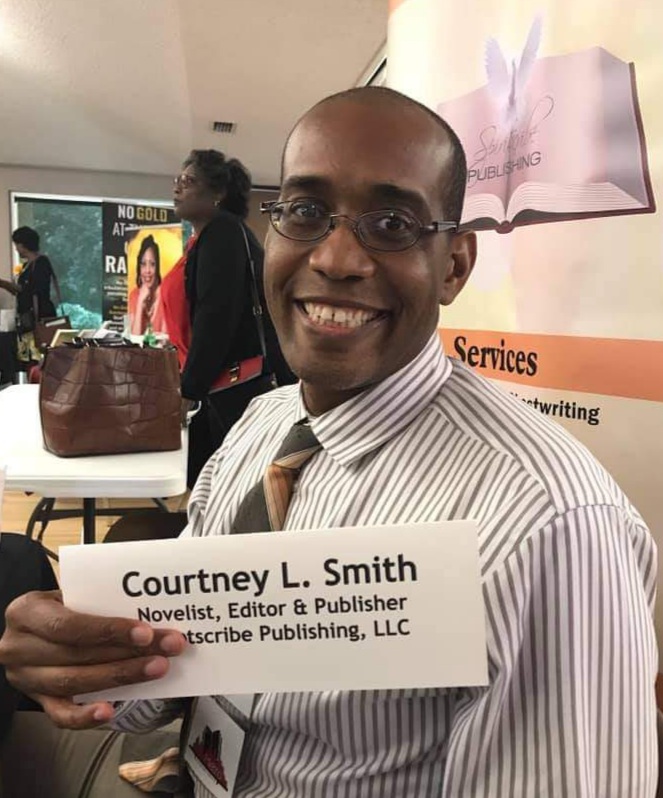
Courtney Smith

Why the name change? What is it now?
My former stage name was “Aggravated,” but I changed it to Admonition because much of my poetry tends to warn people about using wisdom in daily life.  Besides, so many people were using the name Aggravated; it became more common than sunlight.

How do you think life has changed?
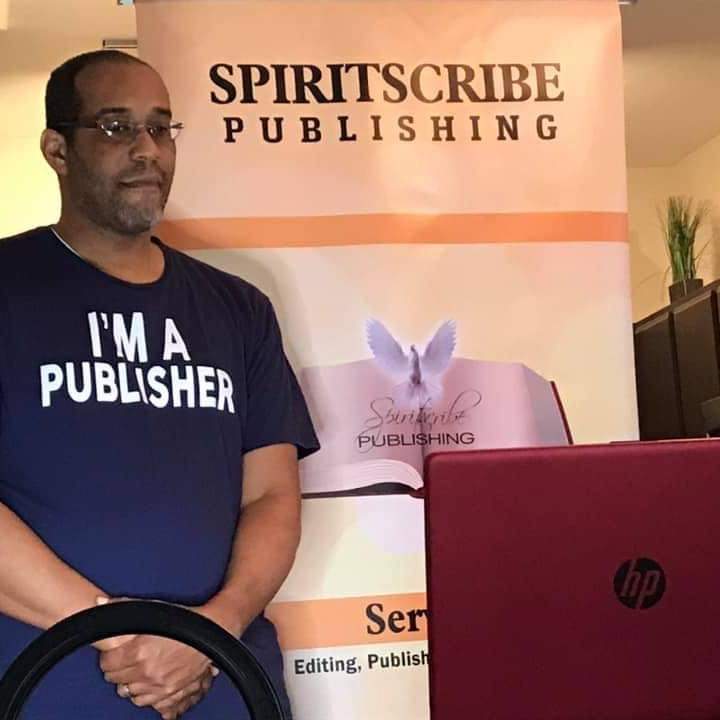
I have obviously gotten older, and I tend to maintain my health more than I did in previous years.  Plus, I have my own publishing business (Spiritscribe Publishing, LLC), and I am married.  My thinking is not primarily directed towards me.  I was never selfish, but I think more about others than myself.

How has your focus developed since 2013?
I realize I cannot be in more than one place at a time, so I need to manage my time and resources, accordingly.

What product have you been sharing with the public since 2013?
I have published two books of my own authorship: Trouble’s Always Watching: Volume 1; Trouble’s Always Watching Volume 2; and Scribing Genesis: Quickstart Writing for Beginners.  I have published and edited many books for various authors.

How have the changes in the world  affected your writing?
My writing tends to reflect more current events as well as ongoing social issues.

What is next that the public can enjoy from you?
I will be conducting more writing workshops and releasing more books and short stories.  The sky is the limit…

Open Mic!!!!
You can showcase your latest story here!


Hail to the King of Pop
By Courtney L. Smith

His coronation as the “King of Pop” by Elizabeth Taylor exceeded the word great.

He first appeared within Gary, Indiana’s steel industry on August 29, 1958.

He glided across the Chitterling Circuits’ floors with his brothers and no shame.

The Jackson Five opened for popular acts such as Gladys Knight and Etta James.

They eased down the Hollywood Walk of Fame, but luxury was not all they felt.

Sometimes, Michael’s and his brothers’ missteps caused them to taste Joe’s belt.

He perfected maneuvers and lifted his legs and defied the description clever.

His greatest demonstration occurred at Motown Yesterday, Today, and Forever.

He had some moments that could have caused his career to collapse and expire.

During the filming of a Pepsi commercial, his hair ignited and caught on fire.

However, he recovered and worked tirelessly as though nothing ever occurred.

Any reference to the incident would probably leave many people’s memories blurred.

“Billie Jean” debuted with the most popular dance anyone would ever see.

He perfected the moonwalk and vocalized issues of paternity on May 16, 1983.

The song resonated with men and women wrestling withparenthood in court.

One of the biggest issues today stems from the enactment of child support.

Frequently, pride and gangs get teenagers killed and leave parents and guardians defeated.

Michael let numerous, endangered adolescents know it is alright to “Beat It.”

Only Michael could bring style to dressing up as werewolves and dancing with the undead.

“Thriller” contains the best lyrics for horror in pop that were ever sung, performed, or read.

Other times, the media’s coverage about his strange habits left him extremely mad.

However, it did nothing to stop him from telling the whole, wide world “I’m Bad.”

Micheal did not deny he had any faults.  This next song made it quite clear.

He acknowledged all people could examine themselves and change with “The Man in The Mirror.”

The greatest scrutiny of Michael’s possessions was something the Paparazzi kept insisting.

In 1995, O.J. Simpson was not the only celebrity to have one of his gloves missing.

He endured scrutiny from every conceivable angle.  He could not even get peace at home.

Is it really any wonder one of Michael Jackson’s most popular songs was “Leave Me Alone”?

In the midst of many accusations of sexual misconduct, his consequences were legally minimal.

Micheal’s acquittal of all charges permitted him to leave the courthouse like a “Smooth Criminal.”

He never allowed his personal torments to ignore the prisons othershad to endure or bear.

The King of Pop encouraged others to “Heal the World” as he showed everyone somebody cared.

He produced a work acknowledging racial injustice, apartheid, oppression, and global distrust.

Michael did not stutter or stammer when he performed “They Don’t Really Care About Us.”

The introductions for his videos were like cinematic productionswith opening credits to match.

Any viewers’ hopes of getting through the videos quickly wereeliminated and quickly dispatched.

He often fulfilled childlike aspirations and shared the name of his home with that of Peter Pan.

It was no wonder he and many children enjoyed themselves in the amusement of Neverland.

The King of Pop definitely left his mark upon the world and departed it in a style that was bold.

On September 3, 2009, he was laid to rest as 17,000 in attendance witnessed his casket of gold.

He permanently influenced pop culture and changed music forever with his talent for all to see.

He will always be appreciated and never fully duplicated with the most authentic style of eternity.

Reaching Milestones

Photo by Snapwire on Pexels.com

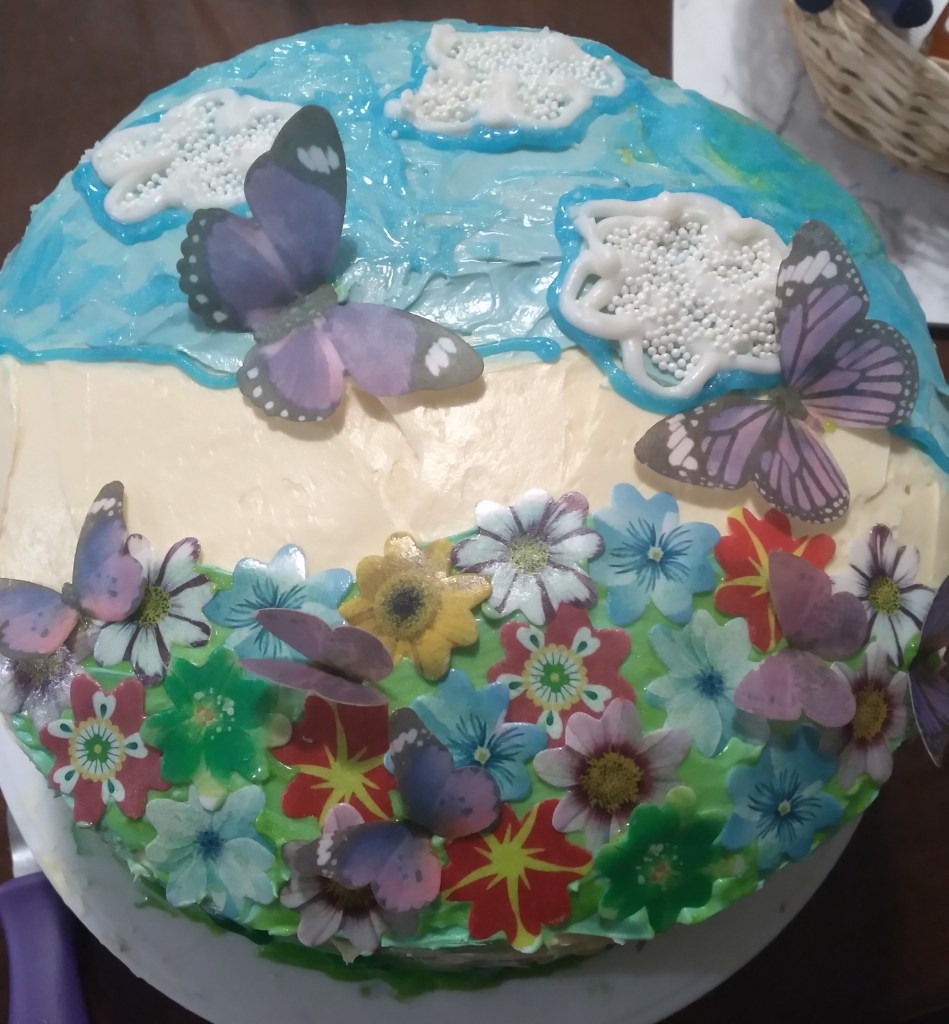
Yesterday I reached a couple of personal milestones and it had me thinking about Milestones in general. For me healthwise I didn’t see myself growing up to make it to 19 so when I did I made a promise to myself that every year I would find a way to celebrate that milestone, and for me that’s baking. So I bake cakes for others to eat as my form of celebrating. Yesterday I made 49 and reflecting what all I went through to get to that number made me take a seat because looking back it was a LOT. Making it past unthought fears and situations and prognosis had this woman a tad bit shell shocked to say the least but I got through them. Another smell of success. That’s just a part of life as we get older. Learning and coping with change. See, I grew up believing in a saying.

“A REASON OR A SEASON”.

Things happen for a reason, so figure out if it is about you or to help guide you. just like a bad period is it just another bad or joyful season? If your favorite season is winter, why do you go through summer? To appreciate winter duh. That phase has helped me throughout my life and it never fails to be relevant with whatever I go through as my days pass on. I thought I would share that with you all. The other milestone is the magazine.

Knowing I was going to get a lot of resistance to continue to grow the magazine and make it more updated and reachable was going to be a challenge to say the least. Past supporters turned into just that….past supporters. I knew just like back then that I would have to prove myself to the public but also to myself that I could do this. I knew that there wouldn’t be any quick success or trust for yet another unknown website. But I slowly got my stride with every interview I was granted, an article or poetry from an artist that had blind faith in me. As I continue to grow I realize that is a major milestone and I don’t take it lightly because I wouldn’t trust just anyone with my own work. Sure I would love to make a profit from the website but I know that has to be proven that it’s worth the value. So that is my next milestone I’m reaching for. To ensure that the website and the people who trust it that they are valuable….That their work is valuable…the time is valuable and in a sense I am valuable because there is no logo for hps because hps is me.

That’s why there’s a picture of me because I’m putting myself out there for criticism and critics and rejections. But the main objective is worth it and that’s feeling fulfilled with what I’m doing and that’s celebrating/showing others. which if you think about it when you celebrate a loved one you feel the feeling I get when I post an interview or showcase someone’s work. So there’s a little perspective for you lol. What’s next I don’t know but I can’t wait to achieve it.

It’s my Birthday!!!

Photo by Dazzle Jam on Pexels.com

I wanted to say THANK YOU all for coming to this blog and showing me that you like the progress its doing. That in itself is the best gift I could receive this year. It’s slowly growing with more followers and likes on each post and along with all that, the people I am getting to work with and admire brings joy to my day. I plan on admiring the cake I made for the big day and relaxing and knowing that a special gift to myself is knowing that this post makes my 200th post since I started this blog for the magazine! So I have something extra to be proud about.

I will be back posting tomorrow!

Can’t draw for nothing but everything is edible

Courtney L. Smith

Poetic Liberation behind the Microphone

By Courtney L. Smith

13th Amendment has been liberating microphones in the southern portion of Atlanta,
Georgia and most recently Houston, Texas. The gospel has been poetically dispersed upon
numerous microphones in addition to his artistic styles of lyrical protests against many of the
social injustices commonly observed by our society. He has embedded his voice in the minds of
poetic patrons through his book Beautiful Scars: The Bittersweet Struggle. 13th Amendment
has two compact discs. Both Psalms of Liberation and Street Corner Slaves release vocal
extrications from generational curses, oppressive habits, and environmental ignorance. Sowing
seeds into the adolescents and younger people of his community is a mission that led to his
spoken-word involvement. 13th Amendment is a prominent member of both Tower of Poets
and Christian Poetics, the Houston based organization that he is looking to see a lot of great
things from as they go into the future. He is also a part of Tower of Poets in Atlanta, Georgia,
which is a poetic collective, and they have done some phenomenal things as well. He obtained
his Masters in Divinity from Fuller Theological Seminary on June 18, 2016. These are his words
regarding the length of his activity in poetry: “I would probably say I have been performing a
little bit over twelve years.”
Touching people with his vocal fingertips brings more than simple performances that
are riddled with artistic patterns and poignant expressions. His objectives combine spreading
the gospel and bringing awareness to sex trafficking, racial discrimination, and civil rights. He
invests himself into his art with the passion and determination of an obsessed gambler filing for
bankruptcy before entering the casino, again. Every opportunity to convey the love of God is
engrained into him like a circuit board. 13th Amendment ignites his words in a manner
resembling lit matches and gasoline. This is his account regarding his motivation: “As far as my
motivation for performing poetry, honestly, is just to communicate every aspect of who I am to
the people and giving to them spiritually, socially, and mentally. That is just making sure that I
try to communicate who I am to the audience. In some cases, I would probably even say
communicate the love of God. I know that sounds a bit cliché, but you know, I want every
person that I have an interaction with or engage to know that it’s more than just speaking
words through a microphone. It is, in a sense, getting in touch with who they are in their
essence.”
Fostering relationships bear more significance for 13th Amendment than seeking
awards or plaques for his performances. Encountering countless individuals and affecting their
lives with performances yield more merit for him than grasping plaques and objects of wood,
metal, and plastic covered in metallic paint. Penetrating the hearts and minds of listening ears
with the impact of a flaming meteor disintegrating the surrounding areas fulfills his desires
more than any form of recognition. Having a network of people awaiting communication with
him or others brings 13th Amendment true satisfaction. Here is how he feels about
recognition: “I don’t know. That’s a really good question. I don’t really look for recognition in a
sense. I’ve built a lot of great relationships over the years, and I think those relationships have

mattered more to me than the actual recognition. I have done things where I was not
necessarily trying to be the poet-of-the-year in a sense, but I have done things where I was just
consciously building relationships to get to know people, to build networks and stuff like that.
But I don’t think I have ever done things consciously to say I wanted to gain recognition.”
Having influential people who are known for their activities throughout the city, nation,
and world witnessing his performances tends to fulfill his accomplishments more than most
others with the exception of implementing his messages of God’s love through poetry. No
enthusiasm courses through the poet’s body like rapids within the rivers with achieving fame or
wealth. However, 13th Amendment will clutch a microphone as though a winning lottery
ticket is produced. Competing in poetic competitions such as the slams does not ignite his
passion like having someone being baptized or accepting Jesus Christ as their Lord. Here is
Thirteenth’s perspective on the matter: “One of the highlights is being able to stand before a
lot of prestigious people. I mean people who are quite notable in the community, nationally,
and internationally. You know, being in the presence of those kinds of people who recognize
you in honor of what you do, to me, was way more than any award I would have ever received.
And honestly, that is kind of what I got into poetry for: to interact with people, so I don’t think I
have ever been gung-ho about trying to receive accolades and awards in slams and stuff like
that. Now, the poets do it, but I know that even when I have gotten into poetry slams, my
heart wasn’t really into it. There are slam poets who are phenomenal and dope, and, you know
what I’m saying, they are good at what they do. I think there are a lot of poets who are just
well rounded and whatever. For me, I only want to go where my heart it at, and my heart has
never been into slam poetry.”
The goals upon 13th Amendment’s agenda involve launching Emissary MDM
International and Liberation180 Communications and immersing himself in obtaining his goals
for the future. Having printing presses release another book for later times brings some degree
of contentment for 13 th Amendment prepares for approaching events. His desire to reconcile
the church with the streets fuels his personal movement to unite people with God. Liberation
enthralls the audience upon hearing his voice. His mind is always active in regards to bringing
people, poetry, and the gospel, together. He explains his experience in his own words: “I’ve
gone through a lot of transitions. I used to stay in Atlanta, and one of my reasons for moving to
Houston was because I wanted to pursue a Masters in Divinity to fine tune my theological
perspectives for engaging urban communities, and it is a graduate school with the best
programs. Fuller Theological Seminary is one of the best schools in the country for theological
engagement. As a result of that, I said how can I fuse what I do theologically and poetically? In
the future, I am releasing a book that is going to connect the existence of the church with the
mission of God in the streets. It will help people know what it means to be a follower of Jesus
Christ as well as the mission of the church. This is the reason for Emissary MDM Int. An
emissary is someone who speaks on behalf of another. MBM are the initials of our last names.
I see myself as an ambassador of The Messiah. This whole concept is being able to build and
take different facets of who I am and package it for public consumption.”

No obscure or esoteric desire exists for how 13th Amendment wants to be
remembered. He simply wants his performances, influence, and legacy to characterize his
career with his mission to leave the imprint of Jesus Christ within the hearts of his audiences
throughout the nation. He does not mention having statues erected in his honor or possessing
financial accounts with six or seven digits as a goal. His mission and objective in poetry and life
is making sure social ills are addressed and Jesus Christ is exalted through his performances.
Here is his perception of the matter: “I really want people to remember me as a poet who
really loved poetry, and someone who was not only a great lyricist but was intentional about
practicing what I speak and trying to walk the walk of God. If anyone sees that, this essentially
highlights what I would want anyone to remember about me. In essence, I love both poetry
and people.”
Obtaining his products is as simple as going to Amazon or approaching him, personally.
A CD or mp3 of his performances are only a few electrical impulses away through a few
keystrokes connecting to the Internet. Having the previously mentioned access or obtaining his
email address should permit availability to his products. Knowing how to reach him is as easy
as blinking. Of course, this is how he conveys it: “As I always say, ‘in the back of the trunk of my
car.’ When you see me in the streets, hit me up. My first published called Beautiful Scars: the
Bittersweet Struggle is still available on Amazon, Barnes and Noble, other major online retailers.
It’s available there, so they can pick up Beautiful Scars: the Bittersweet Struggle. You call also
go to http://www.christianpoetics.com.
There is no way to list all of the influences affecting 13th Amendment: it is as lengthy as
the U.S. Census. He feels the need to credit many of the poets he has meet and shared the
stage with for influencing him. Urban Light (I cannot forget, is like my other mentor. I talk to
her as often as I ever get a chance to.) and Hank Stewart (who hosts The Love Jones Sunday
venue as well as The Hank Stewart Foundation) are two influences who have exposed 13 th
Amendment to a larger audience. Hearing the appreciation of others within his circles provides
the satisfaction he desires. 13th Amendment communicates this through his response to his
influences: “It’s a collection of a lot of people from Gil Scott Herron (I love his work because he
was able to masterfully fuse politics, love, and social issues.), Umar Bin Hassan of The Last Poets
to Def Poet Black Ice have been a huge influence. Black Ice literally defined how I wanted to
come off in spoken word as well as the ATL poetry culture. I remember a lot of poets from
Atlanta have inspired me. Tommy Bottoms, an Atlanta Def Poet, forced me to think, more
politically. I could talk about Georgia Me, Abyss, Malik Salaam, Cocktails, and the list goes on.”
The story behind 13 th Amendment’s stage name is nearly as intriguing as its origin. The
powerful motivation pushing the agenda associated with his name reflects the purpose of the
poet. Liberation inundates his purpose and name as it saturates poetic venues with
enlightenment and empowerment through his art. The transition of his development from its
initial stages to the present was not completed easily in one day. 13th Amendment expresses
his own growth from his poetic conception into the powerful poet currently having his
following’s familiarity: “It was a very difficult process. When I first become widely recognized,
they knew me as Anonymous Composer and, then, eventually Anonymous. One [name], of

course, was a shortening of the first one. The whole concept of how Anonymous Composer
occurred was typically whenever you read those poems and look for who wrote it at the very
end and see ‘unknown writer’ or ‘author unknown,’ I was thinking ‘here is an anonymous
composer, and I wanted to be that anonymous composer. It did not matter whether or not
people knew me, and I am not too big on people knowing me as a personality. However, I
always wanted people to know that even if they have forgotten me, I wanted whatever I spat
on stage or wrote on paper to stick with them. That is what I wanted. It got to a point that
Anonymous Composer was no longer sufficient in the sense of bringing out the various
dynamics of who I was, poetically. So, I started thinking about another name and came up with
13 th Amendment. The concept of the physical liberation of black people post Civil War as well
as the continual need for spiritual, socio-economic liberation provided pertinence for the name.
This will be a great way to fuse the spiritual with the social issues combine everything in a
gumbo without ever having to sacrifice my identity. So, when people think of 13 th Amendment,
Amendment, some people may think, ‘Oooh! This brother is deep!’ Others may think, ‘What is
the 13th Amendment?” So, when people think of the 13 th Amendment, it gives me an
opportunity to share who our Lord and Savior is from a conversational standpoint.”
The artist’s introduction into the Tower of Poets signifies a major manifestation of his
influence in Atlanta. Wanting to foster other Christian artists and create a platform for them is
part of the brand of Tower of Poets, which initially began with Robert Fields. The following is
the result of 13th Amendment reminiscing about this period: “I am part of Tower of Poets in
Atlanta with fellow friend and poet Rob Fields. There’s a whole host of other poets who
associate with The Tower of Poets brand. Robert Fields is a dynamic artist, and what we
wanted to do was create a core group of Christian poets and really just go anywhere and
preach the gospel through poetry. A lot of the poetry places out there were not necessarily
honed in on proclaiming the gospel. We decided to be one of the few that did. I am also part
of Christian Poetics, which is headed by Sister Monica Matthew-Smith since she is married,
now, and, of course, Courtney L. Smith her husband. They are dynamic poets, as well, who
have a heart for God. Those are definitely two of the cliques that I am part of. I did start a
teenage poetry collective in Atlanta, which has taken another form within itself. It was young
people that I have mentored and encouraged to take poetry to another level formerly under
the brand of Skillful Writers, which was inspired by Psalms 45:1. They went on to form their
own identities.”
The greatest challenge conveyed by 13th Amendment regarding poetry involves some of
the division associated with groups of poets alienating themselves from one another. Another
obstacle within the genre, as he perceives it, is the challenge of transitioning poetry into the
mainstream of entertainment such as singing, dancing, and acting through mediums such as
radio and television. Artists are still exploited through their performances by people and
organizations profiting from them without giving them any portion of the funds produced by
their inclusion. 13th Amendment conveys he has a problem with people charging poets a fee to
perform although they are the main source of income for the venue without sharing the profits
incurred. Here are his words on the issues: “My biggest issue with poetry is, with some cases,
poets have become very controlling and cliquish. Our art form is still growing and trying to

break into different arenas. Another issue that we have is we still have not presented ourselves
as a united front or as a united artistry. We have to get past that if we want poetry to grow if
get to where it needs to be. When I refer to cliques, I am referring to how hip hop artists used
to battle each other, and it was healthy. However, I don’t see poetry having a healthy
understanding of competition other than a slam. There is not a lot of healthiness in the
relationships among poets that I would like to see. Because I think once poets come together in
every city and come together as one, we can become a force to be reckoned with. I know that
there is still a struggle for the mainstream to market poetry. In a sense, we are an art in its
purest form. We do not have a lot of the hype that comes with the traditional radio and the
television format. The third and last issue I would say is there are a lot of venues in which you
have people pimping poets without being poets themselves. They might use the artists to gain
some financial benefit that goes towards them and not necessarily the poets.”

Poetry

i carry your heart with me(i carry it in]

By E. E. Cummings

E. E. Cummings | Poetry Foundation Edward Estlin (E.E.) Cummings was born in Cambridge, Massachusetts. He attended the Cambridge Latin High School,…

i carry your heart with me

(i carry it in my heart)

i am never without it

(anywhere i go you go,my dear;and whatever is done

by only me is your doing,my darling)

                        i fear

no fate(for you are my fate,my sweet)

i want no world

(for beautiful you are my world,my true)

and it’s you are whatever a moon has always meant

and whatever a sun will always sing is you

here is the deepest secret nobody knows

(here is the root of the root and the bud of the bud

and the sky of the sky of a tree called life;which grows

higher than soul can hope or mind can hide)

and this is the wonder that’s keeping the stars apart

i carry your heart

(i carry it in my heart)

Edward Estlin (E.E.) Cummings was born in Cambridge, Massachusetts. He attended the Cambridge Latin High School, where he studied Latin and Greek. Cummings earned both his BA and MA from Harvard, and his earliest poems were published in Eight Harvard Poets (1917). As one of the most innovative poets of his time, Cummings experimented with poetic form and language to create a distinct personal style. A typical Cummings poem is spare and precise, employing a few key words eccentrically placed on the page. Some of these words were invented by Cummings, often by combining two common words into a new synthesis. He also revised grammatical and linguistic rules to suit his own purposes, using such words as “if,” “am,” and “because” as nouns, for example, or assigning his own private meanings to words. Despite their nontraditional form, Cummings’ poems came to be popular with many readers. “No one else,” Randall Jarrell claimed, “has ever made avant-garde, experimental poems so attractive to the general and the special reader.” By the time of his death in 1962 Cummings held a prominent position in 20th-century poetry. John Logan in Modern American Poetry: Essays in Criticism called him “one of the greatest lyric poets in our language.” Stanley Edgar Hyman wrote in Standards: A Chronicle of Books for Our Time: “Cummings has written at least a dozen poems that seem to me matchless. Three are among the great love poems of our time or any time.” Malcolm Cowley admitted in the Yale Review that Cummings “suffers from comparison with those [poets] who built on a larger scale—Eliot, Aiken, Crane, Auden among others—but still he is unsurpassed in his special field, one of the masters.”

Cummings decided to become a poet when he was still a child. Between the ages of eight and twenty-two, he wrote a poem a day, exploring many traditional poetic forms. By the time he was in Harvard in 1916, modern poetry had caught his interest. He began to write avant-garde poems in which conventional punctuation and syntax were ignored in favor of a dynamic use of language. Cummings also experimented with poems as visual objects on the page. In April of 1917, with the First World War raging in Europe and the United States just becoming involved, he volunteered for the Norton-Harjes Ambulance Service in France. Ambulance work was a popular choice with those who, like Cummings, considered themselves to be pacifists. He was soon stationed on the French-German border with fellow American William Slater Brown, and the two young men became fast friends. To relieve the boredom of their assignment, they inserted veiled and provocative comments into their letters back home, trying to outwit and baffle the French censors. They also befriended soldiers in nearby units. Such activities led in September of 1917 to their being held on suspicion of treason and sent to an internment camp in Normandy for questioning. Cummings and Brown were housed in a large, one-room holding area along with other suspicious foreigners. Only outraged protests from his father finally secured Cummings’ release in December of 1917; Brown was not released until April of the following year. In July 1918, Cummings was drafted into the U.S. Army and spent some six months at a training camp in Massachusetts.

Upon leaving the army in January of 1919, Cummings resumed his affair with Elaine Thayer, the wife of his friend Schofield Thayer. Thayer knew and approved of the relationship. In December of 1919 Elaine gave birth to Cummings’ daughter, Nancy, and Thayer gave the child his name. Cummings was not to marry Elaine until 1924, after she and Thayer divorced. He adopted Nancy at this time; she was not to know that Cummings was her real father until 1948. This first marriage did not last long. Two months after their wedding, Elaine left for Europe to settle her late sister’s estate. She met another man during the Atlantic crossing and fell in love with him. She divorced Cummings in 1925.

The early 1920s were an extremely productive time for Cummings. In 1922 he published his first book, The Enormous Room, a fictionalized account of his French captivity. Critical reaction was overwhelmingly positive, although Cummings’ account of his imprisonment was oddly cheerful in tone and freewheeling in style. He depicted his internment camp stay as a period of inner growth. As David E. Smith wrote in Twentieth Century Literature, The Enormous Room’s emphasis “is upon what the initiate has learned from his journey. In this instance, the maimed hero can never again regard the outer world (i.e., ‘civilization’) without irony. But the spiritual lesson he learned from his sojourn with a community of brothers will be repeated in his subsequent writings both as an ironical dismissal of the values of his contemporary world, and as a sensitive, almost mystical celebration of the quality of Christian love.” John Dos Passos, in a review of the book for Dial, claimed that “in a style infinitely swift and crisply flexible, an individual not ashamed of his loves and hates, great or trivial, has expressed a bit of the underside of History with indelible vividness.” Writing of the book in 1938, John Peale Bishop claimed in the Southern Review: “The Enormous Room has the effect of making all but a very few comparable books that came out of the War look shoddy and worn.”

Cummings’ first collection of poems, Tulips and Chimneys, appeared in 1923. His eccentric use of grammar and punctuation are evident in the volume, though many of the poems are written in conventional language. The original manuscript for Tulips and Chimneys was cut down by the publisher. These deleted poems were published in 1925 as &, so titled because Cummings wanted the original book to be titled Tulips & Chimneys but was overruled. Another collection quickly followed: XLI Poems, also in 1925. In a review of XLI Poems for Nation, Mark Van Doren defined Cummings as a poet with “a richly sensuous mind; his verse is distinguished by fluidity and weight; he is equipped to range lustily and long among the major passions.” At the end of 1925 Dial magazine chose Cummings for their annual award of $2,000, a sum equaling a full year’s income for the writer. The following year a new collection, Is 5, was published, for which Cummings wrote an introduction meant to explain his approach to poetry. In the introduction he argued forcefully for poetry as a “process” rather than a “product.”

It was with these collections of the 1920s that Cummings established his reputation as an avant-garde poet conducting daring experiments with language. Speaking of these language experiments, M. L. Rosenthal wrote in The Modern Poets: A Critical Introduction: “The chief effect of Cummings’ jugglery with syntax, grammar, and diction was to blow open otherwise trite and bathetic motifs through a dynamic rediscovery of the energies sealed up in conventional usage…. He succeeded masterfully in splitting the atom of the cute commonplace.” “Cummings,” Richard P. Blackmur wrote in The Double Agent: Essays in Craft and Elucidation, “has a fine talent for using familiar, even almost dead words, in such a context as to make them suddenly impervious to every ordinary sense; they become unable to speak, but with a great air of being bursting with something very important and precise to say.” Bethany K. Dumas wrote in her E. E. Cummings: A Remembrance of Miracles that “more important than the specific devices used by Cummings is the use to which he puts the devices. That is a complex matter; irregular spacing … allows both amplification and retardation. Further, spacing of key words allows puns which would otherwise be impossible. Some devices, such as the use of lowercase letters at the beginnings of lines … allow a kind of distortion that often re-enforces that of the syntax…. All these devices have the effect of jarring the reader, of forcing him to examine experience with fresh eyes.” S. I. Hayakawa also remarked on this quality in Cummings’ poetry. “No modern poet to my knowledge,” Hayakawa wrote in Poetry, “has such a clear, childlike perception as E. E. Cummings—a way of coming smack against things with unaffected delight and wonder. This candor … results in breath-takingly clean vision.” Norman Friedman explained in his E. E. Cummings: The Growth of a Writer that Cummings’ innovations “are best understood as various ways of stripping the film of familiarity from language in order to strip the film of familiarity from the world. Transform the word, he seems to have felt, and you are on the way to transforming the world.”

Other critics focused on the subjects of Cummings’ poetry. Though his poetic language was uniquely his own, Cummings’ poems were unusual because they unabashedly focused on such traditional and somewhat passé poetic themes as love, childhood, and flowers. What Cummings did with such subjects, according to Stephen E. Whicher in Twelve American Poets, was, “by verbal ingenuity, without the irony with which another modern poet would treat such a topic, create a sophisticated modern facsimile of the ‘naive’ lyricism of Campion or Blake.” This resulted in what Whicher termed “the renewal of the cliché.” Jenny Penberthy detected in Cummings a “nineteenth-century romantic reverence for natural order over man-made order, for intuition and imagination over routine-grounded perception. His exalted vision of life and love is served well by his linguistic agility. He was an unabashed lyricist, a modern cavalier love poet. But alongside his lyrical celebrations of nature, love, and the imagination are his satirical denouncements of tawdry, defiling, flat-footed, urban and political life—open terrain for invective and verbal inventiveness.”

This satirical aspect to Cummings’ work drew both praise and criticism. His attacks on the mass mind, conventional patterns of thought, and society’s restrictions on free expression, were born of his strong commitment to the individual. In the “nonlectures” he delivered at Harvard University Cummings explained his position: “So far as I am concerned, poetry and every other art was, is, and forever will be strictly and distinctly a question of individuality.” As Penberthy noted, Cummings’ consistent attitude in all of his work was “condemning mankind while idealizing the individual.” “Cummings’ lifelong belief,” Bernard Dekle stated in Profiles of Modern American Authors, “was a simple faith in the miracle of man’s individuality. Much of his literary effort was directed against what he considered the principal enemies of this individuality—mass thought, group conformity, and commercialism.” For this reason, Cummings satirized what he called “mostpeople,” that is, the herd mentality found in modern society. “At heart,” Logan explained, “the quarrels of Cummings are a resistance to the small minds of every kind, political, scientific, philosophical, and literary, who insist on limiting the real and the true to what they think they know or can respond to. As a preventive to this kind of limitation, Cummings is directly opposed to letting us rest in what we believe we know; and this is the key to the rhetorical function of his famous language.”

Cummings was also ranked among the best love poets of his time. “Love always was … Cummings’ chief subject of interest,” Friedman wrote in his E. E. Cummings: The Art of His Poetry. “The traditional lyric situation, representing the lover speaking of love to his lady, has been given in our time a special flavor and emphasis by Cummings. Not only the lover and his lady, but love itself—its quality, its value, its feel, its meaning—is a subject of continuing concern to our speaker.” Love was, in Cummings’ poems, equated to such other concepts as joy and growth, a relationship which “had its source,” wrote Robert E. Wegner in The Poetry and Prose of E. E. Cummings, “in Cummings’ experience as a child; he grew up in an aura of love…. Love is the propelling force behind a great body of his poetry.” Friedman noted that Cummings was “in the habit of associating love, as a subject, with the landscape, the seasons, the times of day, and with time and death—as poets have always done in the past.”

Cummings’ early love poems were frankly erotic and were meant to shock the Puritanical sensibilities of the 1920s. Penberthy noted that the poet’s first wife, Elaine, inspired “scores of Cummings’s best erotic poems.” But, as Wegner wrote, “In time he came to see love and the dignity of the human being as inseparable.” Maurer also commented on this change in Cummings’ outlook; there was, Maurer wrote, a “fundamental change of attitude which manifested itself in his growing reverence and dedication to lasting love.” Hyatt H. Waggoner, writing in American Poets from the Puritans to the Present, noted that “the love poems are generally, after the 1920s, religious in tone and implication, and the religious poems very often take off from the clue provided by a pair of lovers, so that often the two subjects are hardly, if at all, separable.” Rushworth M. Kidder also noted this development in the love poems, and he traced the evolution of Cummings’ thoughts on the subject. Writing in his E. E. Cummings: An Introduction to the Poetry, Kidder reported that in the early poems, love is depicted as “an echo of popularly romantic notions, and it grows in early volumes to a sometimes amorphous phenomenon seasoned by a not entirely unselfish lust. By [his] last poems, however, it has come to be a purified and radiant idea, unentangled with flesh and worlds, the agent of the highest transcendence. It is not far, as poem after poem has hinted, from the Christian conception of love as God.” Waggoner concluded that Cummings “wrote some of the finest celebrations of sexual love and of the religious experience of awe and natural piety produced in our century, precisely at a time when it was most unfashionable to write such poems.”

In addition to his poetry, Cummings was also known for his play, Him, and for the travel diary, Eimi. Him consisted of a sequence of skits drawing from burlesque, the circus, and the avant-garde, and jumping quickly from tragedy to grotesque comedy. The male character is named Him; the female character is Me. “The play begins,” Harold Clurman wrote in Nation, “as a series of feverish images of a girl undergoing anaesthesia during an abortion. She is ‘me,’ who thinks of her lover as ‘him.’” In the program to the play, staged at the Provincetown Playhouse, Cummings provided a warning to the audience: “Relax and give the play a chance to strut its stuff—relax, stop wondering what it’s all ‘about’—like many strange and familiar things, Life included, this Play isn’t ‘about,’ it simply is. Don’t try to enjoy it, let it try to enjoy you. DON’T TRY TO UNDERSTAND IT, LET IT TRY TO UNDERSTAND YOU.” Clurman believed that “the play’s purest element is contained in duos of love. They are the most sensitive and touching in American playwriting. Their intimacy and passion, conveyed in an odd exquisiteness of writing, are implied rather than declared. We realize that no matter how much ‘him’ wishes to express his closeness to ‘me,’ he is frustrated not only by the fullness of his feeling but by his inability to credit his emotion in a world as obscenely chaotic as the one in which he is lost.”

In 1931 Cummings traveled to the Soviet Union. Like many other writers and artists of the time, he was hopeful that the communist revolution had created a better society. After a short time in the country, however, it became clear to Cummings that the Soviet Union was a dictatorship in which the individual was severely regimented by the state. His diary of the visit, in which he bitterly attacked the Soviet regime for its dehumanizing policies, was published in 1933 as Eimi, the Greek word for “I am.” In it, he described the Soviet Union as an “uncircus of noncreatures.” Lenin’s tomb, in which the late dictator’s preserved body is on display, especially revolted Cummings and inspired him to create the most impassioned writing in the book. “The style which Cummings began in poetry,” Bishop wrote, “reaches its most complete development in the prose of Eimi. Indeed, one might almost say that, without knowing it, Cummings had been acquiring a certain skill over the years, in order that, when occasion arose, he might set down in words the full horror of Lenin’s tomb.” In tracing the course of his 35-day trip through the Soviet Union, Cummings made frequent allusion to Dante’s Inferno and its story of a descent into Hell, equating the two journeys. It is only after crossing back into Europe at book’s end that “it is once more possible for [Cummings] to assume the full responsibility of being a man…,” Bishop wrote. “Now he knows there is but one freedom…, the freedom of the will, responsive and responsible, and that from it all other freedoms take their course.” Kidder called Eimi “a report of the grim inhumanities of the Soviet system, of repression, apathy, priggishness, kitsch, and enervating suspicion.” For some time after publication of Eimi, Kidder reported, Cummings had a difficult time getting his poetry published. The overwhelmingly left-wing publishers of the time refused to accept his work. Cummings had to resort to self-publishing several volumes of his work during the later 1930s.

In 1952, Cummings was invited to give the Charles Eliot Norton lectures in poetry at Harvard University. His lectures, later published as i: six nonlectures, were highly personal accounts of his life and work, “autobiographical rambles,” as Penberthy described them. The first two lectures reminisce about his childhood and parents; the third lecture tells of his schooldays at Harvard, his years in New York, and his stay in Paris during the 1920s. The last three lectures present his own ideas about writing. In his conclusion to the lecture series Cummings summed up his thoughts with these words, quoting his own poetry where appropriate: “I am someone who proudly and humbly affirms that love is the mystery-of-mysteries, and that nothing measurable matters ‘a very good God damn’; that ‘an artist, a man, a failure’ is no mere whenfully accreting mechanism, but a givingly eternal complexity—neither some soulless and heartless ultrapredatory infra-animal nor any understandingly knowing and believing and thinking automaton, but a naturally and miraculously whole human being—a feelingly illimitable individual; whose only happiness is to transcend himself, whose every agony is to grow.”

Critics of Cummings’ work were divided into two camps as to the importance of his career. His detractors called his failure to develop as a writer a major weakness; Cummings’ work changed little from the 1920s to the 1950s. Others saw him as merely clever but with little lasting value beyond a few technical innovations. Still others questioned the ideas in his poetry, or seeming lack of them. George Stade in the New York Times Book Review claimed that “intellectually speaking, Cummings was a case of arrested development. He was a brilliant 20-year-old, but he remained merely precocious to the end of his life. That may be one source of his appeal.” James G. Southworth, writing in Some Modern American Poets, argued that Cummings “is too much out of the stream of life for his work to have significance.” Southworth went on to say that “the reader must not mistake Mr. Cummings for an intellectual poet.”

But Cummings’ supporters acclaimed his achievement. In a 1959 essay reprinted in his collection Babel to Byzantium, James Dickey proclaimed: “I think that Cummings is a daringly original poet, with more vitality and more sheer, uncompromising talent than any other living American writer.” Although admitting that Cummings’ work was not faultless, Dickey stated that he felt “ashamed and even a little guilty in picking out flaws” in the poems, a process he likened to calling attention to “the aesthetic defects in a rose. It is better to say what must finally be said about Cummings: that he has helped to give life to the language.” In similar terms, Rosenthal explained that “Cummings’s great forte is the manipulation of traditional forms and attitudes in an original way. In his best work he has the swift sureness of ear and idiom of a Catullus, and the same way of bringing together a racy colloquialism and the richer tones of high poetic style.” Maurer believed that Cummings’ best work exhibited “a new and delightful sense of linguistic invention, precise and vigorous.” Penberthy concluded that “Cummings’s achievement deserves acclaim. He established the poem as a visual object… he revealed, by his x-ray probings, the faceted possibilities of the single word; and like such prose writers as Vladimir Nabokov and Tom Stoppard, he promoted sheer playfulness with language. Despite a growing abundance of second-rate imitations, his poems continue to amuse, delight, and provoke.”