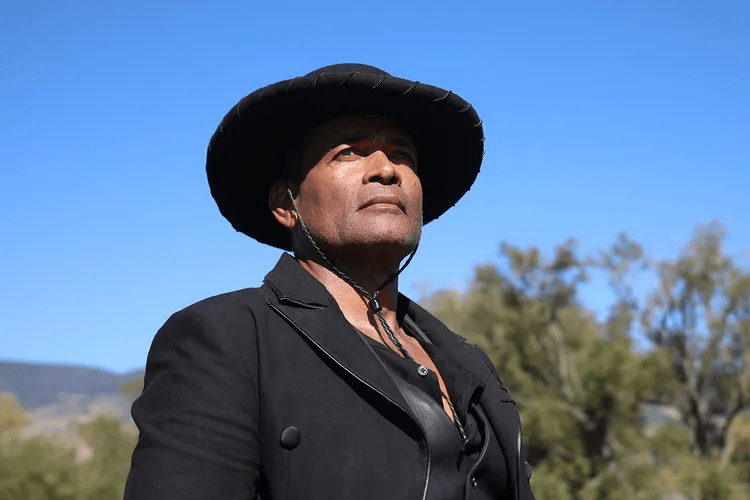
Mario Van Peebles’ “Outlaw Posse” is the latest attempt to correct the erasure of people of color from the classic cinema genre
Mario Van Peebles is a fundamentally American filmmaker. Born in Mexico to an African American father—the iconoclastic filmmaker, actor, musician and playwright Melvin Van Peebles—and a German mother, then raised in the United States and Europe, Van Peebles brought an international, mixed-heritage perspective with him when he followed in his dad’s professional footsteps. Speaking with Smithsonian magazine, Van Peebles gently brushes aside the suggestion that there’s anything particularly political about his latest project, the western Outlaw Posse. But the film, and the rich tradition of Black westerns in which it follows, begs to differ.
Set in 1908, Outlaw Posse stars Van Peebles—who also wrote, produced and directed the movie—as Chief, a formerly enslaved ex-soldier seeking to recover a cache of gold hidden by Confederates in the waning days of the Civil War. He wants the treasure so he can pay reparations to once-enslaved people who never got the 40 acres and a mule they were promised, but he’s frequently distracted by more recent injustices perpetrated against Black and Native people by white assailants, which Chief and his allies feel compelled by duty to redress.
The movie is a work of fiction, but it interpolates real people and events in fun ways. It co-stars Whoopi Goldberg as “Stagecoach Mary” Fields, the first Black woman to be employed as a Star Route mail carrier; a background actor makes a brief appearance as Jack Johnson, the first Black world heavyweight boxing champion. The movie also features a scene in which two members of Chief’s posse rob a bank while disguised as Butch Cassidy and the Sundance Kid, the real-life renegades immortalized by Paul Newman and Robert Redford, respectively, in the eponymous 1969 classic. The ruse requires a character played by D.C. Young Fly to don whiteface makeup and a blond wig. It’s a clever comment on the erasure of people of color that the western genre engaged in from its earliest days.
Outlaw Posse is Van Peebles’ second western, arriving 31 years after 1993’s Posse, a film set primarily in 1898, about a group of Buffalo Soldiers conscripted to fight in the Spanish-American War. (Despite the similar titles, the new movie is not a sequel.) “America made more westerns than any other genre of film,” the filmmaker says. “It’s a uniquely American product.”
When Posse premiered, westerns were also a decidedly unfashionable product. Though Clint Eastwood’s revisionist cowboy flick Unforgiven had won Best Picture at the most recent Academy Awards, few filmmakers were still working regularly in the genre by the early 1990s.
Van Peebles had just made a big splash with his first film as director, 1991’s New Jack City, a pulpy but undeniably powerful crime flick that felt urgent, energetic, contemporary and, well, Black. These descriptors weren’t ones that many people would’ve applied to westerns in that era. ButVan Peebles always believed in the genre’s elasticity. Indeed, he remembers discussing the subject with Eastwood—who’d just finished producing, directing and starring in the 1985 western Pale Rider—on the set of the actor-director’s 1986 war movie Heartbreak Ridge, in which Van Peebles played a young Marine serving in the same platoon as Eastwood’s more seasoned gunnery sergeant.
“It never occurred to me that I couldn’t be in a spaghetti western,” Van Peebles says, referencing the Italian-made movies popular during the 1960s and 1970s. “As a kid, I was just too ignorant, I guess, to think I couldn’t play that character or this character.” He took notice of Woody Strode, who’d played the title role in John Ford’s 1960 western Sergeant Rutledge, about a Black soldier falsely accused of the rape and murder of a white woman in 1880, and eventually cast the actor as the narrator of Posse.
“Later on, I understood I probably wouldn’t get to play those roles unless I wrote [the western] and produced it and directed it,” Van Peebles adds. “So I said, ‘OK, cool. Dad knows how to do that. I can learn how to do that, too.’”
That Van Peebles was enamored with a genre often perceived as conservative might come as a surprise given the radical nature of his father’s work. The younger director’s first screen credit came at age 14, when he appeared in his dad’s wild 1971 independent film, Sweet Sweetback’s Baadasssss Song. Melvin, who served as the movie’s writer, producer, director and editor, played the title role: a sex worker, renowned for his prowess, who is framed for murder by crooked police officers. So it made sense for Melvin to cast his own son in scenes set during the character’s youth—even though those very explicit sequences involved a barely adolescent Sweetback being relieved of his virginity in a brothel.
With its provocative storyline, impressionistic editing style, and memorable funk-soul soundtrack courtesy of Earth, Wind & Fire, Melvin’s movie is largely credited with inventing the blaxploitation genre, which offered (mostly) Black audiences an opportunity to cheer on Black heroes and antiheroes who outwitted and outfought (largely) white antagonists throughout the 1970s. (Few, if any, of the blaxploitation pictures that followed Sweetback were as formally experimental.)
Twenty years later, Van Peebles updated the genre with New Jack City, which examined how authorities had failed to address the crack epidemic in Ronald Reagan-era urban centers—Harlem, in this case. Critically and commercially, the 1991 movie was enough of a hit to put Van Peebles in a position to make any kind of film he wanted. His decision to follow it up with Posse surprised observers at the time. “People were saying, ‘It’s going to be Old Jack City, Boyz n the Saddle,” he recalls, laughing.
Though Outlaw Posse isn’t a sequel to Posse, it is another family affair. In Posse, Van Peebles starred opposite his father, Melvin; in Outlaw Posse, Van Peebles shares the screen with his son Mandela Van Peebles, who plays Chief’s estranged offspring. (The new film is dedicated to Melvin, who died in 2021.)
Despite efforts to make the genre more inclusive, the western remains haunted by the twin maladies of colonialism and white supremacy. Especially in the first half of the roughly 130 years that Americans have been going to the movies, many westerns reduced the complexities of 19th-century life to a conflict between Native Americans—often depicted as primitive and played by European actors—and white characters determined to “tame” the frontier.
“The real wild, wild West was super diverse,” Van Peebles says. “We were all there.”
Research suggests that about one in four ranch workers in the antebellum Southwest was Black. Even the term “cowboy” grew out of the racist practice of addressing Black men as “boy”; white laborers on ranches were typically called cowhands.
/https://tf-cmsv2-smithsonianmag-media.s3.amazonaws.com/filer_public/f4/49/f449f3b2-dab6-4b3e-a24a-cc63015f9841/photographic_postcard_portrait_of_an_early_20th_century_cowboy.jpeg)
/https://tf-cmsv2-smithsonianmag-media.s3.amazonaws.com/filer_public/0f/1e/0f1ecce6-4398-4397-8149-51e9179b8293/nat.jpg)
Westerns featuring predominantly Black casts were made during the 1930s, when movie theaters in many markets remained segregated. These films frequently featured actors Herb Jeffries and Spencer Williams Jr. For the most part, these 1930s westerns depicted at least their principal Black characters with dignity, though reductive comic stereotypes were present, too. Curiously, in the same way that many Black superheroes in later decades have the word “Black” in their names (think Black Panther and Black Lightning), these early Black westerns were frequently coded with the word “Harlem,” regardless of their setting: Between 1937 and 1939, Jeffries and Williams co-starred in Harlem on the Prairie, The Two-Gun Man From Harlem and Harlem Rides the Range.
It took another three decades for a Black artist to take the reins of a western. He only got the opportunity because he was one of the biggest stars in the world—and because he still had something to prove. Sidney Poitier had made history with 1963’s Lilies of the Field,becoming the first Black performer to win the Academy Award for Best Actor. By 1967, Poitier’s star had risen so high that critics began to accuse him of being too conciliatory and demure in his approach to racial politics. The actor was particularly wounded by a New York Times op-ed written by Black playwright Clifford Mason, who asked, “Why Does White America Love Sidney Poitier So?” Poitier himself grew frustrated that he was so often cast as a paragon of virtue, devoid of human foibles or desires.
In the early 1970s, singer Harry Belafonte, who was deeply involved in the civil rights movement, showed his longtime friend Poitier the script for Buck and the Preacher, a movie set just after the Civil War. The two artists agreed that the project would offer them an opportunity to play morally complex characters—and a platform from which to advocate for racial justice through entertainment.
In the movie, Belafonte and Poitier’s characters form an alliance with Native Americans to lead a wagon train of formerly enslaved people through Native territory. The group is hunted by white raiders hired by plantation owners who refuse to accept that they no longer have legal control over the destinies of Black people.
Though Black westerns had existed before Buck, this storyline—Black and Native Americans joining forces to oppose white supremacy—made the movie revolutionary, says Mia Mask, a film studies scholar at Vassar College and the author of Black Rodeo: A History of the African American Western. Buck only grew in cultural significance when producers and co-stars Belafonte and Poitier decided after a few days of shooting that the white director they’d hired, Joseph Sargent, wasn’t working out. Poitier replaced him, becoming both the first Black artist to helm a western and one of the first Black directors of a major studio film.
But when Buck reached cinemas in the spring of 1972, audiences struggled to connect with it, in part because of a revolution in Black cinema that Melvin had already helped to kick-start. With the release of Shaft the previous summer, Black audiences had responded rapturously to John Shaft, the lady-killing, leather-trench-coat-wearing private eye played by Richard Roundtree. Buck didn’t have Shaft’s contemporary urban setting or its Academy Award-winning Isaac Hayes theme song. And while Poitier and Belafonte gave strong performances, both playing against type, the simple fact they were both long-established stars by 1972 contributed to the superficial perception that Buck was old hat.
Though Mask says that Poitier, who died in 2022, would later cite Buck as one of his proudest achievements, the actor enjoyed greater commercial success when he turned to directing comedies. Stir Crazy, starring the popular comic duo of Gene Wilder and Richard Pryor, became the first film by a Black director to gross more than $100 million in ticket sales.
Film critic Aisha Harris says that in general, Black filmmakers can’t make westerns without their work being perceived as a political statement. (Harris is one of the four permanent hosts of NPR’s “Pop Culture Happy Hour” podcast, to which I am a contributor.) “The cross that a lot of Black filmmakers have had to bear is not just of making art, or great art, but also having to course correct for the hundreds of years of erasure,” she adds.
Black artists “can’t just make a western,” Harris says. “It has to have some kind of social or political edge to it. It has to be relevant to now. It has to be subversive.” She cites the decidedly not-subversive 2016 remake of The Magnificent Seven, the third collaboration between Black director Antoine Fuqua and star Denzel Washington, as the exception that proves the rule.
Harris has a fondness for a later trio of 1970s westerns that featured Fred Williamson and D’Urville Martin, Black stars who were making urban-set blaxploitation films at the same time that they were appearing in movies set in the Wild West. The pair’s westerns—including The Legend of Black Charley, a 1972 film whose original title, like those of its two sequels, contains a racial slur—were powered by Williamson’s charisma and the scripts’ modern dialogue. “They were talking like it was the time that they were in,” Harris says. “I really enjoy that. It feels transgressive, in a way.”
Mask points out that the Lone Ranger—a fictional white masked-vigilante whose adventures were chronicled on the radio, in film serials and on television from 1933 to 1957, and in various short-lived revivals since—was based on the real-life Black lawman Bass Reeves. Reeves was born into slavery but escaped as a young man and lived among the Cherokee, Creek and Seminole people; in 1875, he became one of the first Black men to be commissioned as a deputy U.S. marshal. Reeves was renowned for making thousands of arrests in his 34-year career as a lawman.
Not until more than a century after his death in 1910 would Reeves begin to be represented onscreen with any regularity. Delroy Lindo played Reeves in the 2021 Netflix western The Harder They Fall, which featured an all-Black principal cast. The streaming series “Lawmen: Bass Reeves,” starring British actor David Oyelowo as the legendary marshal, debuted in 2023, nine decades after the premiere of Reeves’ fictional white analogue’s radio program. In movies as in life, what goes around comes around. The year after Van Peebles appeared in Eastwood’s Heartbreak Ridge, he had a supporting part in Jaws: The Revenge. If film buffs remember that hilariously inept sequel at all, it’s for the trivial point that the fourth and final Jaws was the reason Michael Caine was unable to accept his Academy Award for Hannah and Her Sisters in person: On Oscars night in the spring of 1987, the venerable English star was on location in Martha’s Vineyard shooting what is almost certainly the worst film of his 60-year career. Behind the camera on Jaws: The Revenge was Sargent, the very man whom Poitier had replaced as Buck’s director some 15 years earlier.


/https://tf-cmsv2-smithsonianmag-media.s3.amazonaws.com/accounts/headshot/Sonja_headshot.png)
/https://tf-cmsv2-smithsonianmag-media.s3.amazonaws.com/filer_public/d5/86/d5867ccd-0b46-43b1-a539-d90af71e51bc/armchair_credit_20cdesign.jpeg)
/https://tf-cmsv2-smithsonianmag-media.s3.amazonaws.com/filer_public/52/36/52367129-e19c-4261-9e7f-b63dcf83acaa/directory_board.jpeg)



 HPS Magazine