Cooking Broke

Photo by Malidate Van on Pexels.com

Vegan Mushroom Stroganoff

Vegan Mushroom Stroganoff is creamy and packed with umami. You won’t believe it’s dairy-free and vegan!

Stroganoff is a classic Russian dish that features a creamy sauce with beef and mushrooms served over wide egg noodles. Vegan Mushroom Stroganoff omits the beef, ups the mushrooms, and uses coconut milk for a version that is just as creamy and satisfying. 

The coconut milk gives the dish an element of creaminess (don’t worry, it doesn’t have a strong coconut flavor). The mushrooms are meaty and full of umami. The garlic, thyme, and sage add complexity and bring the dish together. It’s both healthy and indulgent. 

This is the perfect comfort food for a cold winter day. It is easy to make and comes together in just 45 minutes, so it makes for a great weeknight dinner.

All About the Mushrooms

I love to use mushrooms as a satisfying alternative to beef because of their meaty tender texture and umami. They are porous, so they can soak up a lot of flavors as they cook. Here are some things to consider when choosing, prepping, and cooking mushrooms:

Buying mushrooms: Mushroom stroganoff is usually made with baby bella mushrooms. When buying mushrooms, choose ones that feel firm, have a smooth cap, and aren’t slimy. Shiitake and portobello mushrooms would also work here. 

Cleaning mushrooms: Mushrooms are very porous, so they can soak up water and become soggy if you wash them with water. Instead of rinsing your mushrooms under water, I recommend wiping them off with a damp paper towel.

Adding salt: Add salt to the mushrooms after they are fully cooked. This results in mushrooms with a meatier texture and more concentrated flavor.

Crowding the pan: When cooking your mushrooms, make sure not to overcrowd the pan because this will prevent the mushrooms from searing and reaching optimal texture. You want each mushroom slice to touch the pan.

How to Buy and Store Mushrooms

READ MORE:

Mushroom stroganoff in bowl with fork.
Simply Recipes / Hannah Zimmerman

Picking the Best Ingredients

This recipe comes together very quickly and is great for a beginner vegan cook, but it is still important to use the right ingredients to make sure it comes out perfect. Here are some of my suggestions:

  • Use a dry white wine, like Pinot Grigio or Sauvignon Blanc. Sweet white wines (like Rieslings) may caramelize and add unwanted sweetness. Oaky white wines (like certain Chardonnays) become bitter when reduced. 
  • Classic stroganoff is made with short egg noodles. For this vegan recipe, I would recommend a short pasta like rotini or farfalle, rather than a long pasta like fettuccine or spaghetti, to replicate the texture of egg noodles.
  • Use full-fat coconut milk rather than lite coconut milk for maximum creaminess.

Ways to Adapt This Recipe

This recipe can be adapted to fit your dietary restrictions and preferences. Here are some ideas:

  • To make this recipe gluten-free, use an all-purpose gluten-free flour blend to thicken the sauce and serve the mushroom sauce over gluten-free pasta or rice. 
  • If you want more protein, you can add frozen peas. Stir them in after seasoning the sauce with salt and black pepper, while the stroganoff is still hot.
  • Instead of coconut milk, you can use vegan sour cream. I recommend a brand called Follow Your Heart.
  • If you do not want to add wine, you can add an additional 1/4 cup of vegetable stock.
Two bowls of creamy mushroom stroganoff.
Simply Recipes / Hannah Zimmerman

Serving Suggestions

Vegan Mushroom Stroganoff is a rich meal, so try serving it with light vegetables, like roasted broccoli, steamed green beans, or a simple salad. I’d pair this dish with a full-bodied red wine, like Cabernet Sauvignon, Merlot, or Malbec.

Make It Ahead, But Store Separately

Vegan Mushroom Stroganoff can be made ahead and stored in an airtight container in the fridge for two to three days. But! Store the mushroom sauce separate from the pasta. 

When you are ready to serve, heat the mushroom sauce on the stove over low heat for 3 to 5 minutes, until smooth and warm. Once the sauce is warmed through, add the pasta, stir, and let it heat for 2 to 3 minutes.

Vegetarian mushroom stroganoff in skillet.

Vegan Mushroom Stroganoff

PREP TIME20 mins

COOK TIME25 mins

TOTAL TIME45 mins

SERVINGS6 to 8 servings

Ingredients

  • 1 pound dried short pasta, like rotini or farfalle
  • 3 tablespoons olive oil
  • 1 small white onion, diced
  • 3 cloves garlic, minced
  • 1 pound baby bella mushrooms, stems trimmed and sliced
  • 2 teaspoons fresh thyme leaves (about 2 sprigs), plus more for garnish
  • 1 teaspoon chopped fresh sage, plus more for garnish
  • 3 tablespoons all-purpose flour
  • 1/3 cup dry white wine, like Sauvignon Blanc
  • 1 cup low-sodium vegetable stock
  • 2 tablespoons vegan Worcestershire sauce
  • 1/2 cup full-fat coconut milk
  • 1/2 teaspoon salt, plus more for salting pasta water
  • 1/4 teaspoon freshly ground black pepper, plus more to taste

Method

  1. Cook the pasta:Fill a large pot with water and a generous amount of salt. Bring it to a boil over high heat. Add the pasta and cook according to package instructions. Drain the pasta into a colander set in the sink. Set it aside.
  2. Cook the vegetables:Set a large skillet over medium heat. Add the olive oil and onions, and sauté for 5 to 7 minutes until the onions are translucent. Add the garlic and mushrooms, and sauté for 5 to 8 minutes, until the mushrooms are browned and tender. Stir in the thyme and sage, and cook for an additional minute until fragrant.Mushrooms cooking in skillet.
  3. Add the flour, wine, broth, and Worcestershire sauce:Sprinkle the flour over the mushrooms and cook for 1 minute, stirring constantly with a rubber spatula to incorporate. Then pour in the white wine, vegetable stock, and Worcestershire sauce, and stir to combine. Bring the mixture to a simmer for 5 minutes.Mushroom in creamy sauce for vegetarian stroganoff.
  4. Stir in the coconut milk:Pour the coconut milk into the sauce and stir until just combined. Season with salt and black pepper. Taste and adjust seasoning with more salt and black pepper if needed.Creamy mushroom sauce with coconut milk.
  5. Serve:Stir the pasta into the sauce, divide among serving plates, and garnish with more thyme and sage if you’d like. Bowls of vegetarian stroganoff with mushrooms.
NUTRITION FACTS(PER SERVING)
207CALORIES
9gFAT
26gCARBS
5gPROTEIN

 Show Full Nutrition Label

Nutrition information is calculated using an ingredient database and should be considered an estimate. In cases where multiple ingredient alternatives are given, the first listed is calculated for nutrition. Garnishes and optional ingredients are not included.

Monkeypox vs. COVID-19 

Photo by Artem Podrez on Pexels.com

Although the sudden emergence of monkeypox can be alarming after over two years of living through the COVID-19 pandemic, monkeypox is not a new virus and does not spread in the same way as COVID-19. The table below shows a comparison of monkeypox and COVID-19.  

FAQMonkeypoxCOVID-19
How widespread is it?Typically found in or linked to central and western African countries.  Since May 2022, cases have been identified in many other countries, including the U.S. However, monkeypox is much less common than COVID-19. While it’s good to stay alert about emerging public health outbreaks, the current risk of getting monkeypox in the general public is very low.   Hundreds of millions of cases since the start of the pandemic in early 2020, and still spreading widely throughout the world. 
When was it first identified?Not a new virus – around since 1958.A novel virus – around since 2019.
How does it spread?By very close and/or prolonged contact with someone with symptoms, including through: 
Close physical/intimate skin-to-skin contact, including sex 
Contact with contaminated materials (towels, bedding and clothing) Respiratory droplets spread by close and prolonged face-to-face interaction Monkeypox is much less contagious than COVID-19. 
Through tiny droplets in the air by breathing, talking, sneezing, or coughing. It is extremely infectious. Can spread from others who have the virus, even if they don’t have symptoms. 
 
What are the signs and symptoms?Rash with firm bumps on face, hands, feet, body, or genitalsFeverSwollen lymph nodesChillsLow energyFeverCoughTrouble breathingStomach issuesHeadaches
Muscle aches
Loss of taste and smell
Cold symptoms
How is it prevented?Avoid close physical contact with people who have symptoms, including sores or rashes Talk to your sexual partner/s about any recent illness and be aware of new or unexplained sores or rashes Avoid contact with , contaminated materials Wear PPE (mask, gloves, gown) if you can’t avoid close contact with someone who has symptoms Practice good hand hygiene Get vaccinated and boosted Wear a mask in indoor settings and crowded outdoor settings Meet others outdoors or in well ventilated spaces  
Are there variants?
 
All viruses change and evolve over time. However, the monkeypox virus mutates slower than coronaviruses.   
There are two known families or “clades” of monkeypox virus. The clade recently identified in Europe, Canada, and in the United States is the West African clade, which tends to cause less severe disease.
There are many variants of SARS-CoV-2 (virus that causes COVID-19).  This virus mutates rapidly. 
If you have symptomsAlways stay home if you’re sick Cover any blisters or skin lesions Isolate from others and wear a mask if you have to be around others Contact a health care provider right away to talk about diagnosis, testing, and treatment optionsAlways stay home if you’re sick Get tested. If you test positive, isolate from others Contact a health care provider right away to talk about treatment options

As inflation rises, low-income households grapple with particular challenges

Low- and moderate-income individuals in the Ninth District share their perspectives on increasing prices

Photo by maitree rimthong on Pexels.com

ederal Reserve Bank of Minneapolis staff held six listening sessions around Minnesota and South Dakota earlier this year to increase our understanding of inflation’s effects on households and communities with limited economic resources. This article highlights what we learned by talking to about 50 residents of the Ninth Federal Reserve District. Their experiences affirm and provide important insights into economic data that highlight the ways inflation can have larger impacts on households with low incomes.

Outreach efforts can inform monetary policy

When people talk about the Fed’s role in “setting interest rates,” they’re referring to the Federal Open Market Committee (FOMC), the group of senior Federal Reserve System leaders that meets every six weeks to vote on decisions about monetary policy. Presidents from every regional Federal Reserve Bank participate in the FOMC’s deliberations and take turns filling four of the 12-member committee’s seats.

Federal Reserve Board economists regularly brief the FOMC about the state of the economy, and economists from the Federal Reserve Banks contribute to this process. At President Neel Kashkari’s request, the Minneapolis Fed has diversified its sources of information on the economy, such as the Beige Book, that ultimately help inform the FOMC’s understanding of economic conditions. This practice yields more insights into how big-picture economic trends translate to Main Streets and kitchen tables across the Ninth District and the nation as a whole.

As part of his effort to broaden the sources of information we utilize to understand the economy, President Kashkari has incorporated new outreach work by the Minneapolis Fed’s Community Development and Engagement team. The listening sessions discussed here are part of that outreach.

Higher wages (and harder work), but no added economic security

For the past seven years, hourly pay increased most quickly for workers paid the lowest wages. Meanwhile, prices rose for everyone.

Have increasing wages left low-income households feeling better off economically, even with rising prices? For many of our listening session participants, the answer was a firm “no.”

About the listening sessions

The Community Development and Engagement (CDE) team at the Minneapolis Fed organized six listening sessions in the late spring and early summer of 2022 to hear about inflation firsthand from individuals from households with low and moderate incomes. Each session involved six to 13 individuals. Ten participants communicated via a professional translator. CDE staff posed a set of standardized questions to the groups to guide an open-ended conversation.

The sessions were put together in partnership with:

The Center for Indian Country Development at the Minneapolis Fed, which facilitated a conversation about inflation among its Leadership Council;

HIRED, a nonprofit workforce center in Minnesota;

Lakota Funds, a Native community development financial institution that organized a listening session on the Pine Ridge Reservation in South Dakota;

Rock Ridge Early Childhood Programs, a school-district-based early childhood program serving three communities in the Iron Range region of northeastern Minnesota;

SEIU Local 26, a labor union representing 8,000 janitors, security officers, and window cleaners in Minnesota; and

Southwest Initiative Foundation, a community foundation serving 18 counties and two Native American nations in southwestern Minnesota.

“I work seven days a week to cover my expenses,” said a participant who drives passengers at an airport. “Before, I used to work 40 hours a week. Now it’s taking me 70 hours just to cover my expenses, at two different companies.”

“People don’t realize that [Minnesota law] sets the minimum wage so it goes up with inflation, but the prices keep changing after they raise the wage,” said one worker in the child care sector. “You’re behind the curve, stuck in a box.”

Some participants received raises or had switched jobs to access higher wages but explained that their new earnings went to pay for necessities. Union members explained that their contracts last several years—and negotiated wage increases are not pegged to inflation.

“We get a raise, but then the cost of everything goes up, so it feels the same,” said one union worker. “It’s like you can’t win.”

Some participants felt their ability to increase their earnings by taking higher-paying jobs was limited due to time or resource constraints. Caregivers—those responsible for children, elderly relatives, or others—seemed particularly likely to describe constraints on their economic mobility.

Some parents described the havoc to their schedules caused by their inability to access reliable child care, a problem made worse by the pandemic. Other parents described the employment challenges they faced because of pandemic-related school and child care closures, unreliable school bus service related to driver shortages, and the need to care for sick children or adult family members.

“Child care cuts into my income and if it’s not available , then I can’t go to work. I feel like I’m struggling to get going at all,” said one participant.

A lot of our child care providers shut down during COVID and haven’t come back,” said another. “The ones that are operating are always full.”

Transportation was another oft-cited barrier to higher wages. Rural listening session participants noted that the price of gasoline and a lack of access to reliable vehicles limits people’s ability to find and keep work in the first place. The impact of high gasoline prices on work weren’t limited to rural areas, though.

A substitute teacher in an urban area said they have shrinking options for work sites—a long drive is now too expensive relative to their wages. A former home health aide was required to drive to her clients’ homes in her own vehicle. She quit because her employer did not increase her travel reimbursement, even as gas prices continued to climb. Some workers, like janitors, said they have to pay for work-related costs beyond transportation. The price of these supplies has also gone up, without a corresponding wage increase.

Participants also felt the impact of another much-discussed labor market trend: the shortage of employees. Some workers felt they were being asked to do more at the workplace while treading water financially. “Sometimes I can’t take my break because of all the work I have to do,” said one janitor.

Another added that her employer was trying to cut company costs by requiring the same amount of work in fewer hours. “[My employer] tried to cut my hours, but I wouldn’t let them,” she said. “I told them it isn’t possible [to clean everything I need to] in less time. I physically can’t work any harder. So I was adamant and said no.”

Few options, tough choices when facing higher prices

One way economists expect consumers to react to higher prices is by substituting cheaper alternatives for their usual goods. Data show that higher-income households can find more savings than lower-income households using this approach.

For example, grocery shoppers with higher incomes might usually buy brand-name packaged food, premium cuts of meat, and organic produce. These shoppers can save money by switching to a store brand, cheaper proteins, or conventional produce when they fill their carts.

People with low incomes have fewer options: in many cases, they were already buying the cheapest brands before inflation took off. And inflation did not pass over low-cost retailers, either—as we heard in every listening session, the term “dollar store” is no longer accurate.

From May 2021 to May 2022, food prices increased by 10 percent. Unsurprisingly, grocery bills were the first thing on many of our participants’ minds when we asked them where they’d noticed higher prices.

“When money was tight, we used to say, ‘We’ll just get beans and eggs, we’ll be fine,’” said one working mother. “Now, you can’t even get eggs. We can’t even afford to get a bag of Maseca [to make our own tortillas].”

The increased price of gasoline further limited opportunities to save money because it reduced the value of taking multiple trips to access the best prices across different stores. This was particularly important for residents of rural areas and reservations, where gas prices prevented shoppers from driving a long distance to access the lower grocery prices in urban areas.

When money was tight, we used to say, “We’ll just get beans and eggs, we’ll be fine.” Now, you can’t even get eggs. We can’t even afford to get a bag of Maseca [to make our own tortillas].

—A WORKING MOTHER

I was thinking about moving in July. Prices were $1,800 to $2,100 for a unit with everything that I need. They were $1,500 last year, maybe $1,450. There are still some cheaper units out there, but it’s really competitive [to lease one].

—A RENTER

When it came time to renew my car insurance, it went up $80 a month. The only reason they gave me was, “everything is going up.” Everything stayed the same in the policy except the price.

“I only drive to get basic necessities, maybe a couple times a month,” said one participant. “If I have the gas money to go to [the city to shop], I go. If I don’t, I stay. [The uncertainty] is scary.”

Some participants have changed their diets in order to save money. Canned fruits and vegetables are taking the place of fresh produce. Others are supplementing their purchased food by growing a garden.

Renters in our meetings said the housing market also stressed their finances. Many felt their rents were too high to allow them to save. Others doubled up, combining households to try to save money—an approach that could be stressful for families with older members during the pandemic.

Some felt stuck in place: if they wanted to leave their current rental, they expected they’d have to pay much more for similar housing. These comments reflect increases to the Consumer Price Index, one frequently used tool for measuring inflation. Urban renters are paying an estimated 8 percent more in May 2022 than in March 2020. Zillow reports that the median rents for all listings—in other words, for listings that include rental prices offered to new tenants or for newly constructed rental units—have increased by more than twice that over the same period, indicating that prices are likely to continue to rise. Even before any price increases in the rental market, households with low incomes spent a greater share of their money on rent than households with higher incomes.

“I was thinking about moving in July,” said one renter. “Prices were $1,800 to $2,100 for a unit with everything that I need. They were $1,500 last year, maybe $1,450. There are still some cheaper units out there, but it’s really competitive [to lease one].”

Beyond their grocery and rent expenses, people described the stress caused by price increases on other essentials like car insurance premiums, auto repairs, and utilities. The Internet was described as a new necessity for families with children participating in distance learning. Most people felt the narrow options for such essentials provide them with little wiggle room. Some began performing their own car and home maintenance with the help of online do-it-yourself videos.

When costs for necessities increased, the reasons why weren’t always clear.

“When it came time to renew my car insurance, it went up $80 a month,” said one participant. “The only reason they gave me was, ‘everything is going up.’ Everything stayed the same in the policy except the price.”

With few options to limit the costs of necessities, many participants described efforts to cut out “nonessential” spending. In some cases, this meant ending a subscription to a streaming service, avoiding meals at restaurants, or skipping makeup. Other cutbacks were described as having a larger impact on participants’ well-being. People skipped visits to loved ones, told children they could no longer participate in extracurricular activities, and, for immigrant families, reduced the amount of money they sent to relatives in their country of origin.

Safety net isn’t catching all struggling households

Several participants in each session described frustrations in trying to access public benefits intended to support economically struggling families.

First, funding limits mean that safety net programs that subsidize household costs for child care and housing simply were not available to all eligible people. For example, there are waiting lists for subsidized housing or housing vouchers in many housing markets in the Ninth District. And in many places, programs that provide or subsidize child care, or assist with energy expenses, have similar waitlists or shortfalls.

Second, income-eligibility limits do not necessarily reflect recent changes to the cost of basic necessities. While some federal and state programs do have eligibility limits tied to an inflation-sensitive measure, such as the federal poverty level, these programs are typically adjusted annually instead of at intervals throughout the year. Some participants noted that recent price increases led them to apply for public assistance for the first time. Several were surprised to learn that they were ineligible for any form of assistance despite feeling like they were living paycheck to paycheck.

“We earn a paycheck and try to apply for government services, but we’re denied because we make too much—but we’re barely making enough to support ourselves,” said one working father. “How does the government come up with these thresholds? How does the government decide that we make too much to be accepted when we can barely afford to live?”

Third, the level of public benefits (and other sources of income, like child support payments) may not automatically adjust to reflect the increased price of basic necessities, either. Like income eligibility, some programs feature automatic adjustments to the financial resources they provide. Others do not.

In this way, inflation decreased the ability of cash-like programs like the Supplemental Nutrition Assistance Program to help families meet their needs. It also affected medical benefits. For example, participants noted that in the past, dentists were often reluctant to serve people using public health insurance because of low reimbursement rates. Dentists were even less likely to do so now that inflation had further decreased the value of those reimbursements.

“Our old dentist retired and I can’t find someone in town who [will accept public dental insurance],” said one father. “I had to drive [three hours each way] to get my son’s teeth fixed. It’s cheaper to miss a day of work and drive that far than it would be to pay out of pocket.”

Finally, several people noted that they made decisions about whether to work more or pursue higher-paying jobs based on the potential impact on eligibility for public benefits. These participants estimated that they would actually be worse off if they worked more. In some cases, their overall income may be lowered as a result of the trade-off between private income and public assistance. In others, the trade-off might be worth it economically but feel too risky in an uncertain job market.

“I work part-time but if I work more I start to lose benefits and it isn’t worth it [financially],” said one woman. “Just when you’re starting to get ahead, they cut you down.”

“I can’t work more than a certain number of hours or my Social Security benefits will go down,” said one working mother who lost her husband to COVID-19. “I want to work more to give more to my kids, but I feel like I can’t.”

A frustrating inability to save

Data show that families with limited economic resources generally devote a majority of their income to necessities. Across all the listening sessions, participants made it clear that they were constantly evaluating opportunities to save money and trim excess expenditures.

“I know I can get to school and back 22 times in a month. I can afford that,” said one mother. “But if my kids get sick [and I have to make extra trips to pick them up], I’m going to struggle. Then it’s like a domino effect. Should I pay $5 to get gas or to buy food?”

For the most part, participants said pandemic-related relief was helpful. A few people in each session were well-informed about local efforts to distribute federal relief in forms such as scholarships, energy assistance, and work opportunities. Free food, delivered via nonprofits and churches, was described as particularly important.

“I know when all the free, hot meals are available [in our area], and I’d go to each one. They helped a lot,” said one mother. “On weekends [when these resources were unavailable], it was harder to feed my children.”

We earn a paycheck and try to apply for government services, but we’re denied because we make too much—but we’re barely making enough to support ourselves. How does the government come up with these thresholds? How does the government decide that we make too much to be accepted when we can barely afford to live?

—A WORKING FATHER
I can’t work more than a certain number of hours or my Social Security benefits will go down. I want to work more to give more to my kids, but I feel like I can’t.

—A MOTHER WHO LOST HER HUSBAND TO COVID-1

’m a penny pincher anyway, but when we got the [temporarily expanded] Child Tax Credit, I put it all in savings. That’s what we’ve been falling back on.

—AN UNEMPLOYED FATHER
My dream is to save up money and buy a house. But if rent keeps going up, I can’t save to buy one.

—A CHILD CARE WORKER

Some participants increased their savings by selling assets, like older cars that have risen in value due to pandemic-fueled demand. Others were able to save the dollars that came their way from federal or state efforts to support households directly, like the temporary increase to the Child Tax Credit.

“I’m a penny pincher anyway, but when we got the [temporarily expanded] Child Tax Credit, I put it all in savings,” said one unemployed father. “That’s what we’ve been falling back on.”

Several participants described their frustration at an inability to put money away or build equity despite such efforts. Some described homeownership as an opportunity to reduce monthly expenses, since mortgage payments are largely fixed over time, while rents typically rise year to year. Several participants noted that mortgage payments for a single-family home may be lower than market-rate rents for apartments in their area.

However, an inability to save enough for a down payment frustrated some renters’ desires to own a home. “[Lenders] tell me I can’t get a loan for a $900 mortgage payment, but I’m paying $2,100 a month for rent,” said one mother who was juggling part-time college, caring for her elderly parents, and working full-time. “How does that make sense?”

“My dream is to save up money and buy a house,” said one child care worker. “But if rent keeps going up, I can’t save to buy one.”

Little optimism or faith in institutions

Of the dozens of people who attended our listening sessions, only a handful expressed optimism about the future. Participants with a positive view of the future generally felt that things would improve if the pandemic winds down, if the war in Ukraine ends, or if companies are able to resolve supply chain issues.

However, most people felt that the cost of living would continue to outpace their income. While most acknowledged the challenges caused by current supply chain snarls, they also felt that their employers, private industry, and others were exploiting the situation.

“People say the prices are going to go down. But they aren’t, because [distributors] don’t want them to,” said one laid-off Twin Cities area resident. “We may get raises but those prices will never come down.”

“Even if they raise our wages—which I doubt will happen—I feel like these companies we work for just don’t care,” said one mother who worked as a cleaner. “I think the price increases should really worry us. There must be a way to do something about it. Otherwise, it’s all a hopeless future.”

For these participants, recent experiences with inflation were not described as a break from the norm. Instead, inflation was the latest challenge in a series of economic hardships, inseparable from the continued impacts of the pandemic.

More for us to learn

No two people experience inflation in the exact same way. A dollar’s mileage varies depending on a household’s regular expenses and consumption choices, but also on just plain luck. If a household’s vehicle suddenly broke down in 2021 instead of in 2020, for example, the costs of replacing it were likely much higher.

This isn’t news. A growing number of economists, including some within the Federal Reserve System, are investigating different angles for measuring and analyzing inflation. Researchers are also producing new work about different aggregate inflation levels across demographic groups. Outreach efforts like those described here—and undertaken by our peers at other Federal Reserve Banks—are informed by and complement these analyses. Collectively, the work of Federal Reserve economists and outreach staff will improve our understanding of the health of the economy and the financial well-being of different types of households and communities, and that understanding will inform the FOMC’s decisions.

Minneapolis Fed staff will continue to convene listening sessions in the Ninth District to discuss inflation. We will post what we’ve learned from our next round of meetings in the fall.

or these [listening session] participants, recent experiences with inflation were not described as a break from the norm. Instead, inflation was the latest challenge in a series of economic hardships, inseparable from the continued impacts of the pandemic

By: Ben Horowitz Project Director, Community Development and Engagement


Alene Tchourumoff
Senior Vice President, Community Development and Engagement

2022 Federal Poverty Guidelines / Federal Poverty Levels

Photo by Pixabay on Pexels.com

The 2022 Poverty Guidelines, commonly referred to as the Federal Poverty Level (FPL), follow in the tables below. Note that these amounts change based on the number of individuals in the household and the state in which one resides.

Federal Poverty Levels are used by many assistance programs, including some states’ Medicaid programs, as a way to set financial eligibility criteria. Often programs limit participant’s income to 100% of the FPL, or some percentage of the FPL, such as $138% or 200%.

2022 Poverty Guidelines – Annual

48 Contiguous States and D.C.

Persons in Household48 Contiguous States and D.C. Poverty Guidelines (Annual)
100%133%138%150%200%250%300%400%
1$13,590$18,075$18,754$20,385$27,180$33,975$40,770$54,360
2$18,310$24,352$25,268$27,465$36,620$45,775$54,930$73,240
3$23,030$30,630$31,781$34,545$46,060$57,575$69,090$92,120
4$27,750$36,908$38,295$41,625$55,500$69,375$83,250$111,000
5$32,470$43,185$44,809$48,705$64,940$81,175$97,410$129,880
6$37,190$49,463$51,322$55,785$74,380$92,975$111,570$148,760
7$41,910$55,740$57,836$62,865$83,820$104,775$125,730$167,640
8$46,630$62,018$64,349$69,945$93,260$116,575$139,890$186,520
For each person over 8 add:$4,720$6,277$6,514$7,080$9,440$11,800$14,160$18,880

Alaska

Persons in HouseholdAlaska Poverty Guidelines (Annual)
100%133%138%150%200%250%300%400%
1$16,990$22,597$23,446$25,485$33,980$42,475$50,970$67,960
2$22,890$30,444$31,588$34,335$45,780$57,225$68,670$91,560
3$28,790$38,291$39,730$43,185$57,580$68,625$86,370$115,160
4$34,690$46,138$47,872$52,035$69,380$86,725$104,070$138,760
5$40,590$53,985$56,014$60,885$81,180$101,475$121,770$162,360
6$46,490$61,832$64,156$69,735$92,980$116,225$139,470$185,960
7$52,390$69,679$72,298$78,585$104,780$130,975$157,170$209,560
8$58,290$77,526$80,440$87,435$116,580$145,725$174,870$233,160
For each person over 8 add:$5,900$7,847$8,142$8,850$11,800$14,750$17,700$23,600

Hawaii

Persons in HouseholdHawaii Poverty Guidelines (Annual)
100%133%138%150%200%250%300%400%
1$15,630$20,788$21,569$23,445$31,260$39,075$46,890$62,520
2$21,060$28,010$29,063$31,590$42,1200$52,650$63,180$84,240
3$26,490$35,232$36,556$39,735$52,980$66,225$79,470$105,960
4$31,920$42,454$44,050$47,880$63,840$79,800$95,760$127,680
5$37,350$49,676$51,543$56,025$74,700$93,375$112,050$149,400
6$42,780$56,897$59,036$64,170$85,560$106,950$128,340$171,120
7$48,210$64,119$66,530$72,315$96,420$120,525$144,630$192,840
8$53,640$71,341$74,023$80,460$107,280$134,100$160,920$214,560
For each person over 8 add:$5,430$7,222$7,494$8,145$10,860$13,575$16,290$21,720

2022 Poverty Guidelines – Monthly

48 Contiguous States and D.C.

Persons in Household48 Contiguous States and D.C. Poverty Guidelines (Monthly)
100%133%138%150%200%250%300%400%
1$1,133$1,506$1,563$1,699$2,265$2,831$3,398$4,530
2$1,526$2,029$2,106$2,289$3,052$3,815$4,578$6,103
3$1,919$2,552$2,648$2,879$3,838$4,798$5,758$7,677
4$2,313$3,076$3,191$3,469$4,625$5,781$6,938$9,250
5$2,706$3,599$3,734$4,059$5,412$6,765$8,118$10,823
6$3,099$4,122$4,277$4,649$6,198$7,748$9,298$12,397
7$3,493$4,645$4,820$5,239$6,985$8,731$10,478$13,970
8$3,886$5,168$5,362$5,829$7,772$9,715$11,658$15,543
For each person over 8 add:$393$524$543$590$786$983$1,180$1,573

Alaska

Persons in HouseholdAlaska Poverty Guidelines (Monthly)
100%133%138%150%200%250%300%400%
1$1,416$1,883$1,954$2,124$2,832$3,540$4,248$5,663
2$1,908$2,537$2,632$2,861$3,815$4,769$5,723$7,630
3$2,399$3,191$3,311$3,599$4,798$5,998$7,198$9,597
4$2,891$3,845$3,989$4,336$5,782$7,227$8,673$11,563
5$3,383$4,301$4,668$5,074$6,765$8,456$10,148$13,530
6$3,874$5,153$5,346$5,811$7,748$9,685$11,623$15,497
7$4,366$5,807$6,025$6,549$8,732$10,915$13,098$17,463
8$4,858$6,460$6,703$7,286$9,715$12,144$14,573$19,430
For each person over 8 add:$492$654$678$738$983$1,219$1,475$1,967

Hawaii

Persons in HouseholdHawaii Poverty Guidelines (Monthly)
100%133%138%150%200%250%300%400%
1$1,303$1,732$1,797$1,954$2,605$3,256$3,908$5,210
2$1,755$2,334$2,422$2,633$3,510$4,388$5,265$7,020
3$2,208$2,936$3,046$3,311$4,415$5,519$6,623$8,830
4$2,660$3,538$3,671$3,990$5,320$6,650$7,980$10,640
5$3,113$4,140$4,295$4,669$6,225$7,781$9,338$12,450
6$3,565$4,741$4,920$5,348$7,130$8,913$10,695$14,260
7$4,018$5,343$5,544$6,026$8,035$10,044$12,053$16,070
8$4,470$5,945$6,169$6,705$8,940$11,175$13,410$17,880
For each person over 8 add:$452$602$625$679$905$1,132$1,357$1,810

Importance of Poverty Guidelines / What These Numbers Mean

Many state programs that offer financial assistance to elderly or disabled individuals use the Federal Poverty Levels to calculate their annual or monthly income limits for program eligibility. As mentioned above, some states’ Medicaid programs also use these limits, or a percentage thereof, to determine eligibility for different constituent groups. (These groups can include the Aged, Blind or Disabled, Children Under 18, or Pregnant Women).

The Department of Health and Human Services publishes this information and updates it each January for the current year. The numbers are based on data collected by the U.S. Census Bureau.

Note that there is little difference between the Federal Poverty Guidelines and the Federal Poverty Levels.  Therefore, throughout this article, these terms are used interchangeably. However, these guidelines should not be confused with the Federal Benefit Rate (FBR) / Supplemental Security Income (SSI) Limit.

Did You Know?

The Federal Poverty Level (FPL) is a measurement of the minimum amount of annual income that is needed for individuals and families to pay for essentials, such as room and board, clothes, and transportation. The FPL takes into account the number of people in a household, their income, and the state in which they live. On the other hand, the Federal Benefit Rate, a monthly cash benefit, is the maximum payment that an aged, blind or disabled adult can be paid via Supplemental Security Income.

As a point of reference, at the time of this writing, the annual FPL for a household of one is $12,880 ($1,073 / month). And the maximum annual SSI benefit amount for a single individual is $9,528 ($794 / month). As with the FPL, many assistance programs use SSI figures to determine if an applicant is income eligible. While a percentage of the FPL is often used to determine income eligibility for categorically aged, blind and disabled Medicaid, a percentage of the FBR is often used to determine if one is income eligible for a Home and Community Based Services (HCBS) Medicaid waiver or nursing home Medicaid.

BY: Payingforseniorcare.com

Rising Rents and Inflation Are Likely Increasing Low-Income Families’ Risk of Homelessness

Photo by SevenStorm JUHASZIMRUS on Pexels.com

Throughout the pandemic, many households have continued to struggle with housing insecurity.

Rising rents and persistent inflation increase the risk for people becoming homeless and serve as barriers to people who are trying to exit homelessness. In a 2020 study, researchers at the U.S. Government Accountability Office estimated that “a $100 increase in median rent was associated with a 9% increase in the estimated homelessness rate.”1 New research sheds light on the precariousness of people’s housing situations in the midst of historically high rent prices and inflation, which may lead to increases in homelessness if left unchecked.

Rent Inflation is a Concern

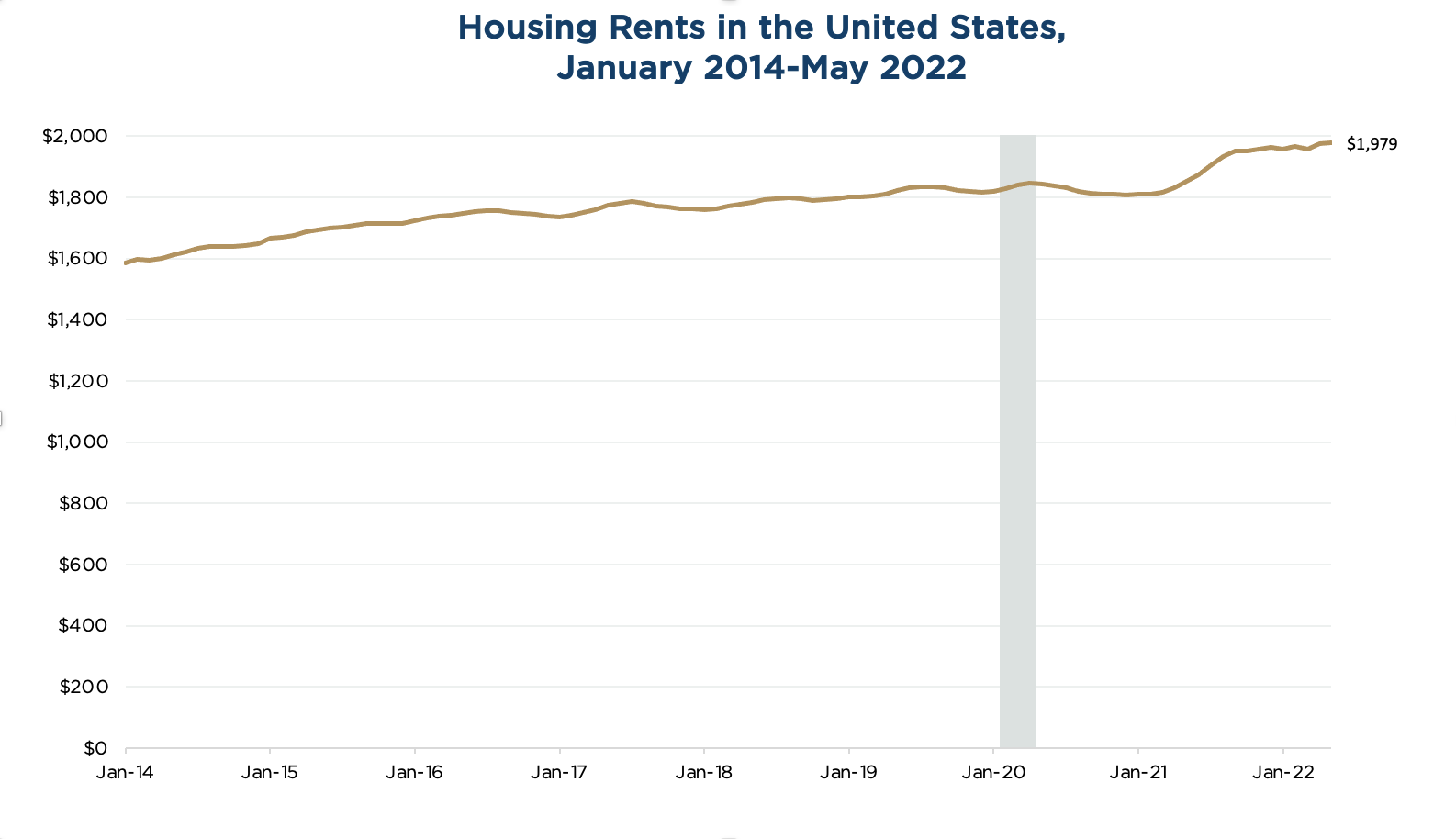
Chart showing how housing rents in the United States have risen every year between January 2014 and May 2022

Source: Zillow Observed Rent Index (ZORI) (Seasonally adjusted); U.S. Bureau of Labor Statistics Consumer Price Index for All Urban Consumers (Seasonally adjusted); NAEH analysis. Recession data are from the National Bureau of Economic Research (NBER).

Rental prices have increased substantially, especially in the past year. In inflation-adjusted terms, the Zillow Observed Rent Index (ZORI)2 reports that the median rent increased by 15.9 percent in the last 12 months nationwide (ending in May 2022) and increased across all housing types. This increase is apparent in the graph above: rents were steadily increasing from January 2014 until January 2021, followed by a noticeable spike in rental costs.

While this increase occurred nationwide, certain areas took a harder hit. California cities San Jose, San Francisco, and Ventura led the nation with median rents exceeding $3,000/month, as of May 2022. However, the greatest increases in rent were concentrated in Florida, where rents rose more than 30 percent in Fort Meyers, Miami-Fort Lauderdale, and North Port-Sarasota-Bradenton within the span of the same year.

How Inflation Impacts the Ability to Pay for Housing

These staggering rent increases are happening as a broader inflation wave has hit the country. Inflation reached a 40-year peak of 8.6 percent from May 2021 to May 2022. Increased spending on essentials such as food, energy, transportation, and health care may cause households to fall behind on housing payments.

Inflation also limits households’ buying power as prices have been rising faster than income. The U.S. Bureau of Labor Statistics reported that average hourly earnings actually decreased 3 percent over the year when adjusted for inflation. Combined with the nationwide lack of affordable housing, households are struggling to keep up with the rent.

Older adults particularly feel this pressure. A combination of fixed incomes, climbing rents, and higher prices have caused increased risk of homelessness among this population. Some patronize food banks or skip meals just so that more of their Social Security income can go towards rent, while many providers report increases in the number of seniors they are serving.

Who Remains At Risk

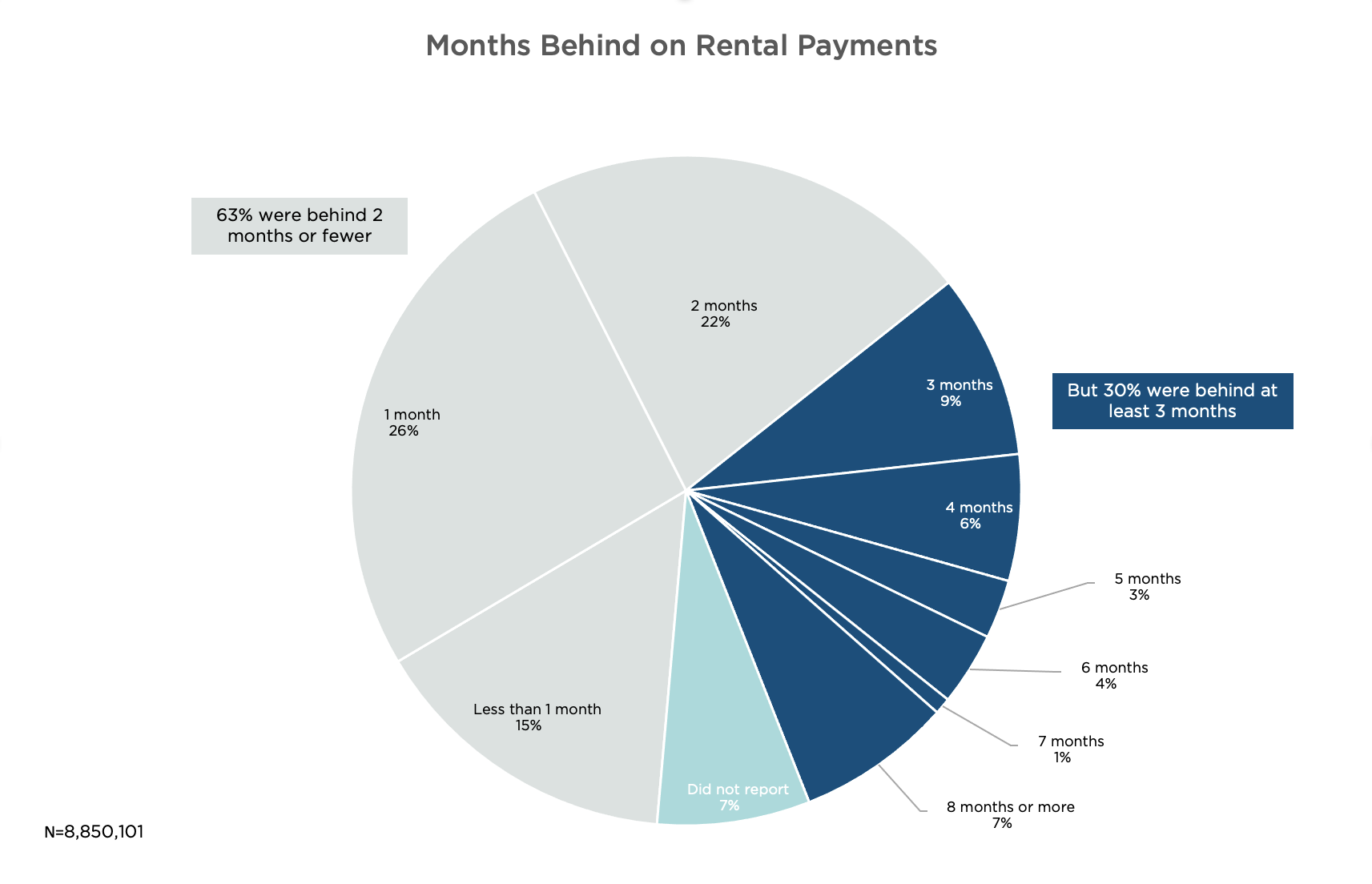
Weeks of April 27–May 9,2022

Chart showing how 63% of individuals were behind 2 months or fewer on rental payments, while 30% were behind at least 3 months

Source: U.S. Census Bureau, Household Pulse Survey; NAEH analysis. Percentages may not sum to 100% due to rounding.

Many renters in the United States remain at risk of not being able to stay in their homes—a pressure that disproportionately impacts people of color and low-income households. According to the latest U.S. Census Household Pulse Survey, which tracks how the COVID-19 pandemic has been impacting people’s lives in the United States, 8.8 million people were behind on their rent payments from April 27–May 9, 2022. This represents an increase of 1.7 million individuals from the same week one year ago. More than 60 percent were behind on only two months’ rent or less, suggesting that even a little rental assistance could help them catch up. Another 30 percent of people were more deeply in arrears, being at least three months behind.

Nearly half of those falling behind on rent also reported that they were “somewhat likely” or “very likely” to be evicted—the majority of whom were Hispanic or Black. One out of every 10 renters was “not at all confident” in their ability to pay the following month’s rent. This sentiment is largely due to these individuals not earning enough to cover their living expenses, and not from unemployment.

Closing the Gaps

Given the scope of the crisis, it’s up to the federal government to solve this problem to scale. In 2021, Congress created the Emergency Rental Assistance (ERA) program to provide billions of dollars in short-term aid to help keep families in their homes. State and local eviction moratoria have also helped low-income renters after the federal ban on evictions ended last August.

However, these are short-term measures not equipped to resolve a long-term problem. The National Low Income Housing Coalition estimates that 23 state grantees are on track to exhaust both rounds of ERA funding by year’s end. Smart use of remaining ERA and Coronavirus State and Local Fiscal Recovery Funds program funds is critical. Congress should create a permanent version of the ERA program. In the meantime, federal and local leaders must do everything they can to make existing resources available, equitable, and accessible to help low-income renters stay housed.


1 These findings account for wages, unemployment, poverty, and other demographic and economic factors.

2 The Zillow Observed Rent Index (ZORI) looks at the monthly market-rate rent for single-family and multi-family units in the United States and are adjusted for seasonal fluctuations in rent prices and housing stock.

Written by Andrew Hall

WHAT AMERICA OWES ITS VETERANS

Photo by Pixabay on Pexels.com

Each year, the U.S. military recruits some 175,000 young Americans. At the heart of its pitch is a sacred promise to take care of those who serve—what President Abraham Lincoln described in his second inaugural address as the national duty “to care for him who shall have borne the battle and for his widow and his orphan.” Today, this promise is enshrined in the ethics of each service: members of the U.S. Army, Navy, Air Force, Marines, and Coast Guard pledge to never leave a fallen comrade behind. After their service, the Department of Veterans Affairs (VA) works to fulfill this same promise on behalf of a grateful nation, enabled by a budget larger than those of the State Department, the Department of Homeland Security, and the entire U.S. intelligence community combined.

Most national security discussions focus on strategy or policy. To the extent that ways and means get considered at all, the talk tends to center on weapons systems, budgets, bases, and buildings. These matter, but people matter, too. Service members are an irreplaceable component of U.S. national security. And because the United States relies on an all-volunteer force, how the country treats its troops during and after their service matters when it comes to sustaining this critical component of national strength.

The wars in Afghanistan and Iraq saw incredible advances in body armor, battlefield medicine, and medical evacuation, all of which dramatically improved the likelihood that soldiers would survive injuries. Deaths from nonbattlefield injuries and illnesses, historically far more deadly than combat, have also fallen greatly, thanks to aggressive public health efforts and fitness requirements for troops. In this respect, the United States is keeping its most sacred pledge to those it sends into harm’s way: to bring them home.

But despite some recent improvements, the VA and other federal agencies struggle to keep other promises to active service members and veterans after they come home. Aging bureaucracies struggle to meet the needs of a diverse and dispersed population. Educational and economic support programs fail to keep pace with the changing needs of veterans and their families. To fix these problems, the United States must rewrite the contract it strikes with its service members, building a support system that not only ameliorates their battle wounds and financial losses but also helps them thrive after their service in a twenty-first-century economy.

AT YOUR SERVICE

The social contract with veterans has changed considerably since the founding of the United States. For economic and political reasons, the framers of the Constitution envisioned a small standing military, supported in peacetime by a citizen militia. When wars did break out, white male citizens were expected to volunteer. Aside from small pensions for war widows or severely disabled veterans, the government offered little in return.

This model persisted through most of the eighteenth and nineteenth centuries. Then came the Civil War. Following the lead of the French during the Napoleonic Wars, both the North and the South eventually resorted to conscription for the first time in U.S. history. By the time the war was over, in 1865, some 3.3 million Americans had served, out of a total population of 35.2 million. Of these, nearly 500,000 were killed, with tens of thousands more wounded. During the war, each side set up battlefield hospitals; afterward, they established convalescent homes to rehabilitate the injured and veterans’ cemeteries to inter and memorialize the dead.

Civil War veterans dominated U.S. political life for the next half century. Veterans’ organizations, such as the Grand Army of the Republic and the United Confederate Veterans, became powerful domestic lobbies. They successfully campaigned for expanded government benefits, such as bigger pensions for disabled veterans and widows and more hospitals, veterans’ homes, and cemeteries. But Washington didn’t think to combine these services into a single federal agency, since the U.S. government wasn’t in the habit of providing social services at the time. Apart from these new benefits, support for veterans remained largely the province of charities and local governments.

The U.S. military has grown increasingly distinct from the population as a whole: a part of society, but also apart from it.

This arrangement changed with the advent of industrialization, the experience of two world wars, and the implementation of the New Deal. During World War I, the United States mustered 4.7 million troops to fight, including 2.8 million conscripts. Over 115,000 died and 200,000 were wounded. Just as had happened after the Civil War, veterans’ organizations that formed in the wake of this war accrued tremendous political influence. This time, however, they used that power to secure more expansive health care, life insurance, vocational rehabilitation, and other programs. In 1930, President Herbert Hoover worked with Congress to create the Veterans Administration, the forerunner to today’s VA, consolidating health care, benefits programs, and cemetery administration into a single agency for the first time. After the Great Depression struck, President Franklin Roosevelt responded by fundamentally changing the role of the federal government in society, vastly expanding social welfare programs—eventually including those for veterans.

The government’s role in veterans’ affairs increased again during World War II, in which 16 million men and women served, 400,000 of whom died and 670,000 of whom were wounded. To prepare for the return of so many troops, in 1944, Congress unanimously passed the Servicemen’s Readjustment Act, better known as the GI Bill. It contained three main provisions: 52 weeks of unemployment compensation, a veterans’ home loan program offering zero-down-payment mortgages, and subsidies for higher education. It also appropriated $500 million for new VA hospitals, authorized the VA to take over existing military hospitals, created a veterans’ employment program, and established a small-business loan program. Together with Roosevelt’s earlier reforms, these benefits added up to a new social contract with service members. The government would not simply treat the wounds of war and compensate the disabled and the widowed for their suffering; it would recognize and reward military service, too.

The GI Bill helped the massive cohort of World War II veterans make the transition back to civilian life. One congressional study from 1988 estimated that for every $1 the government spent on educational benefits, veterans returned nearly $7 to public coffers in increased tax revenue or added economic output. In the ten years after the war, the government issued 4.3 million home loans to veterans, contributing to a housing boom that stimulated the economy and changed the postwar American landscape.

Even during these halcyon days, however, the VA labored to fulfill its expanded role. To address its various problems, in 1954, President Dwight Eisenhower appointed his former colleague, General Omar Bradley, to lead a study of the future of the VA. The Bradley Commission took a conservative view of what veterans were owed, concluding, “Military service in time of war or peace is an obligation of citizenship and should not be considered inherently a basis for future Government benefits.” Helpful as the GI Bill had proved to millions of veterans, Bradley saw it as unnecessary and unsustainable, particularly since new programs such as Social Security were intended to provide economic security for all Americans.

But Bradley ultimately lost the debate. Veterans fought back hard against the attempt to cut their cherished programs, and they found allies in broader society, which had benefited from the tidal wave of former soldiers buying homes, going to college, and starting businesses. As the Cold War took off, the Defense Department continued to recruit or conscript hundreds of thousands of young men, establishing the first large peacetime military in U.S. history (and contributing to a veteran population that would peak at over 28 million in 1980). That military would go to war in Vietnam. As the conflict began to wind down in 1973, President Richard Nixon ended the use of conscription, eliminating one of the great contributors to the antiwar movement. So began the era of the all-volunteer force, which remains in place today.

In the wake of Nixon’s decision, the demographics of the U.S. military began to shift dramatically. Although the military had been formally desegregated for decades, the military (and veteran) population became more racially and ethnically diverse as the self-selection dynamics of the all-volunteer force took root and as minorities increasingly saw service as a form of economic mobility. The military also began to include more women, who gained access to new roles across the force and now make up the fastest-growing demographic within the veteran population. Yet without conscription, which drew young Americans from all classes and regions, the military began to recruit disproportionately from certain parts of the country and society: the South, the Midwest, the middle and working classes, and military families. Among those, the military also recruited a relatively elite group, since not everyone could pass its rigorous entry requirements regarding education, health, and criminal history. The effect of these changes was to produce a military that has grown increasingly distinct from the population as a whole: a part of society, but also apart from it.

During this period, the social contract behind military service also shifted. Today’s promise to veterans still includes the core components provided to previous generations: health care and compensation for wounds and other injuries sustained in the line of duty, help with re-adjusting to civilian life, and support for indigent veterans and survivors of those killed in the line of duty. But now it also includes programs—from the Post-9/11 GI Bill’s educational assistance initiatives to the Small Business Administration’s programs for veteran entrepreneurs—that reward and encourage service by enabling veterans to outperform those who have not served.

Yet the shift to giving veterans a leg up in the workplace is not complete. The VA’s largest program, disability compensation, effectively encourages disability by paying veterans according to the degree to which they are disabled, offering no incentive for them to improve their conditions or leave the disability roster. A related VA program, aimed at vocational rehabilitation and education, aims to get disabled veterans back to work, but it serves a relatively small population and should be broadened to help all disabled veterans. The dissonance between these programs—with one compensating veterans for losses incurred during service and the other seeking to improve their performance after service—creates mixed incentives for veterans.

GET WELL SOON

Of the three categories of veterans’ benefits—health care, economic aid, and crisis support—health care is the largest and most used. By law, nearly all of the country’s 21 million former service members are eligible for VA health care; of these, nine million have enrolled, and almost seven million used the system in 2016, at a cost of $63 billion. This system provides comprehensive coverage, not only for injuries and illnesses sustained in the line of duty but also for any other medical needs that may arise at any point. To do this, the VA runs 144 hospitals, 800 clinics, and 300 mental health Vet Centers and employs more than 300,000 people. In addition to treating veterans, the VA trains nearly half of U.S. doctors and two-thirds of U.S. nurses at some point in their careers and conducts more than $2 billion in research each year.

Generally speaking, the VA provides outstanding medical care. The problem, however, is that many veterans struggle to access it. The VA’s complex bureaucracy is hard to navigate, so many eligible veterans don’t receive care in a timely, convenient manner. The VA system erupted in scandal in 2014, when CNN discovered that employees at a VA hospital in Phoenix were manipulating recorded wait times to make it seem as though veterans were receiving timely care. The incident prompted Eric Shinseki, the secretary of veterans affairs, and Robert Petzel, the VA’s top doctor, to resign.

The federal government already spends more on veterans now than at any point in history.

The VA also has difficulty maintaining quality and patient satisfaction. It relies on an antiquated health records system that once led the country in terms of innovation but now lags far behind those in the commercial sector. (In June, the VA announced that it plans to replace this system with commercial software, but doing so will likely take years.) Because of its size and geographic dispersion, the VA struggles to be good at all things in all places. Hardly a month passes without a scathing report from the VA’s inspector general about flaws in care or squalid conditions at some VA facility. In May 2017, for example, a report on the VA hospital in Hines, Illinois, described cockroaches on patient food trays and transportation carts.

Until the Phoenix scandal, proposals for reforming VA health care generally involved pouring more resources into the existing system. Afterward, however, conservatives, such as Arizona Senator John McCain, won a major debate over whether to rely more on the private sector to improve care. For years, McCain and others had called on the VA to privatize in a variety of ways, in part by relying more on contractors. In 2014, the VA contracted out ten percent of its appointments to private-sector providers; that figure rose to 32 percent by late 2016 and, if the Trump administration gets its way, will increase further. In the years to come, the VA will likely reshape its health-care system into a hybrid public-private model that current VA leaders hope will better and more cheaply serve the shrinking, dispersed veteran population. But this evolution is fraught with peril. It remains unclear whether the VA can maintain its high quality of care or large research and educational missions when a significant number of veterans receive services outside the system.

THE BENEFITS OF SERVICE

The federal government runs a dizzying array of economic support programs for veterans. Some, such as disability compensation, trace their roots back to the Revolutionary War and the core idea of caring for those wounded in war. Others, such as offering veterans small-business loans or giving them preference in receiving government contracts, reflect the more modern aim to reward veterans and attract new recruits.

Of these various efforts, disability compensation and pensions are the most expensive: in 2016, the VA spent $77 billion on payments to roughly five million people eligible for such benefits. It devoted another $14 billion to educational and training programs, including the Post-9/11 GI Bill; these helped just over one million veterans attend college or receive vocational training. Alongside these forms of assistance, the VA also administers life insurance programs and home loans. Meanwhile, the Department of Labor runs a veterans’ employment service, the Small Business Administration offers support for entrepreneurial veterans, and every federal agency provides contracting and hiring preferences for veterans.

Like Social Security, most VA benefits programs run on autopilot. Unlike the VA’s health-care system, which is classified as discretionary spending, its benefits system is considered by Congress to be mandatory spending. Once a veteran earns a benefit, it is paid until it is exhausted, as with the Post-9/11 GI Bill (which runs for 36 months) and disability compensation (which generally lasts for a veteran’s lifetime). Controversy arises only when the system runs aground, as it did in 2011, when the disability claims backlog reached nearly one million, as veterans of all ages simultaneously pursued claims for disability from an overworked system. It also encounters problems if it makes systemic errors, such as denying claims for Agent Orange–related illnesses or posttraumatic stress disorder because the evidence of a causal link between military service and these ailments is tenuous (although, of course, battlefield conditions are not the best laboratories for randomized controlled trials). But veterans have come to accept a certain level of friction in the system, not unlike what they experienced in the military itself.

Yet many of these benefits fail to fully support modern soldiers’ transitions to civilian life. The VA’s disability compensation scheme, for example, matches neither the realities of contemporary service nor the American workplace. With longer terms of enlistment and more frequent deployments, service members often end their tours with at least some physical effects, from hearing loss to orthopedic injuries or worse. The current disability system treats every one of these injuries, no matter how minor or treatable, as a potentially lifelong disability, rather than as the normal wear and tear of service. Veterans have increasingly claimed these injuries as disabilities, taxing the VA’s resources. The system also primarily addresses physical injuries rather than cognitive or mental impairments, an outmoded approach.

In addition, over the past eight years, the unemployment rate for recent veterans rose above the overall national rate. By 2011, the unemployment rate for post-9/11 veterans was 12 percent, compared with just nine percent for the overall population. (The total veteran unemployment rate was lower than the national rate, owing to older veterans, who tend to do better than average in the work force.) Starting that year, the Defense Department, the VA, the Department of Labor, and other agencies worked to address this crisis by revamping the civilian transition training given to service members before discharge and working with companies to establish private-sector hiring goals. Those efforts, plus an improving economy, brought unemployment among recent veterans down to parity with the national unemployment rate by 2016.

But the unemployment spike highlighted a problem. Although the government provides substantial benefits in education and health, it can do much more to facilitate veterans’ transitions into the work force. For example, it should offer programs that subsidize vocational training, such as coding boot camps, and provide seed capital for start-ups, which could help veterans who want to start a business instead of going to college. The Trump administration has pledged to facilitate public-private partnerships to serve veterans and hold the VA accountable. Although such efforts will help, the continued gulf between the culture of the military and that of the civilian work force makes for a difficult shift no matter what services the government provides.

REMEMBER THE NEEDIEST

Although crisis support—programs for homelessness, addiction, and legal problems—represents a small share of veterans’ benefits, it responds to an acute problem. The VA and other federal agencies provide billions of dollars to veterans living on the margins of society, offering a lifelong social safety net that far exceeds what is available to nonveterans.

For years, veterans have been chronically overrepresented in the nation’s homeless population. In 2009, Shinseki announced an audacious goal of reducing the number of homeless veterans to zero. From fiscal year 2009 to fiscal year 2017, the VA poured $65 billion into housing, mental health treatment, and other services for veterans in need. The effort made a huge dent, reducing the number of homeless veterans from 73,367 in 2007 to 39,471 in 2016. Shortly after Trump took office, David Shulkin, his secretary of veterans affairs, announced that the effort would continue, but that instead of simply counting the absolute number of veterans on the streets, it would instead aim for the more realistic target of “functional zero,” a goal that measures the number of homeless veterans against the housing capacity of a given community.

Veterans are also disproportionately afflicted by alcohol and substance abuse. Self-medication of posttraumatic stress appears to be one driver; another may be the tendency of VA and military hospitals to overprescribe medication for everything from sports injuries to combat stress and sleep disorders. The VA has set up clinics to treat addicted veterans, but these lack the resources to meet demand, and other veterans fail to seek any care at all.

Veterans have also historically been overrepresented in the nation’s courts, jails, and prisons, although less so in the era of the all-volunteer force. Across the country, local courts and law enforcement agencies have joined with social service agencies to form veterans’ courts, which resemble diversionary programs for other populations, such as juveniles. For nonviolent, nonserious crimes, these courts can match veterans with supportive services, such as substance-abuse counseling and job placement, in exchange for dismissing or expunging their charges when they complete these programs. The number of veterans entering these courts remains small, but they have no doubt helped many avoid a lifetime of dependency and incarceration.

Another previously marginalized group of veterans has risen to prominence over the past few years: those discharged with “bad paper,” frequently the result of minor misconduct while in service, for which the root cause is often posttraumatic stress. By statute, these former service members aren’t classified as veterans and are thus denied access to veterans’ health care and other benefits. But they are far more likely to struggle with unemployment, homelessness, substance abuse, and suicide than other veterans. Since they are ineligible for VA support, the burden of supporting these veterans falls on state and local governments and charities, often costing tens of thousands of dollars per veteran. In recent years, veterans’ groups, social service organizations, and public interest lawyers have argued that these veterans should at least have access to life-saving health care, if not the full benefits. Shulkin recently embraced this cause, too, although it will likely take action from Congress to make real headway.

TIME TO RETHINK

In all these areas, change will undoubtedly prove slow and challenging. Each VA program has a constituency that depends on it and might oppose reform. Long-overdue adjustments to the system for disability compensation, for example, could include updates to the antiquated schedule used to rate disability percentages or changes to the process for evaluating disabilities. Because these changes would reduce benefits for some, however, for political reasons, current veterans would have to be grandfathered in. On the health-care side, increasing the VA’s use of private-sector doctors could shorten wait times, but it could also weaken the agency’s teaching and research capacity and thus lower the quality of care for those patients who continue to receive treatment from VA doctors. Those veterans who are generally satisfied with the status quo will look at any major changes with skepticism.

Cost must factor into the equation, too. The federal government already spends more on veterans now, in both absolute and per-veteran terms, than at any point in history—but some reforms will cost even more. Trump requested a VA budget for 2017 totaling $186 billion, covering health care, benefits, cemeteries, and the administration of the VA. This represents a four percent increase from the previous year but may still fail to meet veterans’ needs through the existing agency structure. Over the past 15 years, even as the overall veteran population has shrunk, the VA budget has grown enormously, since veterans of all generations are increasingly using the system. And over the next 15 years, demand will no doubt rise, as the VA serves both the Vietnam-era cohort and the post-9/11 cohort. The Defense Department has reported that as of May 2017, 2,874,820 service members had deployed to Afghanistan, Iraq, or other theaters of war since 9/11. The Harvard scholar Linda Bilmes has estimated that the total cost of veterans’ support for the post-9/11 generation will likely exceed $4 trillion. The majority of this bill will come due sometime around 2050, because expenditures typically peak when a cohort reaches its 70s.

With the veteran population evolving and existing programs straining to meet its needs, it is time for the U.S. government to fundamentally rethink the social contract underlying service. If the goal of veterans’ programs is merely to compensate individuals for injuries, hardships, and the costs of service, then they are doing a decent job. But if the goal is to help veterans thrive, then the programs are faring poorly. And leaving veterans better off than their peers is crucial, since it will make service appear more attractive to future generations weighing the military as an option.

With that goal in mind, Washington should redesign the system for supporting veterans. Without scaling back programs such as disability compensation and health care, which primarily ameliorate the harms of service, the government should expand benefits such as the Post-9/11 GI Bill and small-business financing, which can create enormous economic opportunities for those who serve. It should also find ways to leverage the enormous social capital that veterans develop during their service for economic and societal gain. In Israel, for example, veterans of elite intelligence and special operations units move seamlessly into the technology and start-up world, drawing on their connections in much the same way that Stanford graduates do in Silicon Valley. Although Israel is much smaller and maintains conscription, both of which help build a tight-knit entrepreneurial military community, the United States could replicate elements of that ecosystem within parts of its military, especially the intelligence and special operations fields, both of which rely on advanced technology. The Defense Department should also explore ways to more closely link active and reserve units with businesses, particularly those that provide critical infrastructure, such as telecommunications and energy firms. These service members could draw on their hard-earned experience to help defend the private sector against cyberattacks and economic espionage, while fostering a virtuous cycle of innovation between the military and the private sector.

Washington should also be mindful of the ways in which the increasing civil-military divide exacerbates the struggles of veterans—for example, fueling veteran unemployment because of the cultural gap between civilian employers and their veteran employees. This divide may also hinder veterans’ reintegration into communities and their willingness to seek mental health care, because of a fear of social stigma. Absent a foreign invasion or a crisis on the scale of World War II, the country is unlikely to return to conscription or increase the size of the military to the point where it would fundamentally change its relationship to the rest of society.

To repair the split, then, the military should seek greater geographic and socioeconomic diversity among its recruits. It should establish public-private partnerships to support veterans in the work force. And it should rely on reserve units so as to broaden the military’s geographic footprint to include communities away from major base towns such as Killeen, Texas, and Norfolk, Virginia. Veterans have a role to play, too. A recent study by the advocacy group Got Your 6 found that veterans are not always likely to self-identify as veterans after service, and civilians often think veterans are worse off than they are. Veterans, particularly those who succeed after service, must represent the military and explain their service to the wider population.

For the foreseeable future, the United States will rely on a relatively small, volunteer military. Its success depends on its ability to draw in high-quality recruits. And that, in turn, depends on the perception that service will benefit soldiers, their families, and their country.

By Philip Carter, ForeignAffairs.com

Cooking Broke

Photo by Ana Madeleine Uribe on Pexels.com

Chicken Scampi with Angel Hair Pasta

Whip up this 20 minute EASY chicken scampi with angel hair pasta for dinner. This recipe uses simple ingredients you’re likely to have on hand, perfect for a midweek meal.

Most people associate scampi with shrimp and other shellfish, but guess what? This classic pasta dish works just as well with chicken.

The richness from the butter and olive oil is balanced by the acidity of the lemon juice and white wine. You also get a punch of garlic, a hint of heat from the red pepper flakes, and some freshness from the parsley.

Chicken Scampi with Angel Hair Pasta
Aaron Hutcherson

How To Make a Creamy Chicken Scampi Sauce

The most important thing to remember with this recipe is to reserve some of the pasta cooking water. It helps to make a luscious sauce that brings all of the ingredients together.

Chicken Scampi with Angel Hair Pasta in a skillet
Aaron Hutcherson

This recipe is all about the sauce and the pasta. If you’d like more protein or fresh vegetables in your meal, feel free to increase the amount of chicken or throw in whatever veggies you have in the fridge.

Chicken Scampi with Angel Hair Pasta

PREP TIME10 mins

COOK TIME15 mins

TOTAL TIME25 mins

SERVINGS2 to 4 servings

To make without wine, substitute chicken broth plus an optional tablespoon of white or cider vinegar.

Ingredients

  • 1/2 pound angel hair pasta
  • 2 tablespoons unsalted butter
  • 2 tablespoons olive oil
  • 1/2 pound boneless, skinless chicken cutlets
  • 1/2 teaspoon kosher salt
  • 1/4 teaspoon freshly ground black pepper
  • 4 cloves garlic, minced
  • 1/8 teaspoon (a big pinch) crushed red pepper flakes
  • 1/2 cup dry white wine, such as Sauvignon Blanc, Chardonnay, or Pinot Grigio
  • 1 lemon, zest and juice (about 1 tablespoon of zest and 3 tablespoons of juice)
  • 1/4 cup chopped parsley
  • Lemon wedges for serving

Method

  1. Make the pasta:Cook the pasta in a large pot of salted boiling water, according to package instructions or until al dente. Scoop out about a cup of the pasta cooking water and set it aside. Drain the pasta.
  2. Cook the chicken:Meanwhile, melt the butter with the olive oil in a large skillet over medium heat. Pat the chicken dry and season both sides with the salt and a few grinds of black pepper. Add the chicken to the skillet and cook about 2 minutes per side, until golden brown and cooked through.Transfer the chicken to a cutting board to rest, leaving the fat in the pan.Chicken Scampi with Angel Hair Pasta
  3. Make the sauce:Add the garlic and red pepper flakes to the skillet and cook until fragrant, about 1 minute. Add the wine and lemon juice, scraping up any browned bits from the bottom of the pan, and simmer until reduced by about half, 3 to 5 minutes.Chicken Scampi with Angel Hair PastaChicken Scampi with Angel Hair Pasta
  4. Finish the pasta and serve:Add the cooked pasta, lemon zest, parsley, and 1/2 cup of the reserved pasta water to the skillet and toss to combine. If it seems too dry or like the sauce isn’t coating the pasta, stir in some more of the reserved pasta cooking water.Cut the chicken into slices and toss with the pasta. Serve with extra lemon wedges for squeezing over the scampi.Chicken Scampi with Angel Hair Pasta
NUTRITION FACTS(PER SERVING)
425CALORIES
17gFAT
50gCARBS
19gPROTEIN

 Show Full Nutrition Label

Nutrition information is calculated using an ingredient database and should be considered an estimate. In cases where multiple ingredient alternatives are given, the first listed is calculated for nutrition. Garnishes and optional ingredients are not included.