The Forgotten Black Explorers Who Transformed Americans’ Understanding of the Wilderness

Esteban, York and James Beckwourth charted the American frontier between the 16th and 19th centuries

Every summer, millions of Americans flock to the United States’ 63 national parks. Federally protected wilderness areas offer people the chance to explore a wide variety of terrain, from the vibrant canyons of the Southwest to the imposing mountains of the West Coast. Today, these public lands often represent an escape for Americans, 81 percent of whom live in cities. Some may agree with the naturalist John Muir, who believed that “wildness is a necessity” and national parks are “fountains of life.” When Americans walk through dense forests or descend into gloomy caverns, they might recall explorers of the past who trekked across the country decades before Congress established Yellowstone as the U.S.’s first national park in 1872. Names like Daniel Boone, Davy Crockett and Kit Carson loom large in the popular imagination. But their stories are not the only ones.

For too long, the public and scholars alike have overlooked American adventurers from diverse backgrounds whose discoveries shaped the nation’s history. The time has come to fully recover their stories and acknowledge their important contributions. Doing so will not only correct the historical record but also support contemporary efforts to welcome people of color in national parks. According to National Park Service (NPS) data, 77 percent of park visitors are white, while just 23 percent are racial minorities. (People of color make up around 44 percent of the U.S.’s population.)

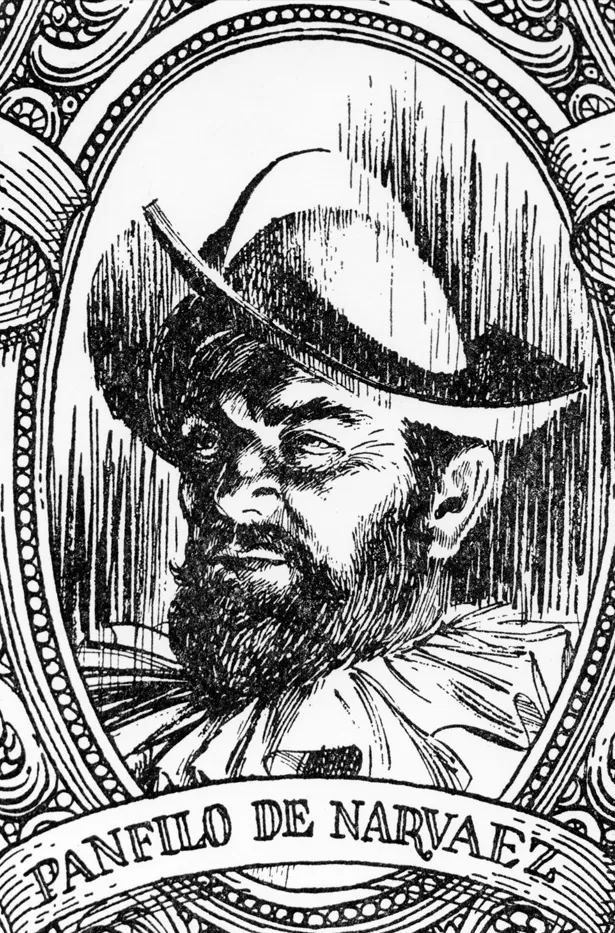
From the earliest days of European settlement, when an estimated 5 million to 15 million Indigenous people populated the lands that would one day form the U.S., people of color have been at the forefront of exploration. In 1527, an enslaved African man named Esteban reached North America as part of a Spanish expedition led by the conquistador Pánfilo de Narváez. After stopping on the islands of Hispaniola and Cuba, Narváez and his men landed in present-day Florida to search for gold. They soon became enfeebled by disease, and many perished. Native Americans drove those who survived, including Esteban, to the coast, where they set sail for the Gulf of Mexico.

During the years that followed, Esteban explored present-day Texas, Arizona, New Mexico and northwestern Mexico. He learned several Indigenous languages and even served as an interpreter. Esteban was, in the words of biographer Dennis Herrick, “the first person from the Old World of Europe, Africa and Asia to travel across the North American continent and also explore the American Southwest in the 1500s.” Although the circumstances of his death remain mysterious, he most likely perished in the Zuni village of Hawikku in New Mexico in 1539.

Over the next two centuries, Spain, France, the Netherlands and Great Britain competed to colonize North America. European settlers seeking economic opportunity arrived by the thousands. Displacing Native Americans from their homelands, they established farms or plantations, built towns, and raised families. Slave traders also forced enslaved Africans onto ships bound for North America, where slaveholders compelled them to work the land. Settlers carried viral diseases like smallpox and measles that decimated Indigenous populations. By the time the U.S. declared its independence from Great Britain in 1776, just four million Native Americans remained.

Two decades after the Revolutionary War ended in 1783, much remained unknown about the continent’s Western interior. By 1800, around five million Americans lived in the country, but most were concentrated on the East Coast.

On May 21, 1804, 45 men led by Meriwether Lewis and William Clark departed from St. Charles, Missouri, on a two-year journey across North America. Hoping to find a water route to the Pacific Ocean, the Corps of Discovery also sought to gather information about the geogra phy, climate, wildlife and Indigenous peoples of the continent. The group’s mission was funded by Congress and supported by President Thomas Jefferson, who had just facilitated the acquisition of Louisiana Territory in 1803.
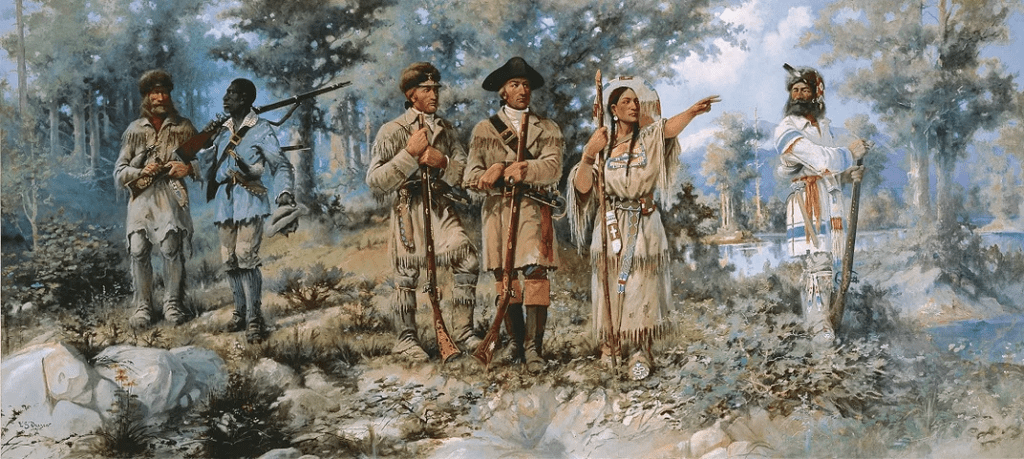
York stands second from left in this 1912 painting of the Corps of Discovery by Edgar S. Paxson. Public domain via Wikimedia Commons

York, an African American man enslaved by Clark, played an integral role as the only Black member of the corps. An experienced frontiersman, York knew how to forage for edible plants and hunt wild game. Although most enslaved African Americans were forbidden to possess guns at the time, York wielded a firearm throughout his journey. He killed bison and geese, providing sustenance for the entire group.

York also provided medical aid to those suffering from illness. Stricken with what was likely a gastrointestinal infection, Sergeant Charles Floyd became incapacitated just months into the journey. It was York, principally, who tried to revive him, Clark wrote in his journal. When Sacagawea, the Shoshone woman who played a critical role as an interpreter and navigator for the corps, fell ill at Fort Mandan, York gave her stewed fruit and tea at regular intervals.

After reaching the Pacific Ocean in November 1805, the corps prepared to establish a winter camp. When deciding where to build the fort, the group held a vote. It is striking that, in an era when African Americans and women were legally denied the franchise, York cast his ballot alongside the other members of corps, including Sacagawea. This moment may have been the earliest occurrence of an African American person and a woman voting in U.S. history.

The corps returned safely to Missouri in 1806. The expedition’s members confirmed that no simple water route across the country existed and retrieved information about at least 178 plants and 122 animals new to science. York was a changed man following his experiences on the frontier. He asked Clark to emancipate him, but the enslaver initially refused. York probably gained his freedom at some point between 1811 and 1815.

Another Black explorer, James Beckwourth, found freedom and opportunity on the Western frontier in the mid-19th century. Born into slavery in Virginia but liberated by his white father, Beckwourth wound up in St. Louis at the height of the fur trade. It was a time when trappers explored the Rocky Mountains in search of lucrative beaver, otter and fox pelts. As a young man, Beckwourth keenly felt the pull of the West. As he later said in his autobiography, he found himself “possessed with a strong desire to see the celebrated Rocky Mountains, and the great Western wilderness so much talked about.”

Two hundred years ago, in the autumn of 1824, Beckwourth set off on a fur trading expedition headed by the frontiersman William Ashley. In the Rocky Mountains, Beckwourth gained critical hunting and navigational skills that enabled him to survive in the wilderness. As time passed, he became a veritable mountain man. In the words of historian Elinor Wilson, Beckwourth and other mountaineers were “pathfinders”; their geographic knowledge of the Rocky Mountains would later aid the Corps of Topographical Engineers and the U.S. Army.

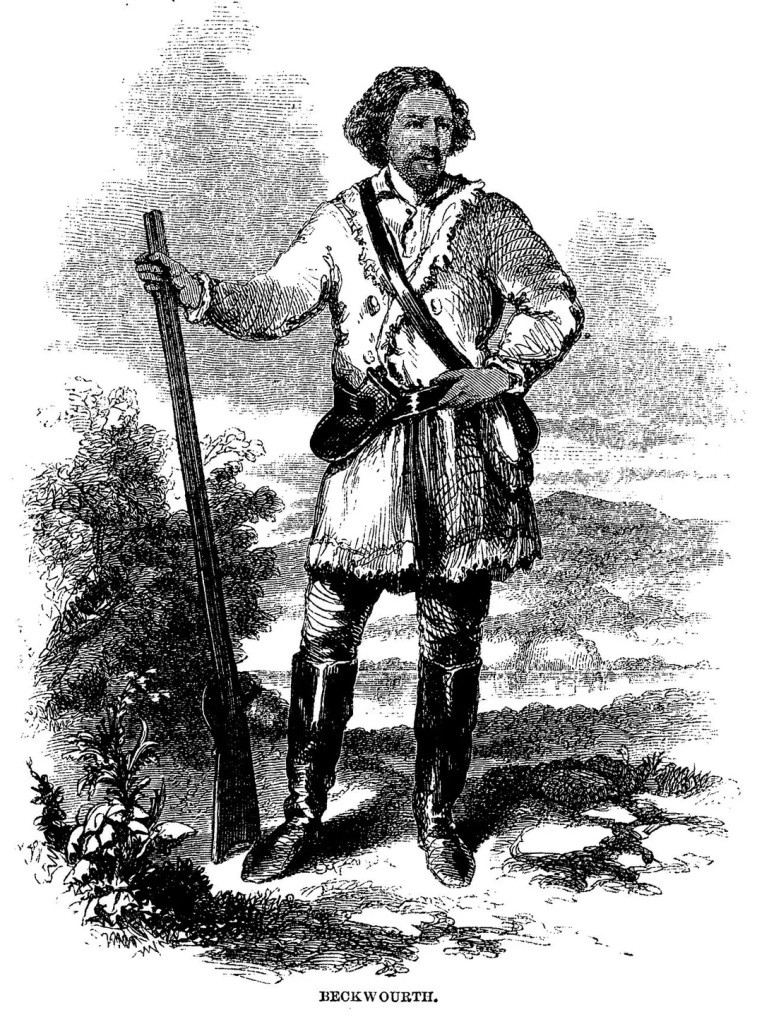
During the years that followed, Beckwourth stayed at the vanguard of exploration. Traveling through Colorado, Kansas and New Mexico, he evinced an entrepreneurial spirit as a trapper and a trader. He made scores of friends, including Sacagawea’s son, Jean Baptiste Charbonneau, and also some enemies due to his mercurial behavior.

Beckwourth had a knack for being in the right place at the right time. When the California Gold Rush began in 1848, forty-niners flocked to the future state from around the world. In 1849, Beckwourth hitched a ride on the California, the first steamship bound for San Francisco from New York, when it stopped for wood in Monterey. Although he never struck it rich as a prospector in the Mother Lode Country, Beckwourth made a profit selling goods to other miners.

While looking for gold, Beckwourth also found an unknown pass in the Sierra Nevada. He raised funds to construct, and worked to complete, a road suitable for migrants who subsequently crossed over it and headed west toward California’s American Valley. Today, a historical marker stands at Beckwourth Pass, acknowledging the explorer’s discovery of the lowest pass through these mountains.
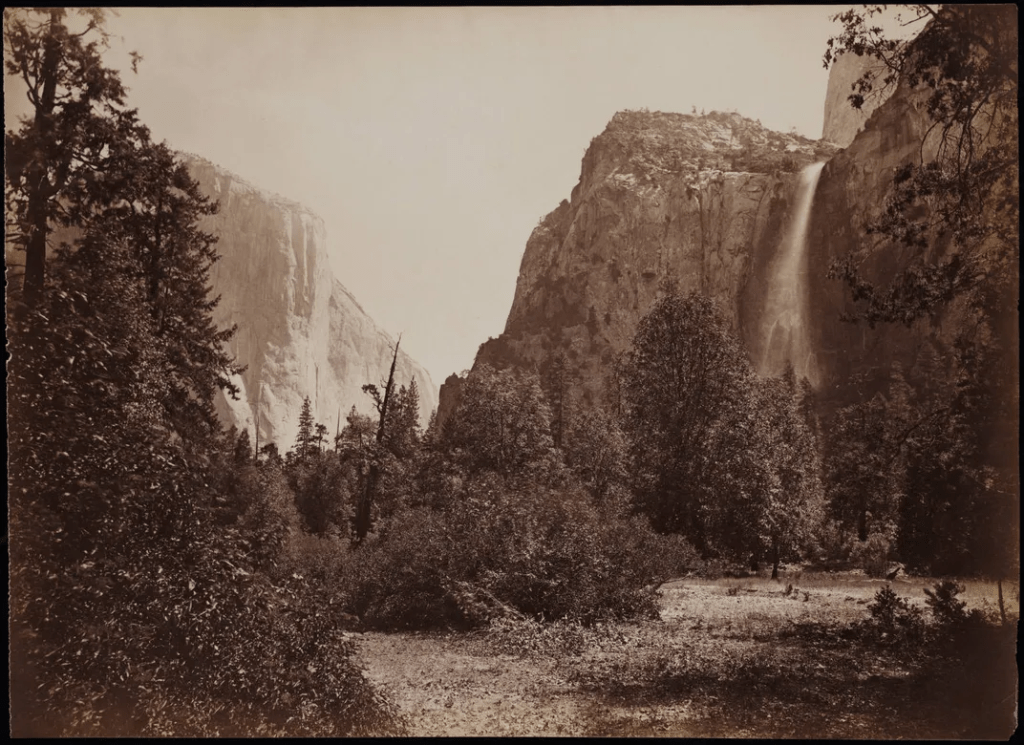
A circa 1880 photo of what is now Yosemite National Park Public domain via Wikimedia Commons

Esteban, Beckwourth and York are just three of many African Americans who explored America in its nascent years. Their findings contributed to the opening of the frontier. White migrants from the east, formerly enslaved people and impoverished immigrants seeking upward mobility all headed west throughout the 1800s. Tragically, increased settlement also led to the violent displacement of Indigenous people, the further spread of deadly illnesses among Native American populations and environmental destruction.

The rise of the conservation movement in the second half of the 19th century led to the creation of America’s system of national parks, many of which were built on Indigenous homelands. Congress passed legislation establishing Yosemite National Park in 1890 and Mount Rainier National Park in 1899, with dozens more to follow. But during the Jim Crow era, African Americans were often refused entry to public spaces within parks or were discriminated against while there. The Interior Department officially desegregated national parks in 1945, but discriminatory practices continued into the civil rights era.

Today, endeavors to make wilderness areas more inclusive are ongoing. In June 2020, the NPS announced its commitment to “lead change and work against racism.” The nonprofit Outdoor Afro “reconnects Black people” to nature through “education, recreation and conservation,” while Black Girls Hike seeks to “inspire others who look like us to be comfortable outdoors,” as a Virginia branch of the organization notes on its website.

The NPS has also taken important steps toward co-managing federal lands with tribal nations. As Charles Sams III, the first tribally enrolled person to serve as the NPS’s director, said in a 2022 statement, the agency is “strengthening the role of tribal communities in federal land management, honoring tribal sovereignty and supporting the priorities of tribal nations.” Today, four national parks have co-management arrangements. In March, the NPS signed a memorandum of understanding giving the Yurok Tribe guardianship of the redwood groves at ‘O Rew in California.
The story of U.S. exploration is a complicated one, with moments of discovery and displacement alongside destruction and preservation. Learning lessons from the past, however, can help our country build a better future where Americans of all backgrounds are able to protect and enjoy its treasured landscapes.

Amanda Bellows – Author, The Explorers: A New History of America in Ten Expeditions

Amanda Bellows

Volunteers Discover 115-Million-Year-Old Dinosaur Tracks Revealed in the Wake of Devastating Texas Floods

Fifteen large prints were probably left behind by meat-eating dinosaurs, and they were revealed as floodwaters washed away dirt in early July

Last month’s extreme floods in central Texas have uncovered 115-million-year-old dinosaur tracks in Travis County, which includes Austin. While the discovery is overshadowed by the deaths of more than 138 people at the hands of the very same natural disaster, it sheds further light on the state’s richly preserved paleontological history.

“It’s one of those sort of bittersweet things about our job, is that it’s the cataclysmic events that often preserve fossils in the first place and then also are exposing them,” Matthew Brown, a paleontologist at the University of Texas at Austin, tells KUT News’ Katy McAfee.

While cleaning up after the floods, a volunteer sent a picture of suspected dinosaur tracks to Travis County Judge Andy Brown, who announced the find at a Travis County Commissioners’ Court meeting, as first reported by KXAN’s Eric Henrikson.

“The tracks that are unambiguously dinosaurs were left by meat-eating dinosaurs similar to Acrocanthosaurus, a roughly 35-foot-long bipedal carnivore,” Matthew Brown tells CNN’s Gordon Ebanks and Zenebou Sylla.

The discovery consists of 15 large footprints, each about 18 to 20 inches long with three claws. Given that the tracks are in a rock layer called the Glen Rose Formation limestone, which is around 110 million years old, the tracks themselves are approximately 110 million to 115 million years old, the paleontologist adds.

Brown and Kenneth Bader, also a paleontologist at the University of Texas at Austin, surveyed the tracks on August 5 and instructed authorities on how to best conserve them throughout the cleanup endeavors, reports ABC News’ Doc Louallen. “We expect to return to the site in the near future to more thoroughly document the tracks with maps and 3D imaging,” Brown tells ABC News.

His team also hopes to figure out whether a group of dinosaurs left the tracks, or if it was a bunch of individuals traveling independently. What’s more, they also identified other nearby tracks that might have been left behind by Texas’ state dinosaur: the large herbivore Paluxysaurus.

The tracks are on private property, where researchers had previously confirmed other dinosaur footprints in the 1980s, per the Dallas Morning News’ Lauren Nutall. Brown tells the newspaper that since the discovery first appeared in the media, several other people in the region have reached out to report potential dinosaur remains revealed by the July floods.

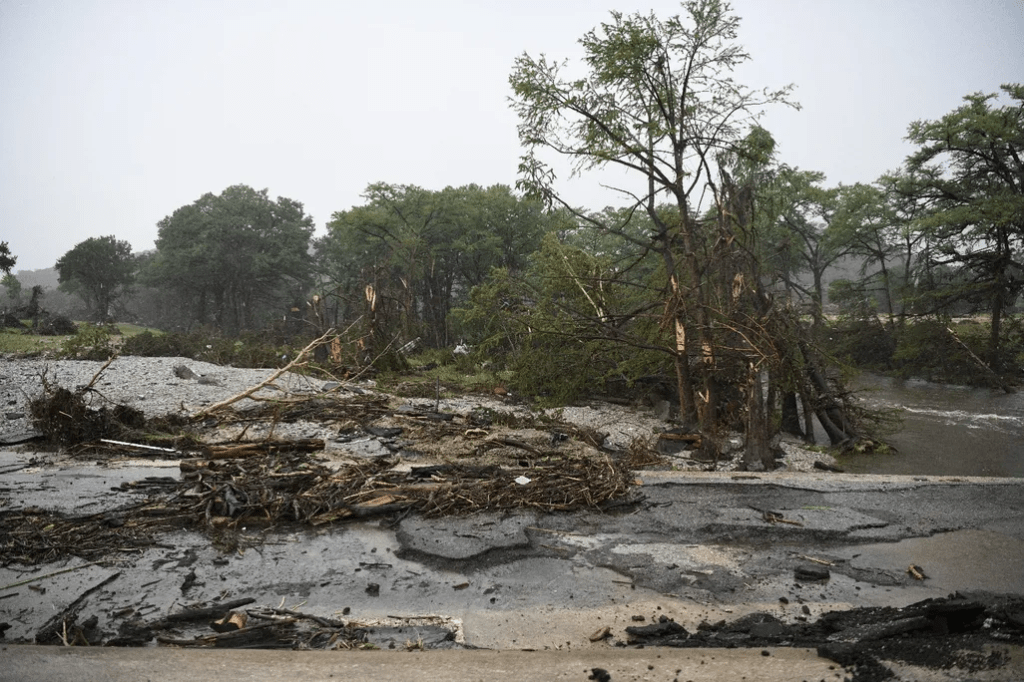
While the nearby Kerr Country experienced the greatest devastation and casualties, Travis County’s typically very dry Sandy Creek, where the tracks were found, swelled to 20 feet because of the floodwaters, per CNN. “That washed away trees. It washed away cars, houses, anything in its path,” Brown tells the network. “So, in this part with the dinosaur tracks … it tore down the trees around them and it also washed away the dirt and gravel that was over the other set of them.”

Given that central Texas is a paleontological hotspot, the recent discovery joins a host of other dinosaur remains in the state. “I wouldn’t call it run of the mill, but what I would say is this is another data point that continues to help flesh out our understanding of the paleobiology and the behavior and the lifestyles of these animals,” Ron Tykoski, curator of vertebrate paleontology at the Perot Museum of Nature and Science in Dallas, tells the Dallas Morning News. Brown notes to ABC News that the discovery will not impede the area’s continuing flood cleanup efforts.

Margherita Bassi – Daily Correspondent

Margherita Bassi

After Confederate Forces Captured Their Children, These Black Mothers Fought to Reunite Their Families

During the Civil War, Confederates targeted free Black people in the North, kidnapping them to sell into slavery. After the conflict ended, two women sought help from high places to track down their lost loved ones

Robert Colby – Author, An Unholy Traffic: Slave Trading in the Civil War South

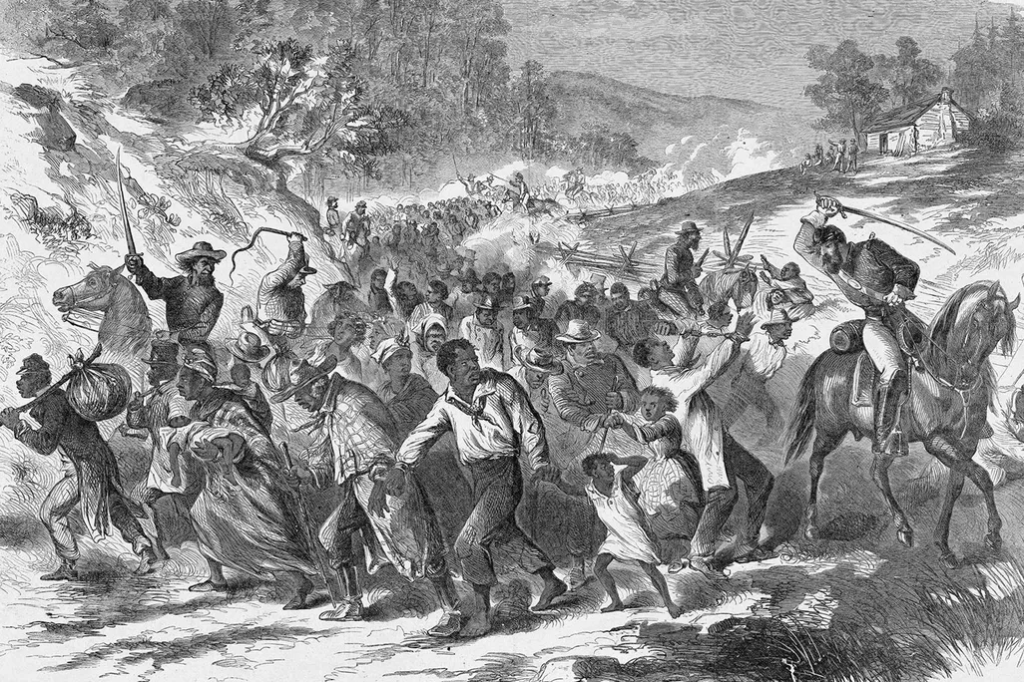
Harper’s Weekly illustration of Confederate soldiers driving Black Americans south in 1862 Library of Congress

In the late summer of 1865, a few months after Confederate General Robert E. Lee surrendered to Union forces at Appomattox Court House, Representative Thaddeus Stevens received a surprising but surely welcome letter. Written from Savannah, Georgia, its author was a free Black woman named Jane Lyles. Lyles had previously lived at Stevens’ Caledonia Furnace, an iron-producing facility in the southern Pennsylvania mountains between Chambersburg and Gettysburg. She labored there alongside her husband, David, the furnace’s keeper, and their children, Annie, George, Thomas and Jane. In the summer of 1863, however, Confederate soldiers bound for Gettysburg captured Lyles and her children.

Two years later, with the Civil War at an end and slavery on the verge of being officially abolished nationwide, Lyles emerged from captivity and set to work recovering the life the Confederates had taken from her. With the help of the famously antislavery Stevens, she hoped to leave the place of her confinement, go to Richmond, Virginia, where she’d been forcibly parted from her children, and finally to “take them home with me.”

A letter from Jane Lyles to Representative Thaddeus Stevens
A letter from Jane Lyles to Representative Thaddeus Stevens Courtesy of the U.S. National Archives and Records Administration, FamilySearch International and the Smithsonian’s National Museum of African American History and Culture

When Confederate forces approached Caledonia in the summer of 1863, Stevens had fled before their arrival. This was probably a wise choice for a man whom their commander, General Jubal Earlylabeled an “enemy of the South” for his support of emancipation and advocacy of vigorously prosecuting the war against the Confederacy. Unable to vent their rage directly against Stevens’ person, Rebel soldiers settled for burning his furnace to the ground and carrying off the materials, provisions and animals needed to operate it. Stevens estimated his losses at a whopping $75,000 (around $1.5 million today), an amount the Confederate press considered the “punishment due for his enormous crimes against the happiness of the human race”—in other words, his opposition to human bondage. The congressman wore his losses as a badge of honor. “We must all expect to suffer by this wicked war,” he wrote to a relative. “If, finally, the government shall be re-established over our whole territory, and not a vestige of slavery left, I shall deem it a cheap purchase.”

For Lyles and her children, the destruction of Caledonia was anything but “cheap.” In addition to wrecking the forge, Confederate soldiers carried off its Black inhabitants for enslavement in Virginia and beyond. The Rebels who invaded Pennsylvania waged war to ensure that slavery would endure not merely in “vestige,” but in totality. These agents of the slaveholders’ republic considered the African American residents of Maryland and Pennsylvania fugitives from slavery, fair game for capture and enslavement.

Reconstructed blacksmith shop at Caledonia State Park, on the site of the Caledonia Furnace in Pennsylvania
Reconstructed blacksmith shop at Caledonia State Park, on the site of the Caledonia Furnace in Pennsylvania Acroterion via Wikimedia Commons under CC BY-SA 4.0

As historian Allen Guelzo writes in Gettysburg: The Last Invasion, “To have left [them] in undisturbed freedom would have been tantamount to denying the validity of the whole Confederate enterprise.” Well before the Confederate soldiers arrived at Caledonia, therefore, one local observed them “scouring the country in every direction … for horses and cattle and Negroes.” Rebel civilians followed behind the men in gray, pursuing people they considered “their stolen Negroes,” ensnaring what a journalist recorded as “gangs of Negroes … captured in the mountains in Maryland and Pennsylvania.” A diarist reported that the Rebels were “driving them off by droves … just like we would drive cattle.”

Lyles and at least three of her children were among those kidnapped and sent to the South. As they crossed the Potomac River, the frontier of Rebel territory, a dire fate loomed in the form of the Confederate slave market. Long a pillar of that horrific global institution, commerce in the enslaved survived and even flourished in the South during the Civil War. It did so in spite of serious obstacles, including the fall of major trading hubs like New Orleans to Union forces, a devastating blockade, wild inflation and severe economic turmoil.

The practice’s endurance fulfilled an array of Confederate needs. Some slave traders bought and sold people in response to crises such as food shortages or unexpected labor requirements, deflecting the hardships of the conflict onto those they fought to keep in bondage. Others trafficked people to prevent them from pursuing the freedom offered by the war. Still others used the slave trade to actively invest in the slaveholding future for which they fought. As a result, despite all the disruptions of the war, Confederates traded thousands of people in the four years between the attack on Fort Sumter in April 1861 and the surrender at Appomattox in April 1865.

If the Lyles family’s experiences mirrored those of others captured by Rebel raiders, they were probably sold first in the Shenandoah Valley, possibly to a Virginian claiming to have once enslaved them. This enslaver almost certainly sold them swiftly in Richmond, the well-defended Confederate capital and the Confederacy’s largest surviving slave market by the summer of 1863. There, Rebels divided the family yet again.

Why different purchasers desired Lyles and her children remains obscure. One may have coveted skills she possessed or her personally. Another might have seen her children as a worthwhile speculation; many Confederates believed enslaved children would appreciate in value after the war and, as they grew up and had families of their own, produce generational wealth in an independent slaveholding republic. In all likelihood, one or more Virginians purchased the Lyles children, while another enslaver carried their mother to Savannah, a city with strong slave-trading ties to Richmond. From there, Lyles seems to have been sold to Thomasville in Georgia’s interior.

In the spring of 1865, however, the Confederate surrender and the ensuing breakdown of the slave system offered families like the Lyleses a chance to heal the wounds inflicted by the wartime slave trade. Not only did they now have unprecedented mobility, but they also could draw upon personal networks, Black churches and (novelly) the United States government in seeking their loved ones.

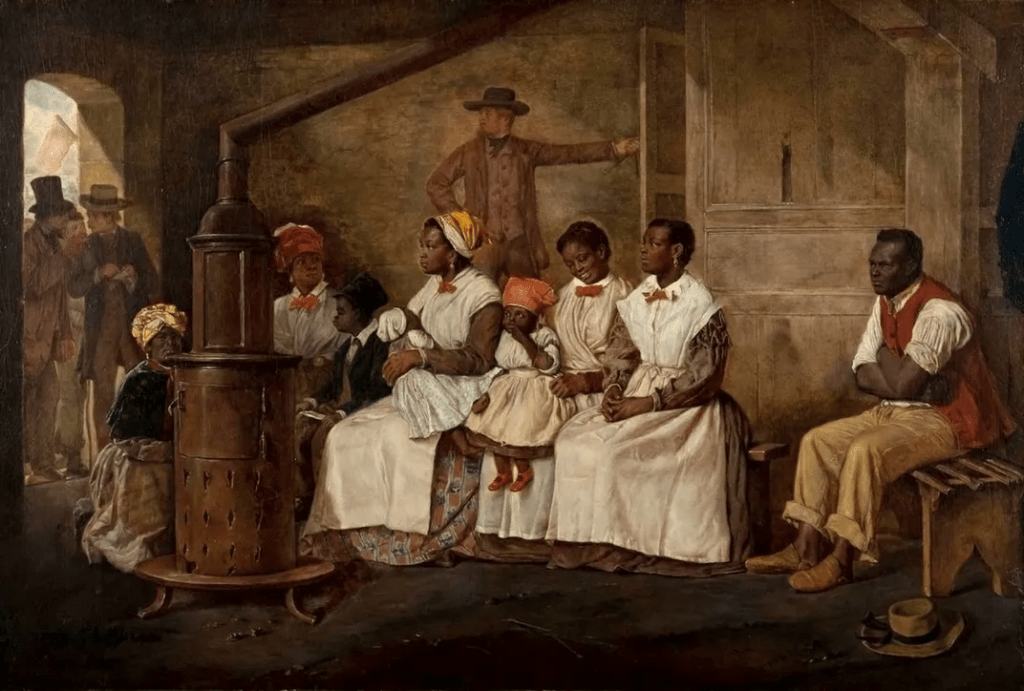
A painting of enslaved people awaiting their sale at a slave market in Richmond, Virginia Public domain via Wikimedia Commons

Of particular utility was the Bureau of Refugees, Freedmen and Abandoned Lands. A government agency created during the war to help formerly enslaved people navigate the transition from slavery to freedom, the Freedmen’s Bureau performed many tasks, including serving as a clearinghouse for efforts to reunite Black families. It assumed this function to rectify the wrongs of slavery, to be sure, but its motives extended beyond the purely charitable. In reuniting Black families, the bureau hoped to prevent them from becoming wards of the state, dependents on government largesse.

Thus, when Lyles informed Stevens of her hopes to recover her children and return home, the bureau saw this request as a chance to achieve multiple objectives simultaneously. Indeed, even as its Virginia agents worked to find the Lyles children, the bureau separately organized the transfer of 31 other Black children from Richmond to Philadelphia. As Superintendent H.S. Merrell wrote in a letter, the logic in doing so was that “these orphans have been for some time supported by [the government] and are now to be provided with homes, relieving it of same.”

Multiple obstacles conspired to prevent the reunion that Lyles so fervently desired. She initially lacked the money needed to pay for her travel home, and though she appealed, at Stevens’ suggestion, to a local authority in Georgia he either could not or would not help her. (Within weeks, this same individual would be arrested for assaulting a formerly enslaved man.) Lyles nevertheless made her way to Savannah, where she applied to the bureau for transportation but found no government boats or trains available to carry her north.

Illustration of a schoolroom at the Freedmen’s Bureau office in Richmond, Virginia, in 1866 Public domain via Wikimedia Commons

At Lyles’ urging, Stevens pressured the bureau into action. Within a few weeks, the agency authorized transportation for Lyles from Savannah to Washington, D.C. and ordered its Richmond agents to find her children “Ann and Jerry” (possibly a nickname for her son George), with the goal of bringing them together and returning them to Pennsylvania. What happened to her husband and other children remains unclear. Perhaps they escaped Confederate clutches, or perhaps the Confederates considered her younger children more effort than they were worth. It’s also possible that Lyles somehow received specific information about these two children’s locations but not the others. What is clear is that the upheaval of war shattered this family as it did all too many others. Whatever the circumstances, by the time the bureau’s orders reached Savannah in the winter of 1865-1866, Lyles had disappeared for a second time.

Bureau officials exerted “every effort” to find her, including seeking her in all of the city’s Black churches (a common tactic for finding lost people of color at the time), but to no avail. She had vanished, leaving no trace behind in the archive. Tragically, so had her children. The bureau’s agents in Virginia followed leads indicating that a pair of children taken from Pennsylvania had been sold to Charlotte County. Upon investigating, they found that these were not the Lyles siblings. The bureau’s failures meant that the destruction wrought by the Confederates and the slave trade would persist well beyond the war’s conclusion.

But the search wasn’t completely fruitless. True, the children rumored to be in Charlotte County weren’t from the Lyles family. But they were indeed people kidnapped from Pennsylvania in the summer of 1863 and sold in Richmond. The supposed Ann and Jerry Lyles turned out to be Zack and Sallie Marshall. Zack (who bureau officials also called “Jack”) was 7 or 8 years old, his sister perhaps 9 or 10. The pair had been taken from Greencastle by Confederate cavalry during the Gettysburg campaign, as had their older sister, Rosa. Confederates had probably seized the siblings separately, as Zack and Sallie recalled having last seen Rosa when they were all “at home with their mother,” Priscilla Marshall.

A letter from the head of the Virginia Freedmen's Bureau office to Priscilla Marshall
A letter from the head of the Virginia Freedmen’s Bureau office to Priscilla Marshall Courtesy of the U.S. National Archives and Records Administration, FamilySearch International and the Smithsonian’s National Museum of African American History and Culture

Like Lyles, the Marshall family matriarch seized the opportunities presented by the Confederacy’s downfall to begin searching for her children, though initially without success. She lacked Lyles’ political connection but exceeded her in good fortune—an unfortunately essential ingredient to the remaking of Black families in the war’s aftermath.

In January 1866, after learning the identities of the children its agents had found, the bureau sprang into action. It demanded that the probable purchaser of Zack and Sallie send them to Richmond, where they would join dozens of other formerly enslaved children in the city’s Colored Orphans’ Asylum. It also initiated inquiries for Rosa, their still-missing sister.

Meanwhile, the head of the bureau in Virginia asked Stevens for assistance in locating the Marshall siblings’ parents. It seems likely that Stevens connected him to Priscilla; two weeks later, the two were exchanging letters, with the bureau promising to send her the children—provided she could get “well-known citizens in [her] neighborhood” to confirm that she was, in fact, their mother. Priscilla rallied the required support and promised the bureau that she could secure “any amount of testimony” the government might require.

Representative Thaddeus Stevens
Representative Thaddeus Stevens Public domain via Wikimedia Commons

Bureau officials soon remanded Sallie and Zack into the hands of Phoebe Rushmore, a teacher working with formerly enslaved people in Richmond, who brought them home to Greencastle, ending their ordeal—though Rosa remained missing. Her continued absence, writes historian Hilary Green, testifies to how the effects of Confederate raiding long resounded in the lives and memories of Pennsylvania’s Black residents. Jane Lyles, Priscilla Marshall and their respective children thus demonstrate the possibilities and limits of the liberation brought by the American Civil War. All fell victim to the armed forces of the slaveholders’ republic and to the wartime slave trade, embodying the lengths to which Rebels would go to keep emancipation at bay. All likewise seized the opportunities created by slavery’s destruction during the conflict, though with varying degrees of success. Their intersecting triumphs and failures demonstrate the uneven emergence of freedom in the U.S.

Though both families experienced the powerful undertow that paralleled the war’s liberating tide, the Marshalls were ultimately able to harness the opportunities it unleashed, though the sweetness of reunion proved to be tinged with bitter loss. The Lyles family, meanwhile, remained scattered, rendered flotsam of the American slave system. Divided by the slave trade, they sought help from a government under-equipped to help the sheer number of people emerging from slavery—and may well have faced opposition from white Southerners angered by the institution of slavery fading away. Taken together, these individuals’ collective experiences force us to expand our understanding of the accomplishments and costs of the Civil War, and to weigh anew the pangs that accompanied the new birth of freedom.