Here it is, your perfect busy day dinner recipe! 15-Minute Chicken & Rice Dinner gives you chicken, rice and veggies, all in one skillet, all in 15 minutes, start to finish. It also uses ingredients you usually have on hand, so there’s no need to make a late grocery run! Start by browning some chicken breasts, then add condensed cream of chicken soup, water, instant rice and broccoli to the skillet. Just make sure you’re using instant rice so it cooks quickly! You can even use instant brown rice- see the tip below for how. This 15-Minute Chicken & Rice Dinner recipe is so quick and easy, no one will even have time to ask, What’s for dinner?
1 1/4 pounds boneless, skinless chicken breast (4 small or 2 large cut in half lengthwise for thinner pieces)
1 tablespoon vegetable oil
1 can (10 1/2 ounces) Campbell’s® Condensed Cream of Chicken Soup or 98% Fat Free Cream of Chicken Soup or Condensed Unsalted Cream of Chicken Soup
1 1/2 cups water
1/4 teaspoon paprika
2 cups uncooked instant white rice (for creamier rice, decrease to 1 1/2 cups)
2 cups fresh or frozen broccoli florets (about 6 ounces)
Instructions
Tip:If preparing using Unsalted Cream of Chicken you can add salt to taste. Our test kitchen found that 1/4 teaspoon of salt enhanced the flavor of the recipe and contributes an additional 147.5 mg of sodium per serving, but you can add less or more to make it right for you.See more
Step 1 Season the chicken with salt and pepper. Heat the oil in a 12-inch skillet over medium-high heat. Add the chicken and cook for 6 minutes or until browned on both sides (to prevent sticking- make sure the skillet and oil are hot before adding the chicken). Remove the chicken from the skillet.
Step 2 Stir the soup, water and paprika in the skillet and heat to a boil. Stir in the rice and broccoli. Reduce the heat to low. Return the chicken to the skillet. Sprinkle the chicken with additional paprika. Cover and cook for 5 minutes or until the chicken is done and the rice is tender. Season to taste before serving.
A lawyer for shooting victims is seeking compensation for victims and families, citing the Texas House committee’s investigative report that found “systemic failures” in response to the tragedy.
On behalf of Uvalde mass shooting victims and their families, the California-based law firm Bonner & Bonner is seeking $27 billion from a litany of governmental entities over the May 24 Robb Elementary School massacre that left 19 children and two teachers dead.
Charles Bonner served the Uvalde Consolidated Independent School District with the multibillion-dollar claim Monday, requesting compensation for the victims. Bonner told The Texas Tribune he intended to serve Uvalde city leaders on Tuesday evening at a City Council meeting.
As evidence of the school district’s responsibility, the claim pointed to a Texas House committee’s report that investigated the shooting as well as law enforcement’s response. The report, which was published a month ago, found that “systemic failures and egregious poor decision making” contributed to the gunman’s ability to get inside a classroom and law enforcement’s delayed response in confronting him.
In addition to serving the school district and City Council, Bonner intends to seek damages from the list of law enforcement agencies present at Robb during the shooting and Daniel Defense, the manufacturer of the AR-15 the shooter used that day.
The claim, which could become a precursor to a class-action lawsuit, puts the would-be defendants of a potential suit on notice. Bonner said he hopes to reach a settlement ahead of the class-action suit, but if those parties don’t come to the negotiating table, he plans to file the federal lawsuit in September.
Bonner said the claim seeks to establish a medical monitoring fund to pay for counseling for those affected by the incident and further compensation for the victims of the shooting, their families and the other people in the school on the day of the tragedy.
As it stands, the class named in the prospective lawsuit covers nine families of shooting victims, but Bonner said he expects that more people impacted by the shooting will sign on moving forward.
“The theme of this invitation to negotiate is accountability, responsibility and justice, and that’s what we want for everyone in that class. We will leave no victim behind,” Bonner said.
Anne Marie Espinoza, a spokesperson for the school district, did not respond to a request for comment Tuesday.
Although inflation eased last month, Americans aren’t seeing any relief in the grocery aisle. Food prices jumped 13.1% in July, the biggest one-year increase since March of 1979.
Annual inflation slowed in July to 8.5%, from 9.1% in June, as gasoline prices dropped. But costs for food at home bucked the trend, increasing at a faster rate in July from the previous month.
Americans say their top concern is paying for everyday expenses such as food and gas, according to a recent survey from New York Life. One way people are coping is tapping their savings. Consumers are also changing their habits in buying groceries, such as by shifting to cheaper brands at the supermarket, noted Neil Saunders, managing director of GlobalData.
“[T]he bad news is that while some categories like gas have seen prices drop back, other essential areas like food eaten at home have seen inflation increases,” he wrote this week in a research note.
Saunders added, “Our latest consumer survey data shows that almost all behaviors continue to move in an unfavorable direction.”
Americans are also buying less and shopping around to find bargains, he noted, citing his consumer survey of almost 2,800 people conducted the last week of July.
Biggest jumps: Eggs and cereal
July’s increase in food prices represents the seventh consecutive monthly increase of at least 0.9%, the Labor Department said on Wednesday. Food at home — or meals prepared from grocery purchases — rose 1.3% last month, with all major grocery store categories seeing price jumps, the government said.
The food item that has jumped the most in price was eggs, with a 38% surge in July compared with a year earlier. But many other food products also saw double-digit increases, including coffee, up 20%, butter (22%) and flour (23%), government data show.
Grocery shoppers are seeking bargains and cheaper brands in the aisles, and are also cutting spending in some nonessential categories to save money. For instance, 6 in 10 consumers in Global Data’s survey said they’re cutting back spending on nonfood purchases, while half are driving less to save on gasoline. “Admittedly, none of these shifts signals an imminent collapse of spending,” Saunders said. “Broadly, the consumer economy remains robust, but there are signs that it is fraying around the edges – especially in nonessential categories.”
Some parents and community members are calling for more school district employees to be fired and for the state to raise the minimum age for buying an assault rifle.
Uvalde CISD board members pray before opening a meeting in Uvalde on Aug. 24, 2022. That night, the board fired the school district police chief over his response to the deadliest school shooting in Texas history, and some community members want to hold more people at the school district accountable. Credit: Kaylee Greenlee Beal for The Texas Tribune
Sign up for The Brief, our daily newsletter that keeps readers up to speed on the most essential Texas news.
UVALDE — When the Uvalde school board fired embattled police Chief Pete Arredondo on Wednesday, families and friends of the victims of Texas’ deadliest school shooting broke out in applause. After three months, families got some sense of closure.
But, as applause faded, shouts of “We’re not done” began.
Parents and community members aren’t resting in the aftermath of Arredondo’s firing, as anger persists throughout a town in mourning. Many have organized with specific goals in mind: They want to hold more people at the school district accountable for safety and transparency issues, including the school board and Superintendent Hal Harrell. And, in a recognition that even a perfect police response might not have saved many lives on the day of the shooting, they are putting pressure on politicians in Austin to raise the minimum age at which a person can obtain an assault rifle.
Vicente Salazar, whose granddaughter Layla Salazar was killed in the attack, said the fight for accountability and justice hasn’t ended. He wants to see the Uvalde County Sheriff’s Office held accountable, criminal charges filed against Arredondo and a change of Republican leadership that has been in control in Texas.
“Getting fired is one thing, but having justice is another thing,” Salazar said. “We need new leadership in Texas so we can have change.”
Some families affected by the shooting have banded together to form LivesRobbed, an organization that will focus on “civic engagement, education and direct action around the impacts of gun violence.”
Salazar said the shooting has alerted people about who their elected officials are, what they do, how they do it and who they do business with.
“Uvalde right now is wrapped around a buddy system. It’s not what you know, it’s who you know,” Salazar said. “People have to gather together and vote the right way, but they got to vote from the heart, not from their pocketbooks.”
Much of that activism has centered around gun laws. On Saturday, Uvalde families and people who survived the 2018 shooting at Santa Fe High School will rally in Austin to demand Gov. Greg Abbott call a special legislative session to raise to 21 the minimum age for purchasing an AR-15.
“With kids across Texas returning to school in the coming weeks, Abbott’s inaction is unconscionable,” read a joint statement from Uvalde parents and March For Our Lives, a student-led gun control group that emerged after the 2018 school shooting in Parkland, Florida. “Every day he doesn’t take action is another day he gambles with our lives.”
A Texas House investigative report on the shooting concluded that it’s impossible to know whether a faster law enforcement response would have saved any lives in the shooting, given how the 18-year-old gunman fired the majority of his rounds from his AR-15 before police arrived inside the school.
Since May, politicians like state Sen. Roland Gutierrez, D-San Antonio, whose district includes Uvalde, and Abbott’s 2022 opponent, Democrat Beto O’Rourke, have repeatedly called for raising the purchase age for such a powerful weapon, to no avail.
Abbott said in a statement Thursday that the “first step for accountability on behalf of the victims, their families, and the Uvalde community” came with the firing of Arredondo. He said there must be accountability at all levels.
“This is a good start, but there is more work to be done,” Abbott said. “The investigations being conducted by the Texas Rangers and the FBI are ongoing, and we look forward to the full results being shared with the victims’ families and the public, who deserve the full truth of what happened that tragic day.”
When asked about legislative actions such as raising the minimum age to acquire a gun, Abbott believes “all options remain on the table,” and more will be unveiled as the Legislature debates solutions, his press secretary, Renae Eze, said.
Daniel Myers, an Uvalde resident, said he still believes more people in Uvalde need to get involved. There was a great turnout for Arredondo’s hearing on Wednesday night, but it’s a lot of the same people.
“I honestly believe that auditorium ought to pack out because the other families got children that are going to go to the schools that these police officers are going to be patrolling,” Myers said. “You would think they would pack that place up.”
Arredondo, a longstanding community member of Uvalde, graduated from the district high school. His father was born in the small, mostly Hispanic town of about 15,000 people. He worked for the city police department for 16 years, left and then came back to Uvalde two years ago to captain the Uvalde Consolidated Independent School District’s police force.
Many have placed much of the blame for the fumbled response to the shooting at his feet. Police took more than an hour to breach the classrooms where the shooter holed up, even as children and teachers were dying inside. Experts have said that Arredondo, as one of the first responders on the scene and chief of the police department with jurisdiction over the school, should have taken command of the scene and moved faster.
In a 17-page statement released minutes before Wednesday night’s meeting, Arredondo’s lawyer insisted that the chief never retreated on the scene and did what he felt was most prudent given the information he had.
“Any allegation of lack of leadership is wholly misplaced. The complaint that an officer should have rushed the door, believed to be locked, to open it up without a shield capable of stopping an AR-15 bullet, without breaching tools, are all reasonable expectations, when they are wholly unreasonable actions as it is tantamount to suicide,” wrote his lawyer, George Hyde, who added that none of the 375 other officers on the scene urged him to respond differently.
Diana Olvedo-Karau, a lifelong Uvalde resident, said every single law enforcement officer who was in Robb Elementary and did not break into the classroom sooner needed to be fired. And she said she believes that the superintendent, Harrell, needs to be terminated, too. She pointed to details in the House report that suggested there was a culture of complacency when it came to school safety and reports of locks not working at Robb Elementary.
“Why did he not know there were issues with doors and keys and locks and people not following policy at the campus level?” Olvedo-Karau said.
According to the House report, multiple witnesses said employees often left interior and exterior school doors unlocked, while teachers would use rocks, wedges and magnets to prop them open. This was partly because of a shortage of keys.
But the head custodian testified he never heard of any problems with the classroom door the shooter entered before opening fire, and maintenance records during the school year do not contain any work orders for it.
Olvedo-Karau said the community should focus on holding Lt. Mariano Pargas responsible for that day as well. Pargas was the acting city police chief the day of the shooting and was suspended in July.
Gutierrez, the state senator, said after the meeting Wednesday that accountability needs to go beyond local school officers to the county sheriff and the Texas Department of Public Safety, who also were present at Robb Elementary the day of the shooting.
Jesse Rizo, whose niece Jackie Cazares was killed in the shooting, said he is hoping criminal charges are brought against Arredondo and some sort of accountability for every officer who was in Robb Elementary.
“There’s not a whole lot to debate,” Rizo said. “You look at someone that didn’t do their job, didn’t follow their protocol there and you simply hold them accountable.”
Rizo said he also believes Abbott didn’t do enough for the grieving community nor did he spend enough time in Uvalde.
“I totally understand that you’re busy, but get to know the families and get to feel what they’re going through and the struggles that they’re going through,” he said.
In a statement, Abbott said he has visited Uvalde over the past several weeks, “meeting individually with over 30 victims’ families” and he remains in contact with local leaders.
But Rizo noted that a special legislative session hasn’t been called. He said the best thing people can do is vote and that right now, the threat of O’Rourke potentially beating Abbott is a form of accountability, he said.
“It’s not until they see that there’s an army of people that are going to come and vote that they can begin to see that there’s a wave coming,” he said.
Music has a way of opening our hearts and helping us feel more connected to others, to ourselves, and to the world around us. As a result, it is a direct line to our emotions and state of being. Consequently, it has been used as a therapeutic intervention since the late 18th century. Dr. Benjamin Rush, a physician and psychiatrist, was an early proponent of and the benefits of music therapy for medical conditions. By the early 20th century, physicians, musicians, and psychiatrists were using it as a treatment aid in a variety of settings.
Today, music therapy is a scientifically validated intervention. Moreover, it is used for multiple physical and mental health conditions, from Alzheimer’s and autism to depression and substance abuse.
“Music has a power over the body, a language that possesses an inherent nature to make us feel.”
—Deborah Bradway, MT-BC, from “Music Therapy as a Treatment for Substance Abuse with At-Risk Children and Adolescents”
What Is Music Therapy?
Music therapy, also known as sound therapy, employs music as a therapeutic modality. The goal is the use of musical interventions to accomplish goals within a therapeutic relationship.
Music therapy sessions typically include making and listening to music, followed by discussion. After an assessment, music therapy treatment can include creating, singing, moving to, and/or listening to music. Moreover, music therapy is based on psychological disciplines like psychodynamic, behavioral, and humanistic therapeutic approaches.
Furthermore, music therapy opens up avenues for communication that transcend the limitations of verbal expression. Consequently, this form of therapy can be particularly impactful for teens. Additionally, it has been used to foster emotional balance, while also providing insight into feelings below the surface that need to be expressed.
There are two different forms of music therapy, active and receptive.
Active music therapy—the therapist and the client(s) create music with instruments, their voices, or other objects.
Receptive music therapy—the therapist plays or makes music as the client listens.
Benefits of Music Therapy
When it is used to support mental health, it provides opportunities to
Explore feelings around issues such as self-esteem or personal insight
Make positive changes in mood and emotional states
Enhance your sense of control over life by having successful experiences
Increase awareness of self and environment
Express oneself both verbally and non-verbally
Develop coping and relaxation skills
Support healthy feelings and thoughts
Improve reality-testing and problem-solving skills
Interact socially with others
Develop independence and decision-making skills
Improve concentration and attention span
Adopt positive forms of behavior
Resolve conflicts, leading to stronger family and peer relationships.
Therefore, the outcomes of music therapy include the following:
Reduced muscle tension
Improved self-image
Better self-esteem
Decreased anxiety/agitation
More skillful verbalization
Enhanced interpersonal relationships
Stronger group cohesiveness
Increased motivation
Successful and safe emotional release.
—Source: American Music Therapy Association
A Calling to Heal with Music
Before he knew there was such a thing as music therapy, Tim Ringgold thought he had to choose between being a doctor and being a musician.
“I thought I was standing at a fork in the road, not an intersection,” says Tim, who is a board-certified music therapist at Newport Academy. “When I discovered the field of music therapy, it was life-changing. I could see the difference it makes on a daily basis.”
Since 1995, Tim has been using music to inspire interpersonal connection and creative, non-verbal expression. Furthermore, he uses it as a therapeutic modality to decrease anxiety and stress.
Tim regularly teaches and presents on music therapy across the country. In addition, he frequently speaks at national conferences, colleges and universities, and health-care organizations.
Plus, Tim has offered group music therapy sessions in numerous clinical settings and for diverse populations. Specifically, he has taken the benefits of music therapy to autistic children, cancer survivors, children and adults with developmental disabilities, people with Alzheimer’s, and hospice patients.
Currently, Tim offers music therapy primarily to adolescents and adults recovering from substance abuse, at Newport Academy, and in other settings.
“Our job is to give our kids healthy coping tools. If we can teach them how to use music as self-care, that’s a tool they will have forever.”
—Tim Ringgold, Music Therapist at Newport Academy
Evidence for the Benefits of Music Therapy
Many recent studies have shown the positive effect of music therapy on substance abuse disorder and mental health issues. In a 2004 review analyzing 11 studies, researchers concluded that this modality has a significant effect on clinical outcomes.
Moreover, music not only releases negative emotions, it also creates positive emotions. In a study of adults being treated for substance use disorder, participants reported that music therapy allowed them to experience emotions without the need for substance use.
Furthermore, research done with depressed adolescents showed that sound therapy shifted their brain activity and levels of cortisol (the “stress hormone”). As a result, researchers concluded that music had positive effects on their physiological and biochemical measures.
Moreover, another study looked at the benefits of music therapy for preadolescents with emotional, learning, and behavioral disorders. Subsequently, the results suggested that music therapy facilitated their process of self-expression. Additionally, it helped them channel frustration, anger, and aggression into creativity and self-mastery.
Drumming as Therapy
In addition, studies have been done specifically on drumming as a complementary therapy for substance use disorder. For example, one study found that drumming has the following positive results:
Enhances recovery through inducing relaxation
Produces pleasurable experiences
Helps release emotional trauma
Supports reintegration of self
Alleviates self-centeredness, isolation, and alienation
Creates a sense of connectedness with self and others
Provides a secular approach to accessing a higher power and applying spiritual perspectives.
Let’s look at some of the reasons why music therapy has these powerful effects.
MusicEnhances Mindfulness
Early in recovery, thinking about the future and all its unknowns can create fear and anxiety. Moreover, thinking about the past can bring up shame, guilt, anger, or resentment. However, music helps teens stay right here, right now.
“There are only three places you can be in your mind—past, present, or future,” Tim says. “Your attention determines your experience.”
As a result, when teens play and listen to music, their attention is focused on what they’re experiencing in the moment. Thus, their levels of well-being go up, because mindfulness is scientifically proven to enhance mental health.
“With music, you have to be in the present in order to keep up with the volume, the rhythm, and the timing,” Tim says. Therefore, you don’t need an instrument. In fact, dancing, singing, and clapping all offer the benefits of music therapy.
How Music Fosters Connection
Whether you’re listening to it or making it, “music connects us to someone outside of us,” Tim says. In other words, it’s like a mutual friend, he says. Therefore, it becomes something that we share with almost everyone.
Moreover, music is a collaborative and cooperative activity. Consequently, playing music with others automatically creates connection, as the group works together to keep the beat and stay in harmony.
In addition, when we listen to heartfelt lyrics and emotional melodies, we’re reminded of our shared human experience. “Contrary to what people think, sad music doesn’t make you sad,” Tim says. “It shows you that you’re not alone.”
Emotional Expression Through Music
For adolescents, using the body to work through emotions is often more effective than using the mind.
As Tim explains, “Sometimes we need a tool for expression that doesn’t involve words.”
“Kids need tools for releasing energy and emotions, and permission to do so. When you hit a drum, you can use it to release anger.”
Furthermore, the experience of making or listening to music offers a healthy emotional reward. Specifically, music stimulates the brain to produce dopamine, Tim explains.
As a result, it is a natural alternative to the high produced by drugs. “A brain starved of substances needs to learn healthy ways to feel joy and pleasure,” Tim says.
The Power of Music to Relax the Nervous System
Scientists have found that rhythm has a significant impact on the nervous system. Specifically, simply listening to music has a measurable positive effect on the psychobiological stress system.
“Every cell in our body operates under the organizing principle of rhythm, and they’re all functioning in concert,” Tim says. “Our heartbeat, sleep cycle, and breathing are all controlled by rhythm—we are walking rhythm machines.”
Because our bodies automatically respond to external rhythm, we can up-regulate or down-regulate the nervous system, Tim says. “We don’t have to be dependent on external devices or substances for relaxation or to increase our energy. We can use music to do the same thing far more efficiently, without side effects.”
Flexing Creativity Muscles
Making music and writing lyrics gives teens a chance to flex their creativity muscles, Tim says. “We can create new ways to relate to the past and present, new behaviors for coping with trauma, and new ways to be in relationships,” he says. “Creativity isn’t about talent—it’s about seeing life as an artistic medium.”
Moreover, creativity is proven to foster mental health. A recent study published in the Journal of Positive Psychology followed 650 young adults. Subsequently, they discovered that the study participants experienced greater flourishing and positivity on the days following increased creativity.
In conclusion, Tim is 15 years into his own recovery journey, and he credits music for helping him create a new life.
“Now I’m sharing these tools that took me out of my darkest place,” he says. “There’s no better use of my skills, and I can’t imagine anything more rewarding.”If you or someone you love is in need of support, contact us. Our team is here to help. Learn more about Newport Academy’s treatment approach.
Images courtesy of unsplash
Sources:
South Med J. 2005 Mar;98(3):282-8.
Am J Public Health. 2003 April;93(4):647–651.
J Child Psych and Psychiatry. 2004 Sept;45(6):1054–1063.
Uvalde school officials have faced mounting pressure to fire Arredondo, who received much of the blame for the delay in confronting the shooter during the May 24 massacre at Robb Elementary.
Pete Arredondo, former chief of the Uvalde school district police, on a dirt road on the outskirts of Uvalde on June 8. He was fired by the school board exactly three months after a gunman killed 19 students and two teachers at Robb Elementary. Credit: Evan L’Roy for The Texas Tribune
UVALDE — The Uvalde school board agreed Wednesday to fire Pete Arredondo, the school district police chief broadly criticized for his response to the deadliest school shooting in Texas history, in a vote that came shortly after he asked to be taken off of suspension and receive back pay.
Arredondo, widely blamed for law enforcement’s delayed response in confronting the gunman who killed 21 people at Robb Elementary, made the request for reinstatement through his attorney, George E. Hyde. The meeting came exactly three months after a gunman killed 19 students and two teachers at the school.
“Chief Arredondo will not participate in his own illegal and unconstitutional public lynching and respectfully requests the Board immediately reinstate him, with all back pay and benefits and close the complaint as unfounded,” Hyde said in a statement.
Arredondo didn’t attend the meeting, citing death threats made against him.
But about 100 people, including relatives of the shooting victims, showed up for the vote. Many chanted “coward” and “no justice, no peace.” Four people spoke during a public comment period before the seven-member board went into closed session to deliberate Arredondo’s employment, criticizing the decision to not discuss the matter in front of the public.
In a statement the day after the meeting, Luis Fernandez, the Uvalde school board president, said firing Arredondo was “an important step in accountability and rebuilding our community’s trust in the district.”
“To our Uvalde community — we hear you, and we are committed to doing what needs to be done to maintain a learning environment that is safe, secure, and nurturing for all students,” Fernandez said.
For months, school officials faced intense public pressure to fire Arredondo, who was one of the first law enforcement officers to respond to the shooting at Robb Elementary on May 24. Nearly 400 local, state and federal law enforcement officers waited more than an hour to confront the 18-year-old gunman after he entered the school.
Uvalde Consolidated Independent School District Superintendent Hal Harrell recommended that Arredondo be fired “for good cause.” Hyde asked school officials to read a statement on Arredondo’s behalf at the meeting. They did not comply with the request.
As board members began discussing Arredondo, Felicha Lopez, whose son Xavier James Lopez was killed in the massacre, told people attending the meeting that the school board needed to “protect our kids” as she wiped tears from her face.
A Texas House committee report released in July said the responding officers lacked clear leadership, basic communications and sufficient urgency to more quickly confront the gunman, who was shot and killed after a U.S. Border Patrol tactical team entered the classroom where most of the victims were shot.
In his statement Wednesday, Arredondo’s lawyer said that the school district violated his constitutional due process rights by failing to provide him notice of the complaints against him and conduct an investigation of his response to the mass shooting ahead of the termination hearing.
Arredondo’s lawyer said that he received an email from the district on July 19, recommending his termination based on his failure to establish himself as the incident commander during the shooting, but argued the letter should have been sent earlier and in a physical format.
Arredondo was listed in the district’s active-shooter plan as the commanding officer, but the consensus of those interviewed by the House committee was that Arredondo did not assume that role and no one else took over for him, which resulted in a chaotic law enforcement response.
In a June 9 interview with The Texas Tribune, Arredondo said he did not think he was the incident commander on the scene. He said he never gave any order, instead only called for assistance. Arredondo did not have his police radio while he was inside Robb Elementary because he wanted both of his arms free to engage the shooter, he said.
Arredondo testified to the House committee that he believed the shooter was a “barricaded subject” instead of an “active shooter” after seeing an empty classroom next to the one where the shooter was hiding.
“With the benefit of hindsight, we now know this was a terrible, tragic mistake,” the House report stated.
Training for active-shooter scenarios directs law enforcement responders to prioritize the lives of innocent victims over those of officers. For a barricaded suspect, officers are not advised to rush in.
The report criticized Arredondo’s focus on trying to find a key to open the door to the room the shooter was in, which “consumed his attention and wasted precious time, delaying the breach of the classrooms.” The report said the classroom door didn’t lock properly and likely wasn’t locked as police waited to confront the shooter.
Hyde, Arredondo’s lawyer, asserted that his client should not have been assigned as the incident commander. He argued the Uvalde County sheriff should have been in charge of the incident given that this office was the only law enforcement agency that knew the gunman had shot his grandmother prior to traveling to Robb Elementary.
Vicente Salazar, whose granddaughter Layla Salazar was killed in the attack, told other meeting attendees Wednesday that, in addition to Arredondo, the Uvalde County sheriff should also be fired. He encouraged residents to be more civically engaged.
“We need to take Uvalde back for our people,” he said.
State Sen. Roland Gutierrez, a San Antonio Democrat whose district includes Uvalde, also attended the meeting.
“It’s 90 days too long to do the right thing,” he said before the school board’s vote.
Gutierrez said other law enforcement agencies also failed in their response and urged residents to keep pushing for accountability.
“I encourage you to keep fighting,” Gutierrez said.
In the Wednesday letter to trustees, Arredondo’s legal team also directed blame back at the school district for allegedly not taking the police chief’s security advice.
“If the school district would have prioritized Chief Arredondo’s request over a year prior to the incident, for key-card locks, better fencing, better training, and more equipment, [it] could have been different,” the letter said.
The Texas House committee’s report investigating the shooting also cited the school’s lack of preparedness for an armed intruder. Some Uvalde residents have also pushed for the termination or resignation of Harrell, the superintendent who recommended Arredondo’s termination. Trustees met behind closed doors on Monday to discuss complaints about Harrell but took no action on the matter.
Arredondo was elected to the Uvalde City Council a few weeks before the shooting but wasn’t sworn in until after the massacre. After missing several meetings, Arredondo stepped down from his District 3 seat to “minimize further distractions,” he said.
Jesse Rizo, whose niece Jackie Cazares was killed in the shooting, said Arredondo’s termination would help people begin healing. But he also said that other law enforcement officers and agencies should be held accountable.
Rizo also expressed shock that Arredondo asked to be reinstated from suspension with backpay.
“The audacity,” he said. “Who would come up with that? You didn’t have a car wreck into a stop sign. You had a loss of life. Twenty-one of them.”
As more workplaces reopen, most teleworkers say they are working from home by choice rather than necessity
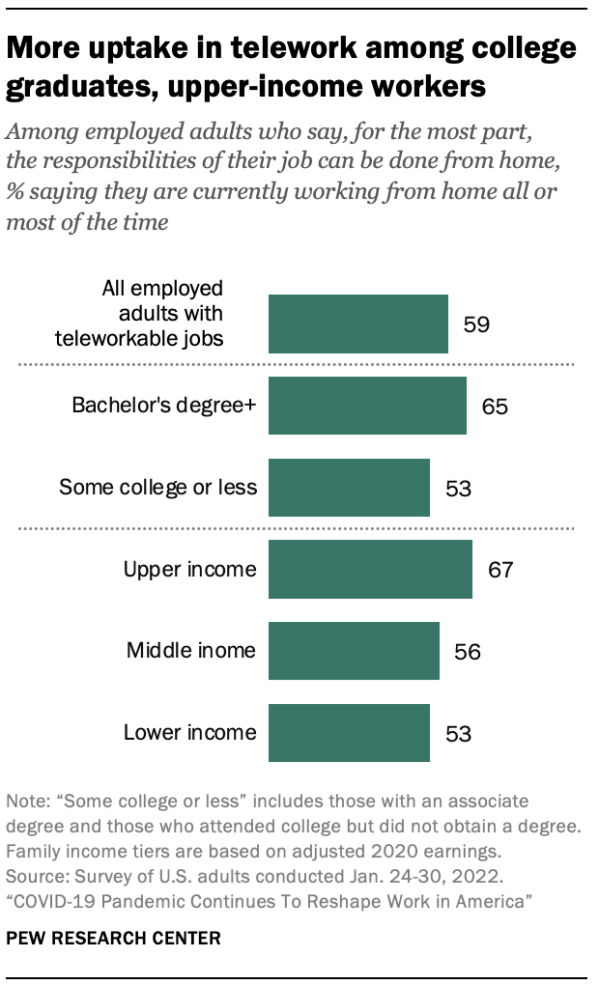
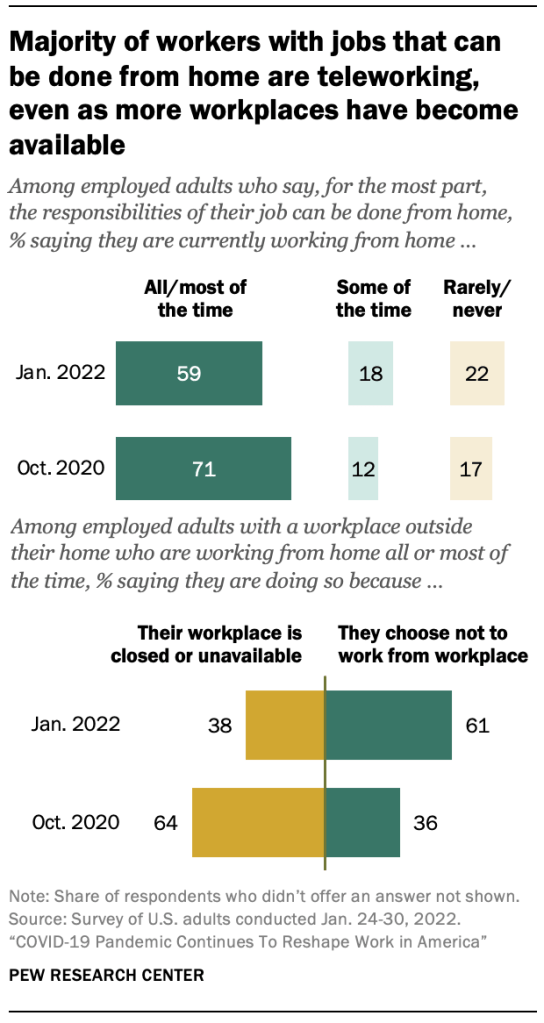
Nearly two years into the COVID-19 pandemic, roughly six-in-ten U.S. workers who say their jobs can mainly be done from home (59%) are working from home all or most of the time. The vast majority of these workers (83%) say they were working from home even before the omicron variant started to spread in the United States, according to a new Pew Research Center survey. This marks a decline from October 2020, when 71% of those with jobs that could be done from home were working from home all or most of the time, but it’s still much higher than the 23% who say they teleworked frequently before the coronavirus outbreak.
The impetus for working from home has shifted considerably since 2020. Today, more workers say they are doing this by choice rather than necessity. Among those who have a workplace outside of their home, 61% now say they are choosing not to go into their workplace, while 38% say they’re working from home because their workplace is closed or unavailable to them. Earlier in the pandemic, just the opposite was true: 64% said they were working from home because their office was closed, and 36% said they were choosing to work from home.
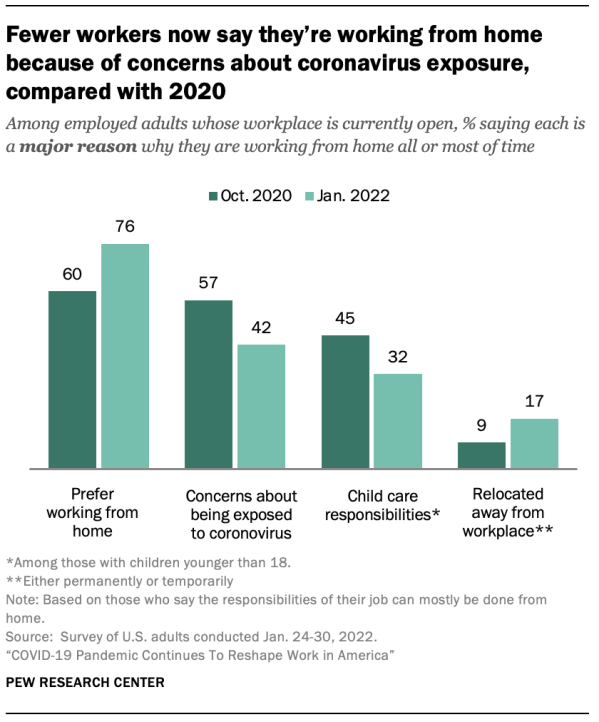
For those who do have access to their workplaces but are opting to work mainly from home, their reasons for doing so have changed since fall 2020. Fewer cite concerns about being exposed to the coronavirus – 42% now vs. 57% in 2020 say this is a major reason they are currently working from home all or most of the time. And more say a preference for working from home is a major reason they’re doing so (76% now vs. 60% in 2020). There’s also been a significant increase since 2020 (from 9% to 17%) in the share saying the fact that they’ve relocated away from the area where they work is a major reason why they’re currently teleworking.
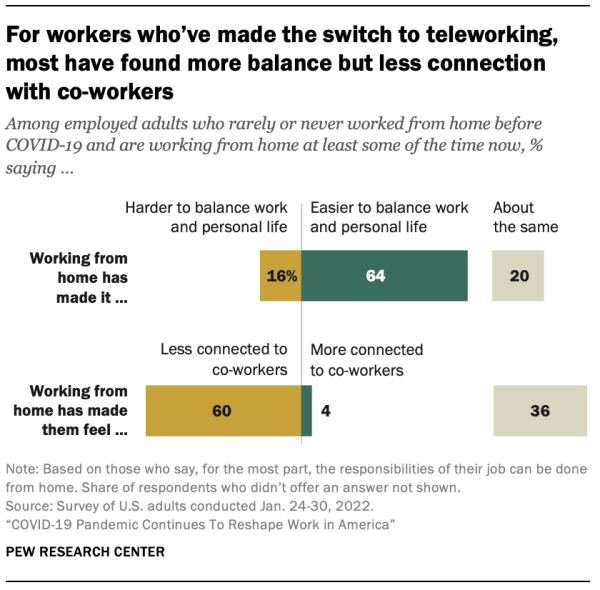
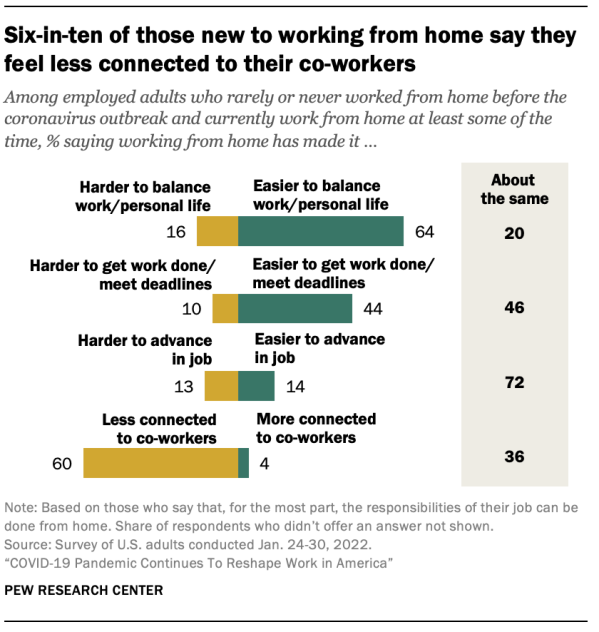
Working from home is a relatively new experience for a majority of workers with jobs that can be done remotely – 57% say they rarely or never worked from home prior to the coronavirus outbreak. For those who have made the switch to telework, their work lives have changed in some significant ways. On the plus side, most (64%) of those who are now working from home at least some of the time but rarely or never did before the pandemic say it’s easier now for them to balance work with their personal life. And many (44%) say working from home has made it easier for them to get their work done and meet deadlines, while very few (10%) say it’s been harder to do this. At the same time, 60% say they feel less connected to their co-workers now. Most (72%) say working from home hasn’t affected their ability to advance in their job.
Looking to the future, 60% of workers with jobs that can be done from home say when the coronavirus outbreak is over, if they have the choice, they’d like to work from home all or most of the time. This is up from 54% who said the same in 2020. Among those who are currently working from home all or most of the time, 78% say they’d like to continue to do so after the pandemic, up from 64% in 2020.
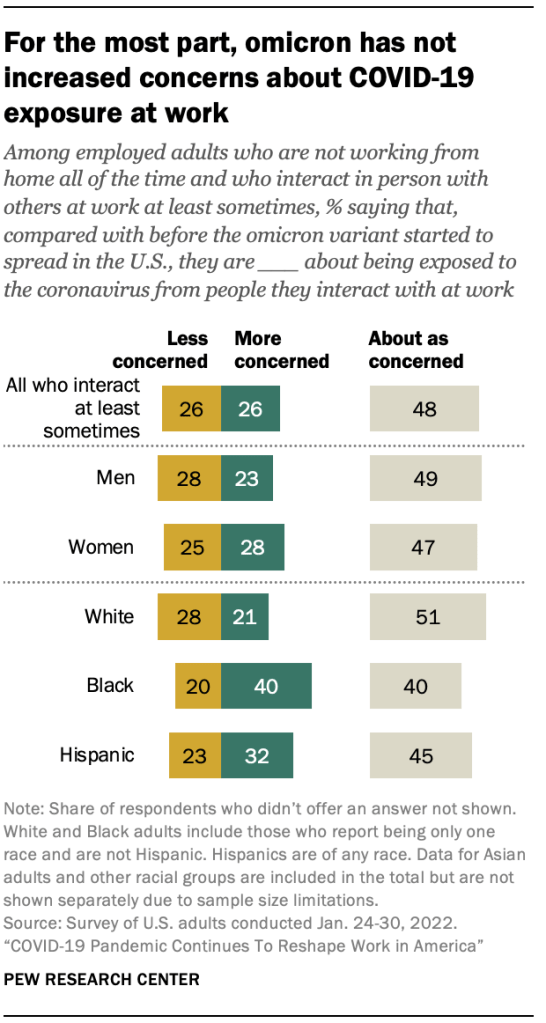
Most U.S. workers (60%) don’t have jobs that can be done from home, and others who do have these types of jobs are going into their workplace at least sometimes. For a large majority of these workers, their jobs continue to involve at least some in-person interaction with others at their workplace. About half of those who ever interact with other people at their workplace say they’re very (19%) or somewhat (32%) concerned about being exposed to the coronavirus. This is virtually unchanged from October 2020. Roughly one-in-four (26%) say they are more concerned about this now than they were before the omicron variant started to spread, and the same share say they are less concerned now. A plurality (47%) say they are about as concerned now as they were before omicron.
The nationally representative survey of 10,237 U.S. adults (including 5,889 employed adults who have only one job or who have multiple jobs but consider one to be their primary) was conducted Jan. 24-30, 2022, using the Center’s American Trends Panel.1 Among the other key findings:
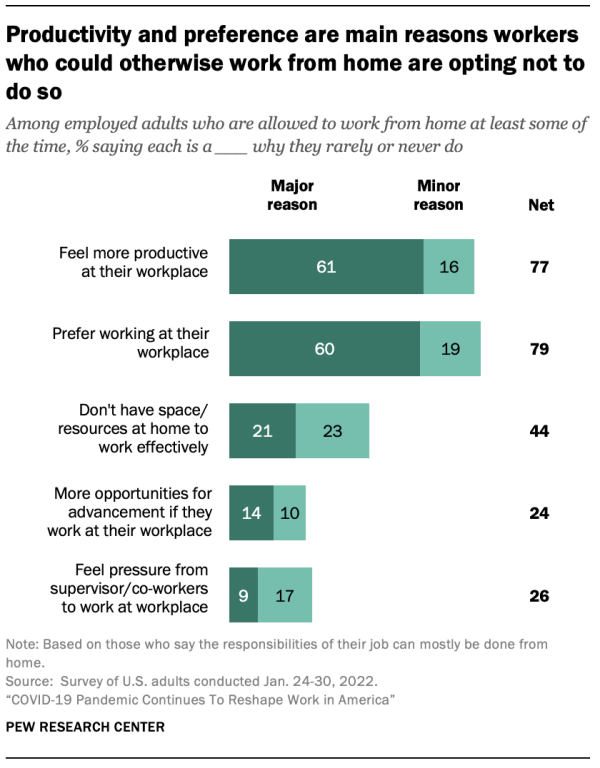
Workers with jobs that can be done from home who are choosing to go into their workplace cite preference and productivity as major reasons why they rarely or never work from home. Six-in-ten of these workers say a major reason they rarely or never work from home is that they prefer working at their workplace, and a similar share (61%) cite feeling more productive at their workplace as a major reason. Relatively few say major reasons for working in-person are that they don’t have the proper space or resources at home (21%), that there are more opportunities for advancement if they’re at their workplace (14%) or that they feel pressure from their supervisor or co-workers to be there (9%).
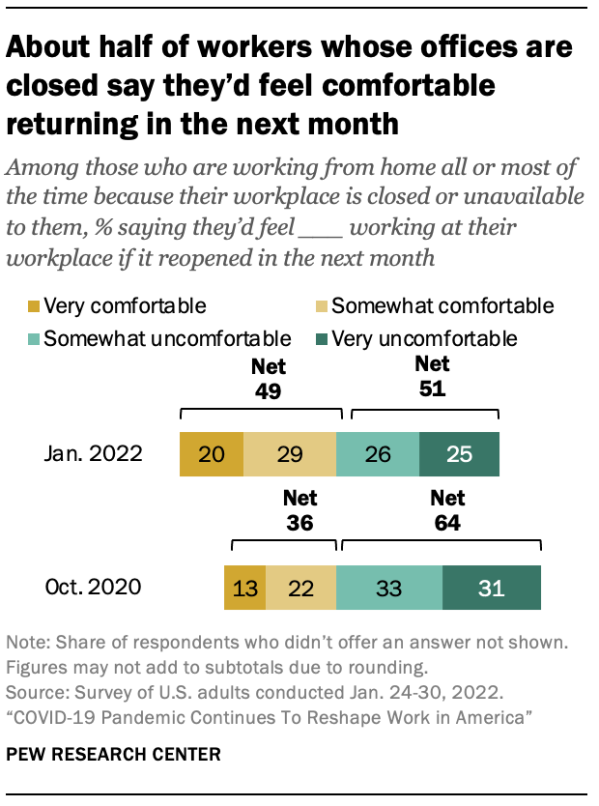
About half of workers who are working from home all or most of the time and whose offices are closed say they would be comfortable going into their workplace if it were to reopen in the next month. One-in-five say they’d be very comfortable returning to their workplace, and 29% say they’d be somewhat comfortable doing this. In October 2020, a smaller share of workers (36%) said they would feel comfortable returning to their workplace in the next month.
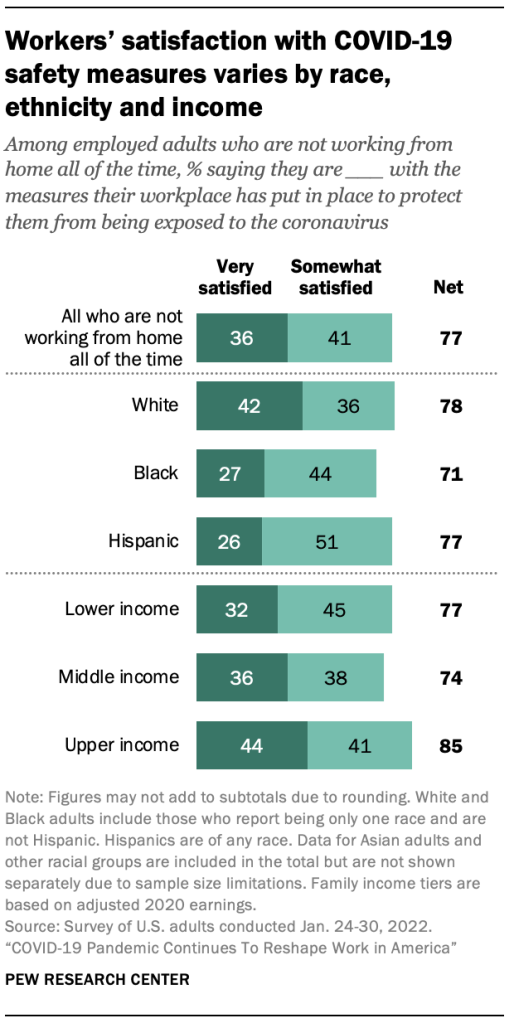
Most workers who are not working exclusively from home (77%) say they are at least somewhat satisfied with the measures their employer has put in place to protect them from coronavirus exposure, but only 36% say they are very satisfied. As was the case earlier in the pandemic, White workers are more likely than Black or Hispanic workers to say they are very satisfied with the safety measures that have been put in place. And upper-income workers are more likely to be very satisfied than middle- and lower-income workers.2
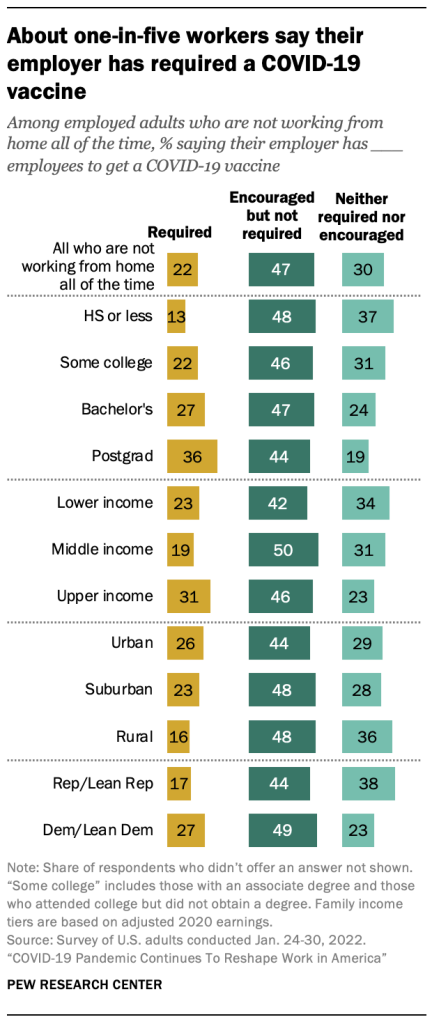
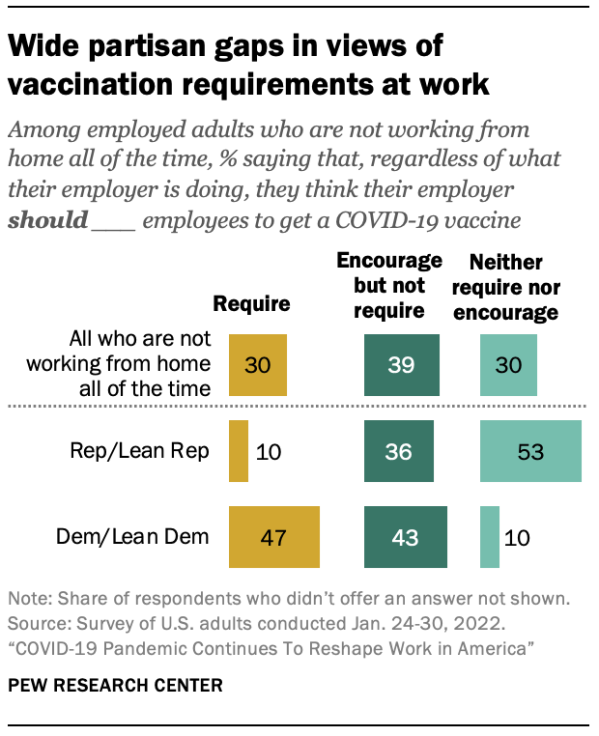
Roughly one-in-five workers who are not working exclusively at home (22%) say their employer has required employees to get a COVID-19 vaccine. About three-quarters (77%) say their employer has not required vaccination (47% say their employer has encouraged it and 30% say they have not). Regardless of what their employer requires, 30% of these workers think their employer should require vaccines, while most say their employer should not (39% say their employer should encourage but not require vaccines and 30% say their employer shouldn’t do either). These views are sharply divided along partisan lines: 47% of Democrats and those who lean to the Democratic Party who are not working exclusively from home think their employer should require employees to get a vaccine, compared with just 10% of Republicans and Republican leaners.
Frequency of telework differs by education, income
There are key demographic differences between workers whose jobs can and cannot be done from home. Among those who say the responsibilities of their job can mainly be done from home, some groups are teleworking more frequently than others.
College graduates with jobs that can be done from home (65%) are more likely than those without a four-year college degree (53%) to say they are working from home all or most of the time. And higher shares of upper-income workers (67%) are working from home compared with middle- (56%) and lower-income (53%) workers.
A plurality (44%) of all employed adults who are currently working from home all or most of the time say this is because they are choosing not to go into their workplace. About three-in-ten (28%) say their workplace is currently closed or unavailable to them, and a similar share (27%) say they don’t have a workplace outside of their home. The share saying they don’t have a workplace outside of their home is up significantly from 2020, when 18% said this. Adults without a four-year college degree are much more likely to fall into this category than those with a bachelor’s degree or more education (40% vs. 19%, respectively).
Workers who are currently teleworking all or most of the time because their workplace is closed or unavailable to them are divided over whether they’d be comfortable returning there in the near future. One-in-five say, if their workplace reopened in the next month, they’d be very comfortable working there; 29% say they would be somewhat comfortable. About half say they’d be either somewhat (26%) or very (25%) uncomfortable returning to their workplace in that timeframe.
In October 2020, workers had more trepidation about returning to their workplaces. At that time, only 36% of workers who were working from home because their office was closed said, if it were to reopen in the next month, they’d be comfortable returning (13% said they’d feel very comfortable working in their workplace, 22% said they’d feel somewhat comfortable). Roughly two-thirds said they’d be somewhat (33%) or very (31%) uncomfortable doing this.
Those who are teleworking by choice are less likely to be doing so because of health concerns, more likely to say they prefer it, compared with 2020
The reasons workers give for working from home when they could otherwise go into their workplace have changed considerably from October 2020. Today, a preference for working from home is driving these decisions rather than concerns about the coronavirus. Fully 76% of workers who indicate that their workplace is available to them say a major reason why they are currently teleworking all or most of the time is that they prefer working from home. An additional 17% say this is a minor reason why they are working from home, and 7% say this is not a reason. The share citing this as a major reason is up significantly from 60% in 2020.
At the same time, the share pointing to concerns about being exposed to the coronavirus as a major reason for working from home has fallen from 57% in 2020 to 42% today. About one-in-four teleworkers (27%) say this is a minor reason they are working from home, and 30% say it’s not a reason. Women (48%) are more likely than men (37%) to say this is a major reason they are working from home. There’s also a partisan gap: Half of Democrats and Democratic leaners cite concerns about exposure to the coronavirus as a major reason why they’re currently working from home all or most of the time, compared with 25% of Republicans and Republican leaners.
A smaller but growing share of workers (17%) say relocation to an area away from their workplace, either permanently or temporarily, is a major reason why they are working from home. An additional 8% say this is a minor reason they are working from home, and 75% say this is not a reason.
Among teleworking parents whose workplaces are open and who have at least one child younger than 18, 32% say child care is a major reason why they are working from home all or most of the time, down from 45% in October 2020. Some (15%) say a major reason why they are currently working from home is that there are restrictions on when they can have access to their workplace, similar to the share who said this in 2020 (14%).
Most workers who could work from home but are opting not to say a major reason is that they feel more productive at their workplace
About one-in-five workers (22%) who say the responsibilities of their job can mostly be done from home also say they rarely or never telework. For most (64%), this is because their employer doesn’t allow them to work from home more often. But for some (36%), there are other reasons why they’re opting to go into their workplace rather than working from home.
Again, personal preference is a driving force behind these choices. Six-in-ten of these workers say a major reason why they rarely or never work from home is that they prefer working at their workplace. An additional 19% say this is a minor reason why they don’t work from home more often, and 21% say this is not a reason. A similar share (61%) say a major reason why they rarely or never work from home is that they feel more productive at their workplace. Some 16% say this is a minor reason and 23% say it’s not a reason.
Relatively few (21%) say not having the space or resources at home to work effectively is a major reason why they rarely or never work from home; 23% say this is a minor reason and 55% say it’s not a reason.
When it comes to having more opportunities to advance at work if they are there in person or feeling pressure from supervisors or co-workers to be in the office, large majorities say these are not reasons why they rarely or never work from home. Only 14% point to opportunities for advancement as a major reason and 9% cite pressure from their colleagues.
A majority of new teleworkers say their current arrangement makes it easier to balance work and personal life
For those new to working from home, the pandemic-related shift to telework has changed some things while leaving others relatively the same. For example, among employed adults whose job can be done from home and who are currently working from home at least some of the time but rarely or never did before the pandemic, 64% say working from home has made it easier to balance work and their personal life. Two-in-ten of these adults say balancing work and their personal life is about the same, and 16% say it is harder.
Some 44% of those who shifted to telework at least some of the time during the pandemic say their new work arrangement makes it easier for them to get their work done and meet deadlines; a similar share (46%) say it’s about the same, while one-in-ten say it is now harder to get their work done and meet deadlines.
Some aspects of telework have been less positive, according to those who are now working from home at least some of the time but rarely or never did so before the pandemic. Six-in-ten of these workers say they now feel less connected to their co-workers. Some 36% say it’s about the same, and 4% say they are more connected to their co-workers.
Most workers new to telework (72%) say their ability to advance at work while working from home is about the same as it was before. Fewer than one-in-five say working from home has made it easier or harder to advance.
Assessments of how working from home has changed some elements of work life vary by gender. Women are about twice as likely as men to say working from home has made it easier to advance in their job (19% vs. 9%). And while about half of women who are new to telework (51%) say working from home has made it easier to get their work done and meet deadlines, 37% of men say the same. Men and women are about equally likely to say working from home has made it easier for them to balance work and their personal life.
For those who have at least some in-person interactions at work, concerns about COVID-19 exposure vary across demographic groups
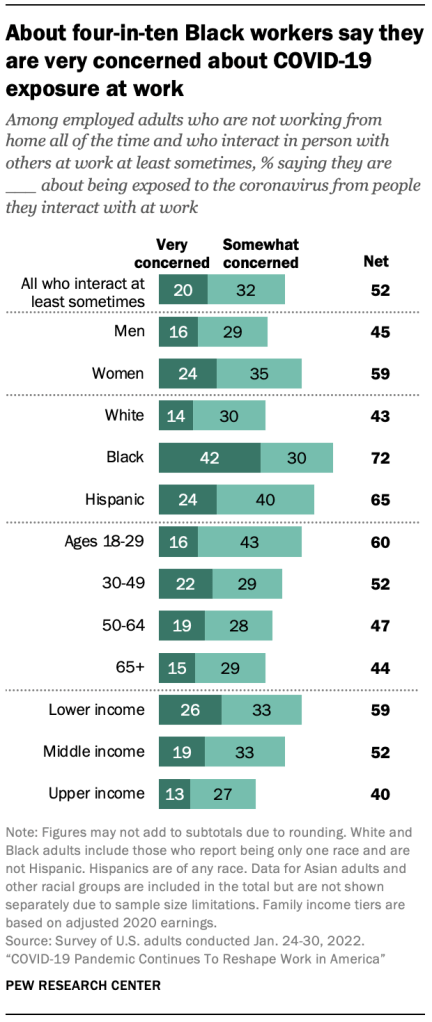
Fully 86% of workers who are not working exclusively from home – either by choice or because they can’t work remotely – say they have at least some in-person interactions with other people at their workplace. Among these workers, 52% say they are at least somewhat concerned about being exposed to the coronavirus from the people they interact with at work, including 20% who are very concerned. A similar share (48%) say they are either not too or not at all concerned. This is virtually unchanged from October 2020.
Black and Hispanic workers are more likely than White workers to express at least some concern about being exposed to the coronavirus at work (72% and 65% vs. 43%, respectively). But Black workers are particularly concerned: 42% say they are very concerned about COVID-19 exposure at work, compared with 24% of Hispanic workers and an even smaller share of White workers (14%).
Concerns about COVID-19 exposure at work also vary by gender, age and income. Women (59%) are more likely than men (45%) to say they are concerned about being exposed to the coronavirus from people they interact with at work. A majority of workers younger than 30 (60%) express at least some concern, compared with 52% of those ages 30 to 49, 47% of those ages 50 to 64 and 44% of those ages 65 or older. And workers with lower incomes (59%) are more likely than those with middle (52%) and upper (40%) incomes to say they are concerned about being exposed to COVID-19 from the people they interact with in person at work.
Workers who are fully vaccinated against COVID-19 and have received a booster shot are the most likely to express concerns about being exposed to the coronavirus from those they interact with in person at work: 66% of these workers say they are at least somewhat concerned, compared with 52% of those who are fully vaccinated but have not gotten a booster shot and just 25% of those who have not gotten any COVID-19 shots.
About half say they are as concerned about being exposed to the coronavirus at work as they were before the omicron surge
About a quarter of workers who are not working exclusively from home and who have at least some in-person interactions at work (26%) say they are more concerned about being exposed to the coronavirus at work than they were before the omicron variant started to spread in the U.S. in December 2021. The same share (26%) say they are now less concerned than they were before the new variant started to spread. About half (48%) say they are about as concerned as they were before.
Black (40%) and Hispanic (32%) workers are more likely than White workers (21%) to say they are more concerned about being exposed to the coronavirus from people they interact with at work than they were before the omicron surge. About three-in-ten employed women (28%) say they are more concerned now than before the new variant started to spread, compared with 23% of employed men.
A third of those who are fully vaccinated against COVID-19 and have received a booster shot say they are more concerned about being exposed to the coronavirus at work than they were before omicron started to spread. A quarter of those who are vaccinated but have not gotten a booster and just 10% of those who haven’t gotten any COVID-19 shots say the same.
Fewer than half of workers are very satisfied with the steps that have been taken in their workplace to keep them safe from COVID-19
Most workers who are not exclusively working from home (77%) say they are at least somewhat satisfied with the measures their workplace has put in place to protect them from coronavirus exposure, but just 36% say they are very satisfied. These assessments vary considerably by race and ethnicity, income and age.
As was the case earlier in the pandemic, White workers who are spending time in their workplace (42%) are far more likely than Black (27%) and Hispanic (26%) workers to say they are very satisfied with the measures that have been put in place to protect them from being exposed to COVID-19 at work. And while 44% of upper-income workers say they are very satisfied, smaller shares of those with middle (36%) and lower (32%) incomes say the same.
Across age groups, those younger than 30 are the least likely to say they are very satisfied with COVID-19 safety measures at their workplace, while those ages 65 and older are the most likely to say this. A quarter of workers ages 18 to 29 say they are very satisfied, compared with 35% of those ages 30 to 49, 44% of those ages 50 to 64, and 53% of workers 65 and older.
Vaccination requirements don’t seem to be related to these views. Some 39% of those whose employers have required employees to get a COVID-19 vaccine, and 35% of those in workplaces without a vaccination requirement say they are very satisfied with the measures that have been put in place to protect them from being exposed to the coronavirus.
Most workers say their employer doesn’t require COVID-19 vaccination
About one-in-five workers who are not working exclusively from home (22%) say their employer has required employees to get a COVID-19 vaccine. About three-quarters (77%) say their employer has not required vaccination (47% say their employer has encouraged it and 30% say they have not).
Workers with upper incomes (31%) are more likely than those with middle (19%) and lower (23%) incomes to say their employer has required employees to get a COVID-19 vaccine. Among workers with a postgraduate degree, 36% say their employer has a vaccination requirement, compared with 27% of those with a bachelor’s degree, 22% of those with some college and an even smaller share of those with a high school diploma or less education (13%).
Vaccination requirements are also more common in urban and suburban areas than in rural communities. About a quarter of workers in cities (26%) and suburbs (23%) say their employer requires employees to get the COVID-19 vaccine, compared with 16% in rural areas.
Democrats and those who lean Democratic (27%) are more likely than Republicans and Republican leaners (17%) to say their employer has required COVID-19 vaccination. These differences remain even after accounting for differences in education and income levels among these groups.
About nine-in-ten workers who say their employer has required employees to get a COVID-19 vaccine (92%) say they are fully vaccinated, including 58% who say they have received a booster shot. A smaller share of those who don’t have a vaccination requirement at work (65%) say they are fully vaccinated, with 38% saying they have received a COVID-19 vaccine booster.
Most workers don’t think their employer should require COVID-19 vaccination
The survey also asked employed adults who are not working exclusively from home what they think their employer should do when it comes to COVID-19 vaccinations, regardless of what their employer is doing. Three-in-ten say their employer should require the vaccine, while most (69%) say their employer should not (including 39% who say their employer should encourage but not require it and 30% who don’t think their employer should do either).
Somewhat similar shares of White, Black and Hispanic workers think their employers should require employees to get a COVID-19 vaccine, but Black workers are more likely than those who are Hispanic or White to say their employer should encourage employees to get vaccinated (55% vs. 43% and 37%, respectively).
Views on COVID-19 vaccination requirements vary widely along party lines. Some 47% of Democrats and Democratic leaners who are not exclusively working from home think their employer should require employees to get a vaccine, compared with just 10% of Republican and Republican-leaning workers. In turn, 53% of Republicans say their employer should neither require nor encourage employees to get vaccinated; only 10% of Democrats say the same.
Among those who say they think their employer should require employees to get the COVID-19 vaccine, 43% say their employer has, in fact, required it; 41% say their employer has encouraged it but not required it, and 15% say their employer has neither required nor encouraged vaccination. By contrast, a majority of those who think their employer should encourage but not require vaccination (64%) and those who say their employer should neither require nor encourage it (61%) say what their employer is doing is in line with what they personally think should be done.
No ice cream maker? No problem! Get ready to enjoy summer peaches at their best with this No-Churn Peach Cobbler Ice Cream. It’s easy and only takes 20 minutes to make. The hard part is waiting for it to freeze!
How to Make Ice Cream Without an Ice Cream Maker
Ice cream is not something you’re excluded from making if you don’t have an ice cream maker. Sure, the machine helps create a smoother frozen dessert, but don’t feel like you must have one in order to create your favorite ice cream.
The process is simple to follow: a flavor base is made with condensed milk, which is later folded into a mound of whipped cream. The condensed milk stands in for the cooked custard of a conventional ice cream, and the whipped cream lightens the mixture and adds that creaminess we should all expect from ice cream.
After combining both elements, the mixture is frozen and, after a few excruciating hours of waiting, you can dip joyfully into the ice cream.
Marta Rivera
Tips for Making Successful No-Churn Ice Cream
When it comes to this fruit-based, no-churn ice cream, ripe peaches are key! It’s the only way to ensure that sweet, peachy flavor shines through the creamy milk mixture. Using fruit that is soft to the touch is crucial. It’s how you know it’s ripe enough to taste in this recipe.
Full-fat heavy whipping cream must be used in this recipe to mimic the slow-churned mouthfeel of conventional ice cream.
Even with the full fat cream, no-churn ice cream will still contain more ice crystals than its churned cousin. To reduce ice crystal formation, I add vanilla extract and vodka. It’s not enough to make you tipsy, and the small amount of alcohol keeps the fruit from freezing rock hard. It’s an important part of this recipe.
Can You Use Frozen Peaches in No-Churn Ice Cream?
Yes, you can use a frozen peaches! Just taste them prior to pureeing them; you want to get a gauge on how sweet they are because we are using the uncooked fruit puree to boost the peach flavor.
If using frozen peaches, thaw the peaches and drain off any water (don’t worry—you won’t lose any peach flavor). Avoid adding any excess liquid to the peach puree because it will water down the condensed milk base, which will manifest itself as ice crystals in your batch of ice cream.
Marta Rivera
How Long Does No-Churn Ice Cream Last
Most commercial ice cream has stabilizers or anti-crystallization compounds to keep it fresh and prevent ice crystals from forming. Homemade ice cream doesn’t have that, so how you store it matters.
When stored in an ice cream container, no-churn ice cream will keep for one to two weeks. My ice cream never survives my family that long, though.
The Best Homemade Ice Cream Containers
While I prefer to freeze the ice cream in a metal loaf pan because it sets up better, once it’s frozen I transfer the ice cream to a plastic ice cream container with a tight-fitting lid. The container helps prevent freezer burn and preserve freshness.
No, you don’t have to go out and buy cute ice cream containers to make ice cream. You can use whatever you have around the house. Any container with a tight-fitting lid (even a paper quart container) is suitable for longer storage.
If you want to keep the ice cream in the metal loaf pan because you know you’re going to use it up within a day or so that’s fine too. Just press wax paper or parchment against the surface of the ice cream to prevent freezer burn.
Marta Rivera
No-Churn Ice Cream Swaps and Substitutions
Make this no-churn peach cobbler ice cream even more exciting:
Swap the vanilla wafers for graham crackers or gingersnaps
Add a tablespoon of fresh, chopped mint leaves to the peach puree
Use equal amounts of a different fruit (like nectarines or berries) for a different fruit-flavored ice cream.
If you want a really wild peach flavor, toss your peaches in sugar and roast them in a 350°F oven for 45 minutes. The caramelized peaches will taste more pronounced in the recipe. Just allow the peaches to cool before pureeing.
No-Churn Peach Cobbler Ice Cream
PREP TIME20 mins
TOTAL TIME20 mins
SERVINGS8 servings
If you don’t have access to fresh peaches, you can substitute frozen peaches in this recipe. Just make sure you thaw them, then drain off any excess liquid.
Ingredients
4 ripe medium peaches, pit removed
1 tablespoon vodka
1 tablespoon fresh lemon juice
1 teaspoon vanilla extract
3/4 teaspoon ground ginger
1/8 teaspoon ground nutmeg
Pinch kosher salt
1 tablespoon brown sugar, optional
14 ounce (400g) canned sweetened condensed milk
2 cups (475g) heavy cream
16 vanilla wafer cookies, crushed
Method
Make the peach chunks:Cut one peach into small chunks (about the size of a chickpea) and toss with the vodka. (If you don’t like peach skin you can peel the peaches, but I will leave that up to you.)
Make the peach purée:In a blender or food processor, purée the remaining peaches, along with the lemon juice, vanilla extract, ground ginger, ground nutmeg, and salt.Taste the peach puree. If it isn’t sweet enough for your tastes, blend in the brown sugar. If it’s sweet for you, leave it out.You should have 1 1/2 cups of peach puree.
Make the ice cream base:In a large bowl, whisk the peach purée and the sweetened condensed milk together vigorously for about a minute.
Whip the heavy cream:In a separate large bowl, use an electric mixer or stand mixer to whip the cold heavy cream until stiff peaks form. This should take 3 to 4 minutes.
Combine the ice cream base and whipped cream:Gently fold 1 1/2 cups of the peach ice cream base into the whipped cream using a rubber spatula.Once the 1 1/2 cups base has been folded into the whipped cream, transfer this whipped cream mixture to the bowl containing the remaining ice cream base.Gently fold the remaining base into the whipped cream mixture. Take care not to over-mix, fold the mixture just until the whipped cream no shows streaks in the base.
Assemble, then freeze the ice cream:Crush 8 vanilla wafers into the bottom of a large loaf pan. Top the cookies with the ice cream. Crush and sprinkle the remaining cookies on top of the ice cream. Strain the peach chunks and sprinkle them over the cookies. Use a spoon or small spatula to swirl the peach chunks and cookies into the ice cream.Press a piece of wax or parchment paper directly onto the ice cream to prevent ice crystals from forming. Place the pan into the freezer and freeze for 6 to 8 hours.
Warm and scoop:Ten minutes prior to scooping, remove the pan from the freezer to allow for easier scooping. Portion out your serving size, then transfer the rest to an air-tight container for maximum freshness.Enjoy the ice cream within 1 to 2 weeks for the best flavor.
Nutrition information is calculated using an ingredient database and should be considered an estimate. In cases where multiple ingredient alternatives are given, the first listed is calculated for nutrition. Garnishes and optional ingredients are not included.
Music is what keeps humans alive. If there were no music, there would be no dancing, no celebrating, and no community. You don’t have to know someone’s language to like a song. Music is a bridge to other people, to the present, and even to the past.
Music, specifically older music, connects us to the past in multiple ways. Through music, we can see pop culture trends- such as synths from the ’80s or acoustic grunge riffs from the ’90s. It is important to know music from the past because it is a way to connect the younger generations to the older generations. After all, music is a part of history–it’s a tell-all. If you want to learn about pop culture from any decade, music is one way to do so.
Music is a bridge from the past to the present because it gives younger generations the ability to connect with the generations before them. Adults used records, radios, and boomboxes to listen to music. Although all these things are still around, they are vastly unpopular. Music now is mostly streamed via the internet. Modern technological advancements have made listening to music easier than ever before, so there is no excuse as to why younger generations can not give older music a try. If younger generations learn to enjoy music from different decades, they can connect with adults in a new way.
So listening to old tunes on new platforms is a great way to expand your musical taste. Although I will admit I enjoy today’s music, I am also a nut for classic rock. Many pops and rap songs of today are sampled. When I listen to them, I can hear rhythms from music from the ’70s, ’80s, and ’90s. But not all teenagers enjoy music from before Y2K, and they are unable to understand, hear and appreciate these re-used samples. But did you know that even your favorite rappers, like Drake and Kanye, sample classic rock songs?
Songs You Didn’t Know Were Sampled
Who’s a big fan of rap? I know I am! Rap and hip-hop have taken over the pop culture scene in recent years. It has become the new pop. Pop icons that teens used to be people like Brittany Spears and Justin Bieber, but my generation loves rap/hip-hop, for example Kanye’s song “Hell of A Life” has millions of streams. But did you know that the aggressive rhythm and beat in the back is actually originally from Black Sabbath’s “Iron Man?” Or take Drake, for example, who sampled a 90’s rap song in one of his albums from 2014. In “Poundcake,” by Drake, you can hear “C.R.E.A.M” by the Wu-Tang Clan on repeat during the chorus.
Juice WRLD has also sampled music, his biggest hit song made me realize how music connects us through generations and shared experiences. His most popular song, “Lucid Dreams,” (2018) samples Sting’s “Shape of my Heart” melody. When I first heard it in middle school, I heard the guitar (Sting’s sample) and thought it was so beautiful and catchy. Juice WRLD’s song includes rap, and has an upbeat sound, but the Sting song is somber and sad sounding. What connects them is their shared exploration of emotions and heartbreak.
So when my mom played Sting’s “Shape of My Heart,” it made me more aware of the fact that Juice WRLD’s song was also a sad song even though the beats are happy. As for what the original artist thinks of remakes, you may be surprised. Sting actually commended Juice WRLD for his remake of the song, claiming it was one of the most beautiful remakes yet. They’ve even performed Juice WRLD’s version during concerts before. Sampling from an artist does not make another artist a thief. It is their way of paying tribute, and older artists can understand that. So it is important for fans of current musicians to see this kind of collaboration.
Honoring The Past
When artists sample music they are paying homage to legends. “Ice Ice Baby” by Vanilla Ice samples “Under Pressure” by Queen as his baseline. This is perhaps one of the most famously sampled songs, due to the fact these songs were produced so close to each other. And When Kanye sampled “Iron Man,” he explained that it was to pay tribute to Black Sabbath’s influence on rock and roll. Artists take samples to not only play homage or tribute to other artists but to also provide a sense of nostalgia for the listener. Older listeners will be able to recognize and enjoy these beats that take them back in time. It is also important for younger generations to recognize these samples too and see how music connects us from the past to the present.
If teenagers think that the artists they idolize created all these samples/sounds, they will never know the truth. Music is generational, and the more you know about music that is not from your own generation, the more you can appreciate it. When artists use the same music, they want a certain atmosphere in their song. By understanding that the sounds you hear are not solely created by a contemporary artist means you can better understand the music as a work of art on an even deeper level like I did with Juice WRLD.
Connecting To The Present
It is vital to recognize the legends who bought us these beats. If teenagers idolize artists thinking that they created all these samples, they will never know the truth. Art needs the past.
Difference between stealing and consciously using to be in a tradition or to honor an artist you like. If art never say anything or take false credit for their work, not only is it wrong, they are misleading an entire generation.
If rap and pop artists are attempting to honor other artists through their music, isn’t it evident they want their fan base to see that and to also enjoy the artist? Many teenagers don’t appreciate the samples behind these famous songs, and can’t appreciate the true beauty of the music.
So my advice? Go home and listen to some rock. See what you can hear and find, and try to make connections to modern music. You will not only discover some legendary music, but you will also be surprised at how much music you can recognize.





/https://static.texastribune.org/media/files/c5469a33fcac35e7a84cbba25411fb4b/Uvalde%20School%20Board%20KGB%2008.jpg)





/https://static.texastribune.org/media/files/7a7f244a8279759daacf5899a3a34d87/Chief%20Pete%20Arredondo%20EL%20TT%2003.jpg)







:max_bytes(150000):strip_icc():format(webp)/__opt__aboutcom__coeus__resources__content_migration__simply_recipes__uploads__2020__07__No-Churn-Peach-Cobbler-Ice-Cream-LEAD-3-8d9b92c147c34704b6eb0711aa6518d6.jpg)
:max_bytes(150000):strip_icc():format(webp)/__opt__aboutcom__coeus__resources__content_migration__simply_recipes__uploads__2020__07__No-Churn-Peach-Cobbler-Ice-Cream-LEAD-5-113e34202fec451d8f349731ba7c7afe.jpg)
:max_bytes(150000):strip_icc():format(webp)/__opt__aboutcom__coeus__resources__content_migration__simply_recipes__uploads__2020__07__No-Churn-Peach-Cobbler-Ice-Cream-LEAD-8-005ebd6414844c38acb36f059b5cc136.jpg)
:max_bytes(150000):strip_icc():format(webp)/__opt__aboutcom__coeus__resources__content_migration__simply_recipes__uploads__2020__07__No-Churn-Peach-Cobbler-Ice-Cream-METHOD-1-fe227ddd7c604a6db2b7e0775bc82c92.jpg)
:max_bytes(150000):strip_icc():format(webp)/__opt__aboutcom__coeus__resources__content_migration__simply_recipes__uploads__2020__07__No-Churn-Peach-Cobbler-Ice-Cream-METHOD-2-814b81158f454ba380d91f07ed0296fb.jpg)
:max_bytes(150000):strip_icc():format(webp)/__opt__aboutcom__coeus__resources__content_migration__simply_recipes__uploads__2020__07__No-Churn-Peach-Cobbler-Ice-Cream-METHOD-3-29dcc637eaf34a2296a7e1ae0bb7be42.jpg)
:max_bytes(150000):strip_icc():format(webp)/__opt__aboutcom__coeus__resources__content_migration__simply_recipes__uploads__2020__07__No-Churn-Peach-Cobbler-Ice-Cream-METHOD-4-b2700ca5f0ba4548831b4de63c46dfac.jpg)
:max_bytes(150000):strip_icc():format(webp)/__opt__aboutcom__coeus__resources__content_migration__simply_recipes__uploads__2020__07__No-Churn-Peach-Cobbler-Ice-Cream-METHOD-5-5738ae7e0cce494b9463936bbf81f8d2.jpg)
:max_bytes(150000):strip_icc():format(webp)/__opt__aboutcom__coeus__resources__content_migration__simply_recipes__uploads__2020__07__No-Churn-Peach-Cobbler-Ice-Cream-METHOD-6-c73c275d385043c6ade30f241e746637.jpg)
:max_bytes(150000):strip_icc():format(webp)/__opt__aboutcom__coeus__resources__content_migration__simply_recipes__uploads__2020__07__No-Churn-Peach-Cobbler-Ice-Cream-METHOD-7-6213ed3a9c674a9f9f9c4c669cbf122f.jpg)



 HPS Magazine