
Poetry, Arts, Cooking, Communication, Culture and More!

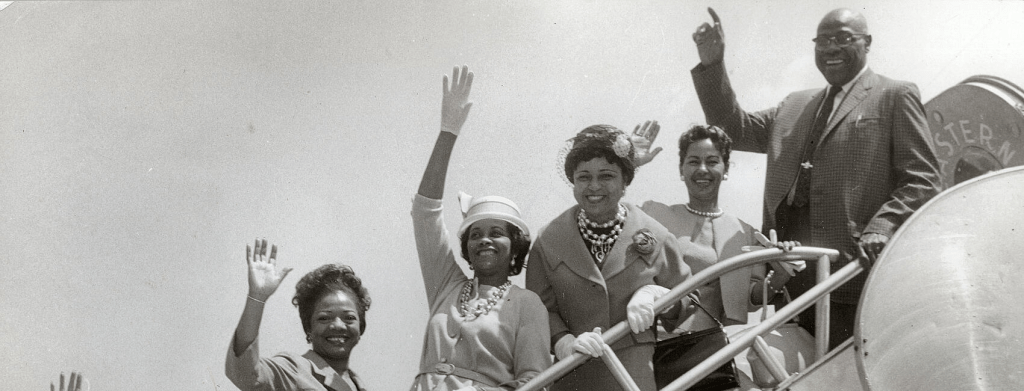
The fact that transportation was a segregated business in the American South for many decades of the twentieth century is well known. Many older African Americans who grew up in the South painfully remember the time when black passengers had to sit in the back of busses or use separate train compartments; and when train stations and bus terminals provided separate but mostly unequal facilities such as drinking fountains, restrooms, waiting lounges, and eating facilities for black and white passengers.
Most people I talk to about my research are surprised to learn that segregation laws also regulated access to air transportation well into the post-war period. While African American travelers enjoyed free and unrestricted access to the aircraft cabin, and the airlines, as federally regulated businesses for the most part, provided non-discriminatory services to all passengers, many airports across the South subscribed to so-called Jim Crow practices. Studies conducted in the mid-1950s by the National Association for the Advancement of Colored People (NAACP) and Congressman Charles Diggs, a Democrat from Michigan, showed that in fact the vast majority of Southern airports provided duplicate waiting rooms, restrooms, and dining facilities in order to separate the races in their use of airport terminal space. To many critical observers such as Diggs it seemed absurd that travelers who were en route to enjoy the most modern means of transportation – the airplane – had to subject themselves to the humiliating experience of having to pass through segregated terminals. Local municipalities, in charge of airport management, in most instances ruthlessly enforced segregation claiming local laws or local customs as the basis for their actions. Eager to preserve the South’s system of institutionalized racism, mayors and airport managers in places such as Jackson, Mississippi, Montgomery, Alabama, and New Orleans, Louisiana, resisted change. They saw no contradiction between the shiny exteriors of their newly constructed modern terminals and the datedness of the rules that structured their use.
Opposition to airport segregation began to express itself as early as the 1940s, when National Airport in Washington, DC became a target. To many observers it was a particular embarrassment that foreign dignitaries had to pass through segregated spaces at a facility which not only served as the gateway to the nation’s capital but was run by the federal government. The fact that at the time the District of Columbia still practiced segregation did not alleviate the criticism but rather enforced it. Civil rights organizations like the NAACP demanded that something be done and supported Helen Nash’s lawsuit against the airport in 1948. While the courts deliberated the merits of her case, which would ultimately go nowhere, the Administrator of Civil Aeronautics, the head of the federal agency responsible for the regulation of aviation and the administration of the country’s only federally-owned airport, stepped up his act and ordered the integration of the airport by way of amending the Washington National Airport Act in December 1948. Considered a bold regulatory move at the time, it ended discrimination at National Airport and enabled travelers to enjoy terminal services without “segregation as to race, color, or creed.”
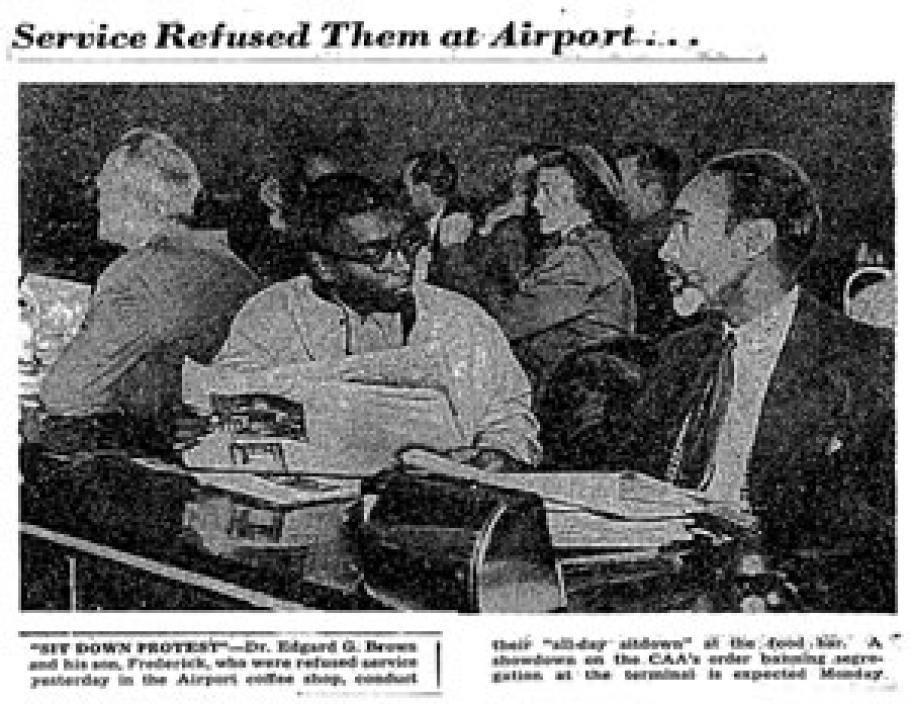
Due to the special ownership structure at National Airport, the case could not be used to force airports elsewhere into compliance with the government’s new anti-segregation policy. Instead, the fight against airport segregation had to be fought on a case by case basis. It involved different actors: civil rights organizations, individuals, and federal agencies. And it relied on various strategies: direct action, litigation, and statutory reform. The airport in Atlanta was one of the first airports to be hit by direct action in 1959. Protesters had appeared before city councils and airport authorities. But until then none had staged protests in the locations where black air travelers experienced discrimination. The Atlanta Airport protest was organized by The Congress for Racial Equality (CORE) and is best described as an eat-in. It was carried out by an interracial group of activists who went to the segregated Dobbs House restaurant on August 8, 1959 to have lunch together. Unable to receive service for all members of the group they shared the meals they were able to buy and were asked to leave by the airport management thereafter. Although the protest did not lead to the immediate integration of the airport, James R. Robinson, CORE’s executive secretary, encouraged others to imitate it in an interview with the Cleveland Call and Post on August 8, 1959: “We all agreed,” he said, “that it was the best coffee we had ever had – the extra tang of drinking your coffee interracially across the Georgia color bar is highly recommended!”
Over the course of the next two years, more airports were targeted by direct action campaigns: CORE staged a “prayer pilgrimage” at the Greenville Airport in South Carolina; a group of CORE Freedom Riders targeted the airport in Tallahassee, Florida; students from the local colleges staged a protest at the Raleigh-Durham Airport. As a result of the protests, all three airports were desegregated.
Direct action protest was flanked by efforts to challenge segregation in the courts. The NAACP had long championed litigation as an effective road to integration and helped plaintiffs bring suit. This resulted in a number of individual damage suits against airport administrators and airport restaurants filed during the 1950s. But litigation was a slow and tedious process that moved from case to case. With an urgency that increased in the late 1950s and early 1960s civil rights leaders also tried to put pressure on the federal government and its regulatory agencies. They demanded the enforcement of existing anti-discrimination provisions in the Federal Airport Act and otherwise called for statutory reform. The Civil Aeronautics Administration, subsequently organized as the Federal Aviation Administration, was slow to react but eventually joined the fight against Jim Crow practices. Its attention focused on the Federal Aid Airport Program, a grant-in-aid program designed to subsidize airport construction across the country, as a way of preventing the construction of segregated airport facilities.
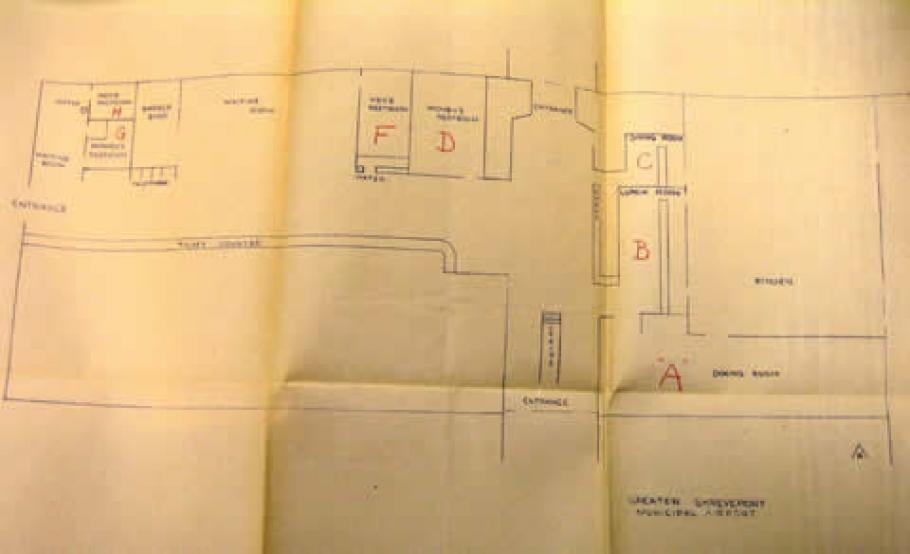
Finally in the early 1960s, the Department of Justice weighed in. In 1961, it initiated law suits against the airports in Montgomery, Alabama, and New Orleans. The following year, it filed actions against the airports in Shreveport, Louisiana and Birmingham, Alabama. In the leading case against Montgomery, the Justice Department produced testimony, images, and floor plans to prove that the airport management and the restaurant proprietor had systematically discriminated against black travelers by posting signs and segregating along racial lines the airport’s waiting, eating, drinking, and restroom facilities. The court ruled in favor of the government in January 1962 and ordered the integration of the airport. The case served as the precedent upon which the other cases were decided. Shreveport was the last airport to be forced into compliance. Losing its appeal against court ordered integration, the last signs at an American airport leading travelers to segregated facilities were ordered to come down on July 10, 1963.
By Anke Ortlepp, Verville Fellow



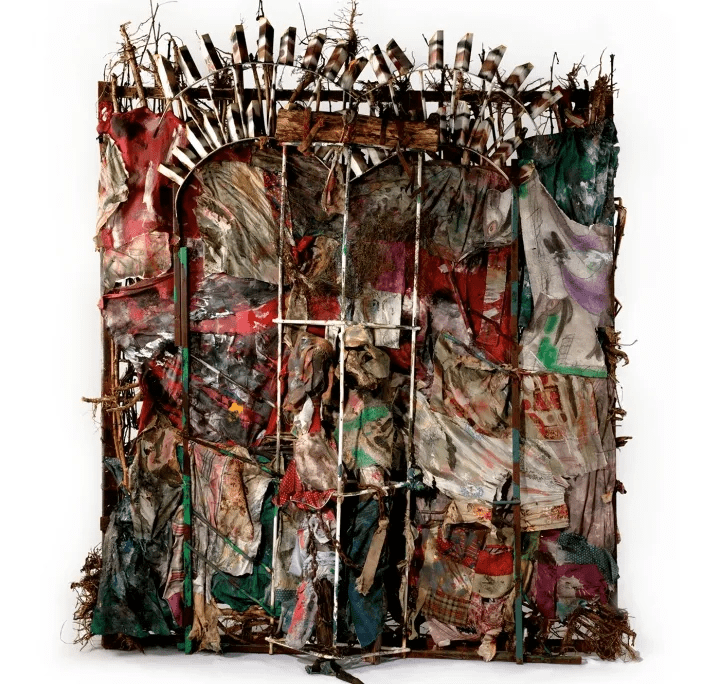
Thornton Dial, “History Refused to Die” (2004) The Metropolitan Museum of Art, New York, Gift of Souls Grown Deep Foundation from the William S. Arnett Collection, 2014
WNYC’s art critic Deborah Solomon predicts that many of the artists featured in a recently opened show at the Metropolitan Museum of Art will soon become household names.
It’s a high bar, but one that History Refused to Die excites. The exhibition highlights 30 works by self-taught black artists from the American South. This is the first time the Met has exhibited works by these historically excluded artists. By presenting their sculptures, paintings, quilts and other artistic works alongside the Met’s 20th-century collection, the artists—considered Outsider artists for their nontraditional approaches or mediums—are finally being given the recognition they deserve.
The show, originated by former Met curator Marla Prather and organized by Randall R. Griffey, curator in the department of modern and contemporary art, and Amelia Peck, curator of American Decorative Arts, comes from a selection of works donated to the museum by the Atlanta-based Souls Grown Deep Foundation.
The organization has collected an estimated 1,100 works by more than 160 self-taught African-American artists, two-thirds of whom are women, since 2010. Starting in 2014, the foundation began presenting these works to institutions and museums throughout the world.
The Met spent almost two years considering which pieces to select for the exhibition, according to The New York Times’ Roberta Smith. Much of the work on view was built from found or scavenged materials, like cans or clothing. Take Thornton Dial’s 2004 piece “History Refused to Die,” from which the exhibition takes its name. The sculpture measures 9 feet tall and was built from okra stalks, clothes and chains. The American artist and metalworker, who died two years ago, is perhaps the best-known artist in the show, and nine of his pieces are showcased.
Ten intricate, hand-sewn patchwork quilts created in Alabama’s remote black community of Gee’s Bend are also on view. According to the Souls Grown Deep website, the approximately 700-strong community has been producing masterpieces since the mid-19th century; the oldest surviving textile goes back to the 1920s. “Enlivened by a visual imagination that extends the expressive boundaries of the quilt genre, these astounding creations constitute a crucial chapter in the history of African American art,” the organization writes.
Souls Grown Deep, which was founded by art historian and collector William Arnett, traces the history of many of these Outsider artist creations back to the collapse of agricultural economy in the aftermath of the Civil War, when African-Americans were forced to migrate out of rural areas to bigger cities in search of work. One of these places was Birmingham, Alabama, where there were iron and steel industry jobs and where black art started to take shape through quilting and funerary.
Black folk artists had reasons aside from stylistic ones to use scavenged material: Many of them were poor, so they worked with what they had.
The tradition of using everyday objects in artwork is known as assemblage. The Tate Museum traces its history back to Europe the early 1900s when Pablo Picasso started making 3-D works with found objects. However, as Solomon points out, some of the best-known mid 20th-century assemblage artists, like the artist Robert Rauschenberg—born Milton Rauschenberg in Port Arthur, Texas—may have pulled their inspiration from work by these black folk artists.
In her review about History Refused to Die she muses that there’s a compelling case that assemblage “may have originated in the vernacular culture of the South.”
“If [the Met] had included works from the ‘40s and ‘50s and put everything in context, then we could show how the assemblage tradition, which was part of black vernacular culture, influenced artists,” Solomon writes.
The works on view are more recent, many dating from the 1980s and ’90s. As Solomon says, that just calls attention to the need for another show to specifically grapple with how these artists influenced the discipline.



 HPS Magazine