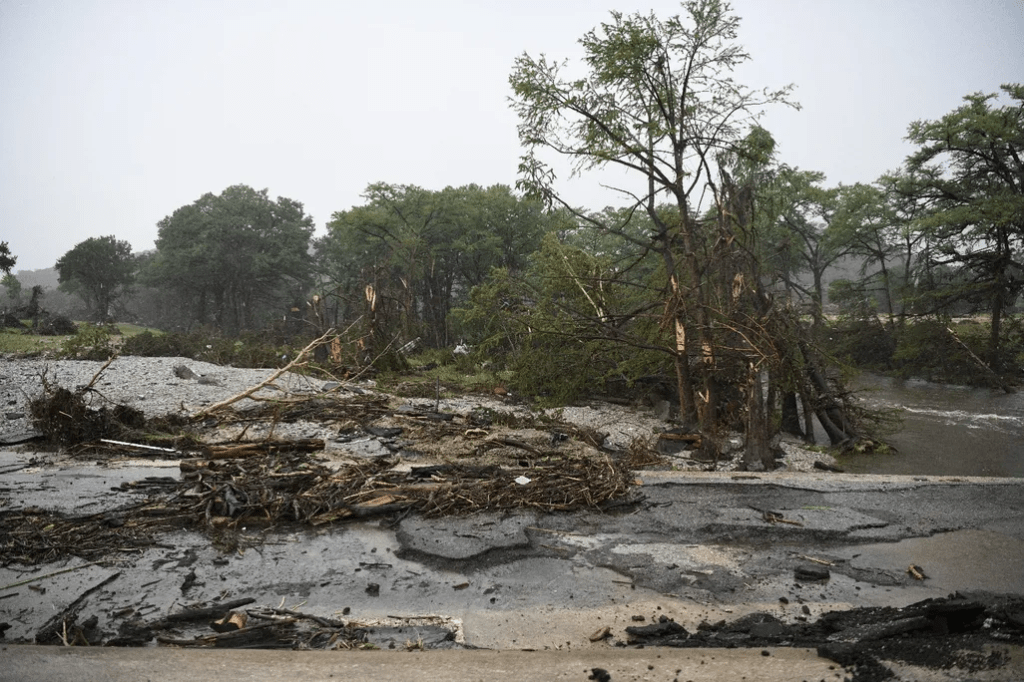
Fifteen large prints were probably left behind by meat-eating dinosaurs, and they were revealed as floodwaters washed away dirt in early July
Last month’s extreme floods in central Texas have uncovered 115-million-year-old dinosaur tracks in Travis County, which includes Austin. While the discovery is overshadowed by the deaths of more than 138 people at the hands of the very same natural disaster, it sheds further light on the state’s richly preserved paleontological history.
“It’s one of those sort of bittersweet things about our job, is that it’s the cataclysmic events that often preserve fossils in the first place and then also are exposing them,” Matthew Brown, a paleontologist at the University of Texas at Austin, tells KUT News’ Katy McAfee.
While cleaning up after the floods, a volunteer sent a picture of suspected dinosaur tracks to Travis County Judge Andy Brown, who announced the find at a Travis County Commissioners’ Court meeting, as first reported by KXAN’s Eric Henrikson.
“The tracks that are unambiguously dinosaurs were left by meat-eating dinosaurs similar to Acrocanthosaurus, a roughly 35-foot-long bipedal carnivore,” Matthew Brown tells CNN’s Gordon Ebanks and Zenebou Sylla.
The discovery consists of 15 large footprints, each about 18 to 20 inches long with three claws. Given that the tracks are in a rock layer called the Glen Rose Formation limestone, which is around 110 million years old, the tracks themselves are approximately 110 million to 115 million years old, the paleontologist adds.
Brown and Kenneth Bader, also a paleontologist at the University of Texas at Austin, surveyed the tracks on August 5 and instructed authorities on how to best conserve them throughout the cleanup endeavors, reports ABC News’ Doc Louallen. “We expect to return to the site in the near future to more thoroughly document the tracks with maps and 3D imaging,” Brown tells ABC News.
His team also hopes to figure out whether a group of dinosaurs left the tracks, or if it was a bunch of individuals traveling independently. What’s more, they also identified other nearby tracks that might have been left behind by Texas’ state dinosaur: the large herbivore Paluxysaurus.
The tracks are on private property, where researchers had previously confirmed other dinosaur footprints in the 1980s, per the Dallas Morning News’ Lauren Nutall. Brown tells the newspaper that since the discovery first appeared in the media, several other people in the region have reached out to report potential dinosaur remains revealed by the July floods.
While the nearby Kerr Country experienced the greatest devastation and casualties, Travis County’s typically very dry Sandy Creek, where the tracks were found, swelled to 20 feet because of the floodwaters, per CNN. “That washed away trees. It washed away cars, houses, anything in its path,” Brown tells the network. “So, in this part with the dinosaur tracks … it tore down the trees around them and it also washed away the dirt and gravel that was over the other set of them.”
Given that central Texas is a paleontological hotspot, the recent discovery joins a host of other dinosaur remains in the state. “I wouldn’t call it run of the mill, but what I would say is this is another data point that continues to help flesh out our understanding of the paleobiology and the behavior and the lifestyles of these animals,” Ron Tykoski, curator of vertebrate paleontology at the Perot Museum of Nature and Science in Dallas, tells the Dallas Morning News. Brown notes to ABC News that the discovery will not impede the area’s continuing flood cleanup efforts.
Margherita Bassi – Daily Correspondent
/https://tf-cmsv2-smithsonianmag-media.s3.amazonaws.com/accounts/headshot/Margherita_Bassi.png)

 HPS Magazine