LOTTIE “THE BODY” GRAVES CLAIBORNE
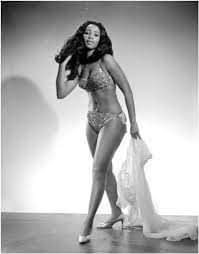
Lottie “The Body” Tatum-Graves-Claiborne (October 31, 1930 – February 28, 2020) was an American burlesque dancer who performed from the late 1940s to the early 1980s. She was given the nickname “Lottie the Body” when she was a teenager working in modeling. She also became known as the “Black Gypsy Rose Lee” and the “Gypsy Rose Lee of Detroit.” Born and raised in New York, her career in burlesque began in San Francisco, and later she moved to Detroit. Lottie was renowned for her support of other exotic dancers, musicians, and entertainers. During her lengthy career, she worked throughout the U.S. and in numerous other countries, performing with many of the great singers, comedians, musicians, and dancers of her era.
When Lottie lived and performed in San Francisco in the late 1940s and early 1950s, she also traveled the country to work. She became a popular performer in Arthur Bragg’s Idlewild Review at the Paradise Club in Idlewild, a resort town dubbed the “Black Eden of Michigan.” There she was known as the “Black Gypsy Rose Lee.” She eventually made Detroit, Michigan, her home base.
Throughout her career, her strip show used Afro-Cuban music and choreography, and she wore elaborate costumes. Her routine included removing clothing, but no nudity. At times she removed no clothing at all, but enchanted her audiences with her performances in either case. Her technique made her enormously popular, and she was in high demand in venues around the country and in other countries. A racketeer in Indianapolis even built a nightclub for her, called the Pink Poodle.
Lottie worked alongside many performers – comedians, singers, musicians, and dancers – who were popular in that era, including Redd Foxx; T-Bone Walker; Della Reese; Billie Holiday; Sammy Davis, Jr.; Aretha Franklin; Miles Davis; Sam Cooke; Bessie Smith; B.B. King; Louie Armstrong; Martha Reeves; the Four Tops; the Rhythm Kings; Sarah Vaughn; Cab Calloway; Dinah Washington; Fats Waller; Totie Fields; a number of Motown groups; and others.
Supporting and mentoring other performers, especially dancers, was important to Lottie. Christine Jorgensen, a nightclub entertainer who was the first well-known transsexual in the US, became one of her best friends. Lottie felt strongly about supporting others regardless of sexual orientation. She also met many famous people who were not in the entertainment business, like politicians and government leaders. While traveling with the Harlem Globetrotters to Cuba before Communism in that country, they met Fidel Castro. She found him to be “a sweet little man,” having no idea he would become a Communist revolutionary.
Early in her career, when she was married to Tatum, she often served as an unpaid MC for the Globetrotters. By the time she was in her fifties, she danced less and worked as an MC more, at Detroit night clubs. Her effervescent personality made her popular with club audiences. She retired at age 61. When she needed a walker late in her life, she laughed and said it was because she’d done the splits one too many times.
***Lottie believed that she lived her “own sort of Civil Rights Movement”, making friends and connections in her own way everywhere she went. However, at times she was treated like a second-class citizen because she was black. Those times were surprisingly rare, she said, especially considering that African Americans were not always welcome while the U.S.A. was mired in an era of inequality and bias. The Civil Rights Movement, with African Americans campaigning for equality, lasted throughout the 1950s and 1960s. During that time of protest and struggle, Lottie felt that she was treated respectfully most of the time, by black and white people, men and women. She recalled with fondness being the first black woman to dance on television in Alaska, where she was treated like “a queen.” The wives of political leaders in other countries would take her shopping, and she was invited to be a guest in the Dodge family (the car people) summer home in Michigan. Although she experienced some of the bigotry many African Americans experienced, like occasionally not being allowed in the front door of a club and having deplorable sleeping quarters, for the most part she felt that her career afforded her some privileges that not all black people experienced. Fame had its advantages. She had worked long and hard to build that career, and conducted herself in a way that demonstrated that she knew she deserved to be respected for her efforts. She expected nothing less, but did not let it stop her when she did not get it.
 HPS Magazine