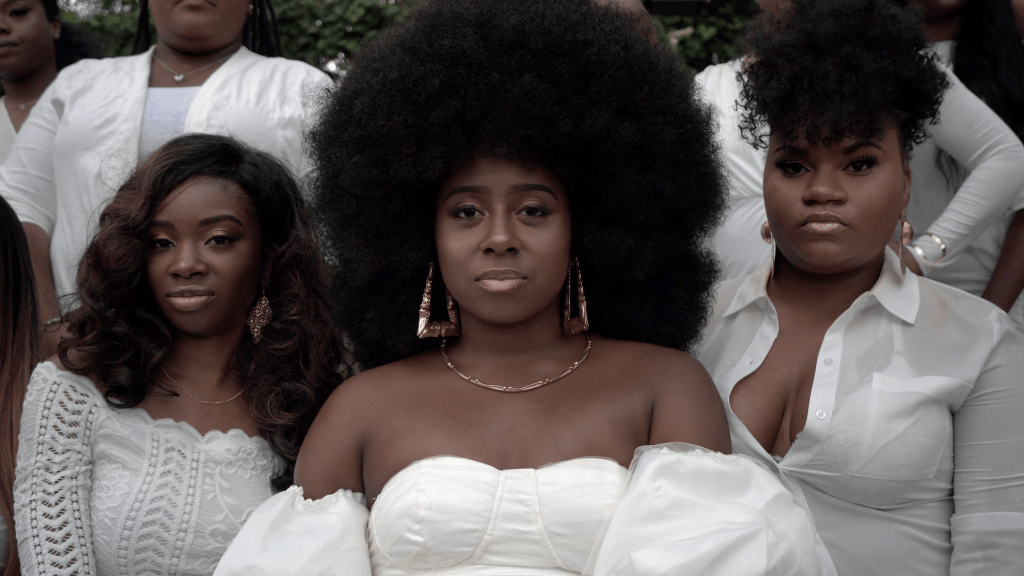
Now that we are returning to the office, it is time to talk about the racism behind what is considered correct office attire.
When you google “unprofessional hair for work,” most of the results show black women with their natural hair. Check “professional hairstyles,” and you will find mainly coiffed white women. This has been the case for years, it was first called out on Twitter by @HereroRocher.
The only change today is that amongst the top results you also find references to articles about @Hererorocher’s tweet.
While some people suggested that the results show the racism of the Google algorithm, in reality, it seems more likely that the results are a mirror of the opinions of society at large.
For much of Western history, naturally curly black hair has been deemed unprofessional or even dirty, seen as a sign of laziness and lack of personal grooming, especially in places of work.
Only last year did the US Army revise its regulations on grooming and appearance, including a ban on dreadlocks. Until then, black women were not allowed to wear their natural hair on the job.
Some companies have even fired employees for the way their hair looked. Brittany Noble, a former TV news anchor in Mississippi, started wearing her hair naturally after she became pregnant with her son. Ater only a month, her news director asked her to change her hairstyle back to her previous look because it was “unprofessional.”
“One day, my boss said, hey, look, the real problem is your hair. It’s unprofessional. It was the equivalent of me wearing a baseball cap to go to the grocery store, and that viewers needed to see a beauty queen,” she told PBS. “It felt like, not only were you telling me that my hair was unprofessional. You’re telling the people in our community, the people that look like me that our hair is unprofessional, that our look is unprofessional. I didn’t feel like I could vocalize my feelings at the time. But it certainly hurt.”
She filed a complaint with the Equal Employment Opportunity Commission, and, a month later, she was fired. The EEOC said it couldn’t determine whether there had been discrimination. Last year, Noble sued the station’s parent company for race discrimination. The case is still ongoing.
Discrimination because of black hair is also present in schools. In 2018, a referee in New Jersey forced a high school wrestler to cut off his locs before competing in a match. Last year in Texas, another high-school student was suspend, and told he couldn’t walk at his graduation ceremony because his locs were “too long.”
2020 research from Duke University confirmed that bias against natural hair limits job opportunities for Black women. The study showed that Black women with natural hair were seen as less competent and professional than black women with straight hair, white women with curly hair, and white women with straight hair. They were also not recommended as frequently for interviews, according to the study authors.
Black women speak up about hair-based discrimination
Like Noble, many women have started talking about the hostile reactions they have faced due to their natural hair.
Thobe Mak, a salon manager at Sheldeez Salon told PBS about how her black clients are afraid to wear their hair naturally:
“A lot of times, when we talk to our clients who are in the corporate setting, most of the conversations are along the lines of: I’m in a predominantly non-Black environment, so I can’t go in looking like my hair is not being taken care of, because there seems to be that assumption or that bias that, if you have natural hair, you’re not taking care of it.”
Minda Harts, CEO of The Memo LLC, a career development company for women of color, told
“The careers of many Black women have been deferred due to discrimination around our hair … I remember having a conversation with a white woman who is a recruiter for board placements. She told me flat-out that she will only advance Black women with straight hair as potential nominees for board placement because she knows her clients will perceive them as more professional.”
22-year-old Nyria told Shape::
“In 10th grade, my high school exposed us to year-long internships around the city. We completed applications and interviews; I thought I truly aced all of them, but when it was time to review my feedback, the majority of it was about my professional attire. I was so confused because I had worn typical corporate attire: blazer, blouse, long black pants, comfortable working flats, minimal jewelry. What was wrong? And then it hit me: Was it my hair? (…) Because I was such a people-pleaser in high school, I caved and decided to take my twists out and wore a weave to my next interview; low and behold, I got the internship at a local children’s hospital.”
Jodi, aged 31, also shared her experience of a job interview where she was called out because of her hair:
“I was prepared, qualified, and the interviewer and I had built an amazing rapport. Mid-way through the laughter and me feeling super confident the interviewer paused abruptly and said, ‘Jodi only thing is for the final interview I think you should push your hair back. I mean I get it and I love your look but it’s a bit much.’ I never got the invite to the final interview or any formal feedback but I always wonder who I would have been able to become if I was given the opportunity.”
At her interview, Yelitsa didn’t explicitly get called out on her hair, but felt like her white interviewer had some discomfort with her appearance:
“I once went to an interview with red Havana twists that went down my back. No less than four times throughout the 30-minute interview for a design role, the white female owner pointedly stated and asked if I was comfortable with them running a background check. “
22-year-old Kimberly said:
“I’ve always felt weird when wearing my natural hair in white spaces. Whether it was at an interview or at work, I felt as if all eyes were on me. One summer while working in an office, I was the only Black woman there. I always felt uncomfortable because I felt like I didn’t belong or fit in. At times when I would be sitting, minding my own business, my coworkers would ask me questions about my hair. They would say things like, ‘I like your hair, how long is it when you straighten it?’ and ‘How come it’s so short?’ I couldn’t react the way I wanted to because then I’d be labeled as angry, so I just left to do other things.”
Some women avoid wearing their natural hair because of the attention it provokes, even if it isn’t necessarily negative.
Receptionist Etsa told Essence:
“ I don’t like the unwanted conversations my curly hair invites — either from well-intended non-Black people who gawk and ask too many questions about maintenance, or even from brainwashed Black men who make ignorant comments about my hair or assumptions about what it means about my personality.”
Now that we’re going back to the office, it is a good time to question these racist stereotypes
It is time to recognize that discrimination against black people’s natural hair is just the same as discriminating against skin tone.
Some states have already passed laws banning hair-based discrimination.
The CROWN Act, which stands for “Create a Respectful and Open World for Natural Hair,” was elaborated by Drexel University Law Professor Wendy Greene with legislators around the country, and first introduced in 2019. It’s a law that bans discrimination in workplaces and schools against hair textures or styles linked to racial identity. Eight states, including California, Connecticut, New York and Washington, have already passed the act, in addition to a handful of cities and counties. A federal version of the CROWN Act passed the House of Representatives last year, but was stalled in the Senate.
While this is a good step, it is not enough, because much hair-based discrimination happens at the level of our subconscious. Recruiters may not even know that a candidate appears less competent, in their eyes, because of their hair. We make split-second decisions based on deeply ingrained stereotypes. To fight it, companies need to raise awareness amongst recruiters and employees, and we all need to consciously strive to rewrite our unconscious biases.
Written by Stark Raving-starkraving.medium.com

 HPS Magazine